Centre Relaxes Construction Restrictions in Ganga Floodplain
Source:The Hindu ↗
આ શા માટે મહત્વનું છે
Floodplain zoning is a vital mechanism to prevent natural disasters and protect river ecosystems. The transition from an absolute conservation zone to a stratified, regulated construction system represents a major shift in India's environmental governance. It balances infrastructure demands against ecological conservation, making it a highly relevant theme for UPSC questions on river rejuvenation (Namami Gange), environmental litigation (NGT), and climate adaptation.
સારાંશ
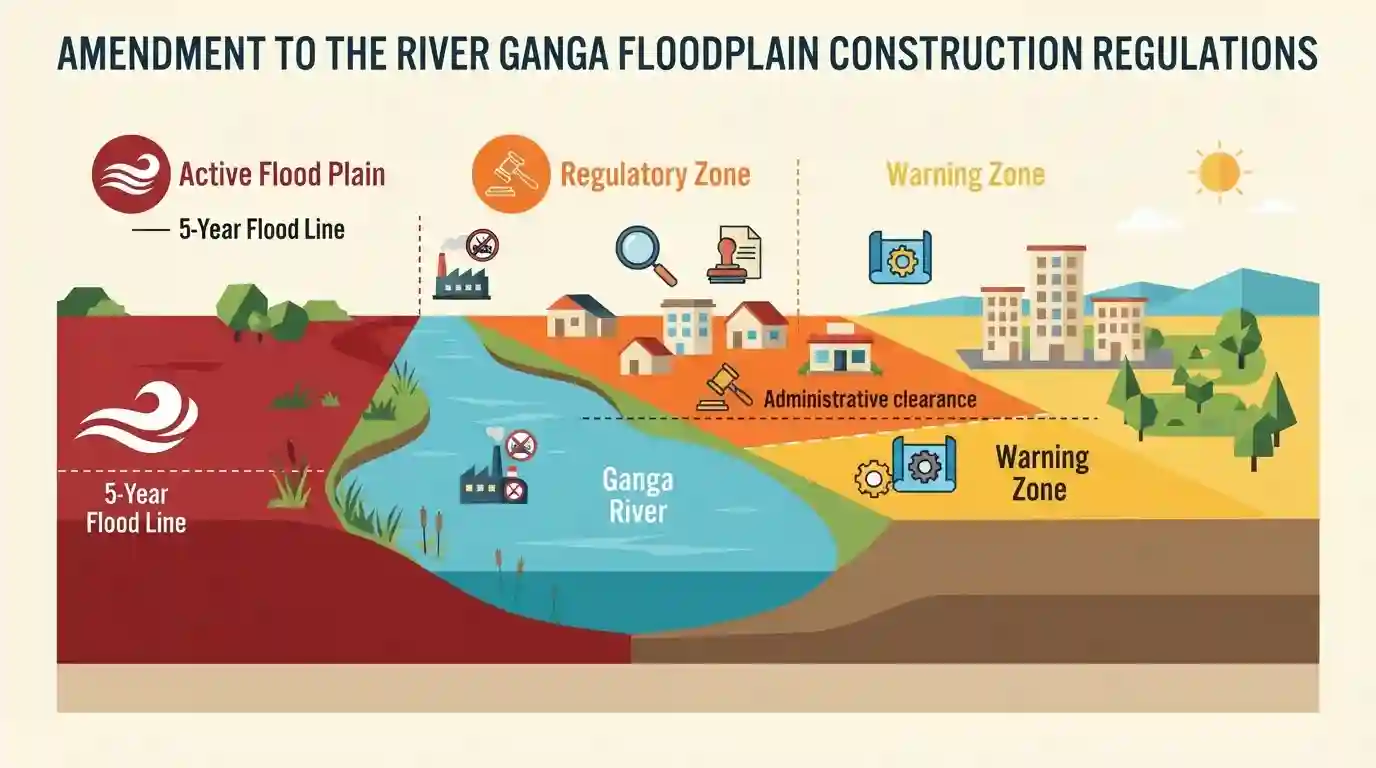
The Union Ministry of Jal Shakti has amended the River Ganga (Rejuvenation, Protection and Management) Authorities Order, 2016, to lift the blanket construction ban across the entire Ganga flood plain. The amendment introduces a tiered, three-zone classification based on flood risk (Active Flood Plain, Regulatory Zone, and Warning Zone), aligning with Central Water Commission guidelines. Under this new structure, absolute building prohibitions are restricted to the 5-year flood line (Active Flood Plain). Construction in the other zones (subject to 5-to-100-year floods) is now permitted, provided projects secure environmental and administrative clearances from the National Mission for Clean Ganga (NMCG) and regional bodies. Government officials defend the move as resolving a legal ambiguity, while it also addresses ongoing disputes regarding infrastructure and developmental works before the National Green Tribunal (NGT).
મુખ્ય મુદ્દા
- The Union government has relaxed restrictions on construction in the Ganga flood plain by amending the River Ganga (Rejuvenation, Protection and Management) Authorities Order, 2016.
- The blanket 'construction-free zone' mandate for the entire 100-year flood line has been deleted, shifting the framework from an absolute ban to a regulated, approval-based system.
- A stratified definition of the 'flood plain' based on flood frequencies (following July 2025 Central Water Commission guidelines) has been introduced: Active Flood Plain (floods once in 5 years), Regulatory Zone (floods 5-25 years), and Warning Zone (floods 25-100 years).
- Strict construction bans are now limited solely to the 'active flood plain' (with minor exceptions for temporary religious setups), while development in the 'regulatory' and 'warning' zones is permissible subject to prior written approvals from the National Mission for Clean Ganga (NMCG) and regional bodies.
- The government asserts this is not a 'dilution of standards' but a correction of a long-standing inconsistency, as the 2016 order left the term 'active flood plain' undefined, leading to legal conflicts before the National Green Tribunal (NGT) over infrastructure and sewage treatment projects.
મહત્વપૂર્ણ શબ્દો
River Ganga (Rejuvenation, Protection and Management) Authorities Order, 2016

An executive notification issued under the Environment (Protection) Act, providing the legal framework and institutional structures to protect, conserve, and rejuvenate the Ganga river basin and its tributaries.
UPSC context
GS Paper III (Environmental Protection); tests understanding of environmental legislation, regulatory frameworks, and river conservation policies in India.
National Mission for Clean Ganga
The implementation wing of the National Ganga Council, established in 2011 to reduce pollution, ensure ecological flow, and coordinate the rejuvenation of the River Ganga and its tributaries.
UPSC context
GS Paper III (Government Policies & Initiatives); tests understanding of statutory and executive bodies tasked with environmental governance.
Central Water Commission
A premier technical organization in India's water resources sector, responsible for coordinating schemes for control, conservation, and utilization of water resources, including flood forecasting and floodplain zoning.
UPSC context
GS Paper III (Disaster Management & Infrastructure); tests knowledge of technical bodies regulating water resources and managing natural disasters.
National Green Tribunal
A specialized statutory quasi-judicial body established in 2010 under the NGT Act for the expeditious disposal of civil cases related to environmental protection and conservation of forests.
UPSC context
GS Paper II & III (Statutory Bodies / Environment); tests understanding of environmental jurisprudence and the role of specialized tribunals.
Namami Gange Mission
An integrated conservation flagship programme launched in 2014 by the Union Government with the twin objectives of effective abatement of pollution and conservation and rejuvenation of the national river Ganga.
UPSC context
GS Paper III (Conservation & River Rejuvenation); tests conceptual awareness of flagship environmental missions, pollution control, and sustainable development.
Ministry of Jal Shakti
A Union ministry formed in May 2019 by merging the Ministry of Water Resources, River Development & Ganga Rejuvenation, and the Ministry of Drinking Water and Sanitation to ensure integrated water governance.
UPSC context
GS Paper II (Government Policies & Interventions); tests understanding of institutional reorganizations and policies aiming for holistic water resource management.
પ્રિલિમ્સ ટ્રેપ
"Floodplain zoning is a Concurrent List subject jointly administered by the Centre and States."
Floodplain zoning is inherently a State subject under Entry 17, List II. The Centre relies on model bills or specific EPA 1986 provisions to intervene.
સંલગ્ન સ્થિર ખ્યાલો
What is the institutional framework under the 2016 Ganga Order?
- National Ganga Council: Replaced the National Ganga River Basin Authority (NGRBA) and is chaired by the Prime Minister, serving as the apex policy-making body.
- NMCG: The National Mission for Clean Ganga acts as the executive arm and holds statutory Authority status under the Environment Protection Act, 1986.
- Tiered Structure: The framework is 5-tiered, extending downward to the Empowered Task Force, State Ganga Committees, and District Ganga Committees for localized action.
How does the Indian Constitution distribute legislative power over water management?
- State List: Entry 17 covers water supplies, irrigation, canals, drainage, and embankments, placing day-to-day flood and water management firmly under state jurisdiction.
- Union List: Entry 56 gives the Centre power over inter-state rivers and river valleys, but only to the extent Parliament declares it expedient in the public interest.
આંતર-વિષય પેટર્ન
Floodplain Zoning + Disaster Management
Links the GS1/GS3 theme of urban flooding to policy. Relaxing norms in the 'Warning Zone' directly impacts urban resilience against climate-change-induced extreme rainfall events.
EPA 1986 Overreach + Federalism
Demonstrates how the Centre uses the Environment (Protection) Act, 1986 to issue sweeping mandates (like the 2016 Ganga Order) on subjects that technically fall under the State List (Land/Water).

Expect a 2026 prelims question merging NMCG's statutory status under the EPA 1986 with the State-list nature of floodplain zoning.
સંલગ્ન PYQ · 3
સંલગ્ન PYQ · 3
- 2015MainsGS3
Discuss the Namami Gange and National Mission for Clean Ganga (NMCG) programmes and causes of mixed results from the previous schemes. What quantum leaps can help preserve the river Ganga better than incremental inputs?
- 2016PrelimsGS1
Which of the following are the key features of 'National Ganga River Basin Authority (NGRBA)? 1. River basin is the unit of planning and management. 2. It spearheads the river conservation efforts at the national level. 3. One of the Chief Ministers of the States through which the Ganga flows becomes the Chairman of NGRBA on rotation basis. Select the correct answer using the code given below.
- 2024MainsGS3
Flooding in urban areas is an emerging climate-induced disaster. Discuss the causes of this disaster. Mention the features of two such major floods in the last two decades in India. Describe the policies and frameworks in India that aim at tackling such floods.
