Western Ghats Eco-Sensitive Zone Notification Reissued by Centre
Source:The Hindu ↗
Why It Matters
Important for understanding environmental governance, biodiversity hotspots, and center-state conflicts regarding developmental projects in ecologically fragile regions of India, which frequently feature in civil services and state public service exams.
Summary
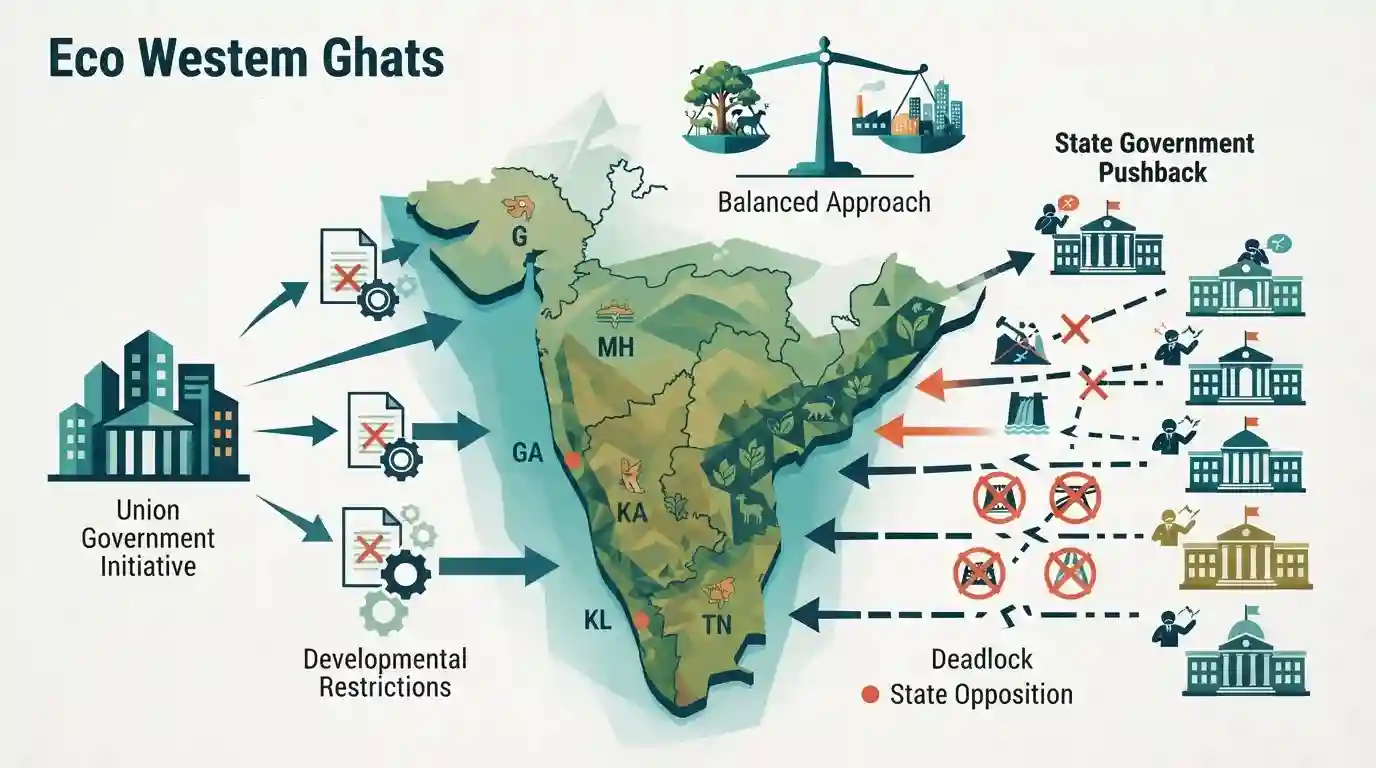
The Union government has reissued notifications to declare parts of the Western Ghats as an Eco-Sensitive Zone (ESZ), facing pushback and deadlock from various State governments over developmental restrictions. The Western Ghats represent one of the world's major biodiversity hotspots, touching six Indian states, and require a balanced approach between ecological preservation and regional development.
Key Points
- The Centre has reissued the notification regarding the Western Ghats Eco-Sensitive Zone (ESZ), aiming to protect its fragile ecology amid continuous delays and deadlocks with the six stakeholder States.
- The Western Ghats span across six States: Gujarat, Maharashtra, Goa, Karnataka, Kerala, and Tamil Nadu.
- The protection framework is heavily debated due to restrictions on mining, quarrying, large construction projects, and thermal power plants within the designated ESZ.
- Past committees like the Madhav Gadgil Committee and Kasturirangan Committee have provided extensive frameworks for preserving the biodiversity hotspot.
Important Terms
Eco-Sensitive Zone (ESZ) notification

Areas notified around protected areas, national parks, and wildlife sanctuaries to act as shock absorbers by regulating and minimizing negative anthropogenic impacts on fragile ecosystems.
UPSC context
MPSC/UPSC Environment and Ecology: Tests understanding of conservation laws, protected area regulations, and developmental trade-offs in fragile ecosystems.
Gadgil Committee
An expert panel appointed in 2010 that recommended declaring the entire Western Ghats region as an Ecologically Sensitive Area with strict developmental bans and decentralized governance.
UPSC context
MPSC Environment & Geography: Tests knowledge of key environmental committees, biodiversity governance, and developmental sustainability reports in India.
Kasturirangan Committee
An expert committee formed to examine the Gadgil report, which recommended designating about 37% of the Western Ghats as an Ecologically Sensitive Area while protecting inhabited and agricultural regions.
UPSC context
MPSC Geography & Environment: Evaluates balancing federal state demands with ecological conservation policies in mountainous and biodiversity-rich regions.
Prelims Trap
Gadgil Committee recommended restricting only 37% of the Western Ghats as an Eco-Sensitive Area.
Aspirants often believe the Madhav Gadgil Committee report recommended classifying the entire Western Ghats as graded ESZ zones with controlled development, whereas it recommended the entire region as ecologically sensitive with a ban on most commercial activities. Kasturirangan suggested 37%.
Static Concepts Connected
What are the key differences between the Gadgil and Kasturirangan committees on the Western Ghats?
- Scope & Coverage: Total Area: Gadgil recommended classifying the entire Western Ghats as Ecologically Sensitive Area (ESA); Kasturirangan limited it to 37% (natural landscape).
- Regulatory Model: Development Approach: Gadgil advocated bottom-up decentralized governance with a ban on mining; Kasturirangan permitted graded regulated development and phased mining phase-outs.
Cross-Topic Patterns
ESZ Notifications vs. Federal Cooperative Friction
The friction between Eco-Sensitive Zone notifications and state-led development models mirrors mineral-concession disputes under the Mines and Minerals (Development and Regulation) Act.
Biodiversity Hotspots & Global Conservation Obligations
Western Ghats biodiversity governance intersects with international commitments under the Convention on Biological Diversity (CBD) and UNESCO Natural World Heritage listings.

Gadgil vs. Kasturirangan committee recommendations and ESZ legal basis under EPA 1986 are high-yield MPSC matching pairs.
Linked PYQs · 3
Linked PYQs · 3
- 2025MPSC_PRELIMSGS1
Match the following. | Biosphere Reserve | Establishment Year | |---|---| | a. Nilgiri | I. 2011 | | b. Sundarban | II. 2008 | | c. Kutch | III. 1989 | | d. Panna | IV. 1986 | Code: a b c d
- 2022MPSC_PRELIMSGS1
In India, which of the following has become a hot-spot with reference to threats to biodiversity ?
- 2017MPSC_PRELIMSGS1
Which of the following mountains are considered as one of the top biodiversity hot spots ?
