Centre Reissues Western Ghats Eco-Sensitive Zone Notification
Source:The Hindu ↗
Why It Matters
Crucial for understanding environmental governance, Centre-State friction on ecological regulations, and biodiversity conservation policies in ecologically fragile regions like the Western Ghats.
Summary
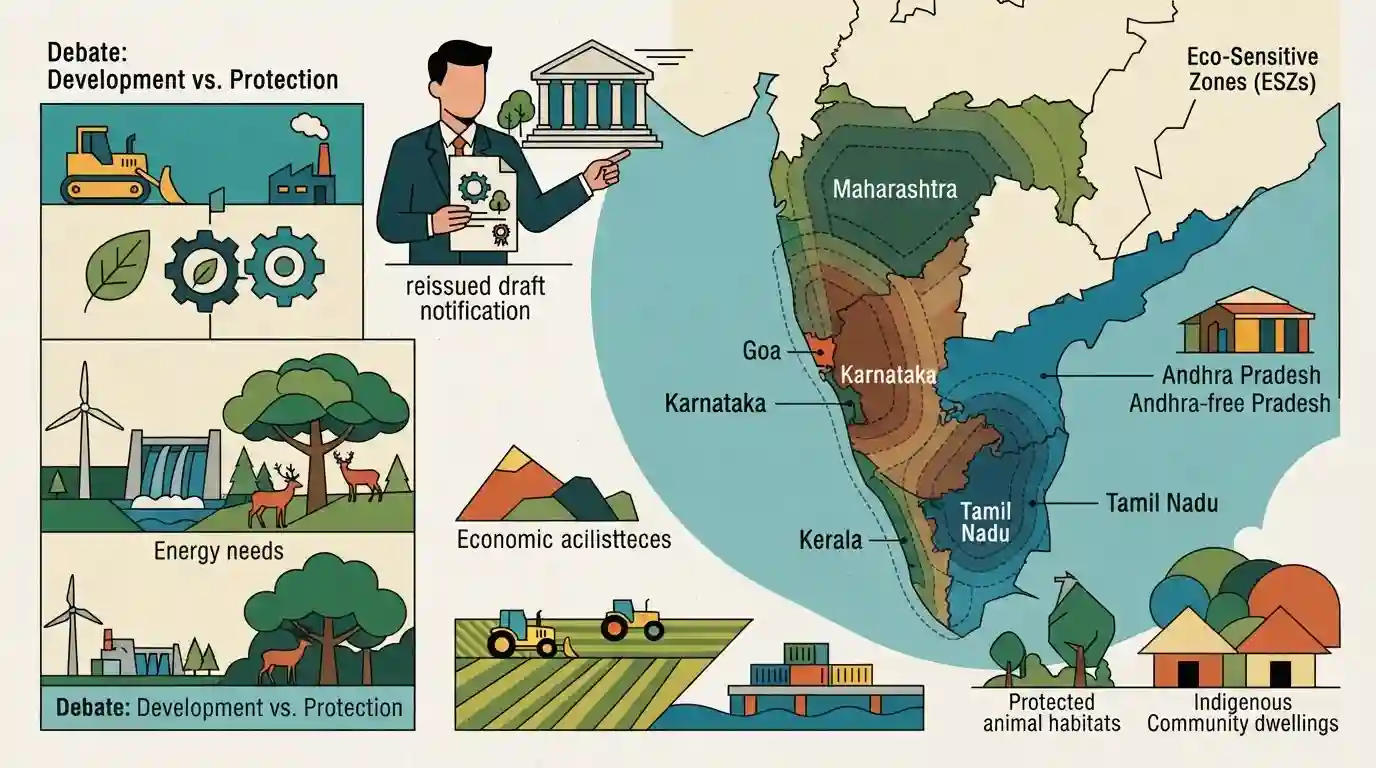
The Central government has reissued the draft notification identifying Eco-Sensitive Zones (ESZs) along the Western Ghats, rekindling debates over balancing developmental imperatives with environmental protection across the six stakeholder states.
Key Points
- The Union Environment Ministry has reissued the notification declaring Eco-Sensitive Zones (ESZ) in the Western Ghats region.
- The notification faces prolonged political and administrative deadlock with several Western Ghats states opposing blanket restrictions on developmental activities.
- The Western Ghats span across six states, including Maharashtra, Goa, Karnataka, Kerala, Tamil Nadu, and Gujarat, and are recognized globally as a biodiversity hotspot.
- Key committees like the Gadgil Committee (WGEEP) and Kasturirangan Committee were previously established to recommend conservation measures for the region.
Important Terms
Eco-Sensitive Zone notification

Areas notified around protected areas, national parks, and wildlife sanctuaries to act as a shock absorber by regulating activities and minimizing negative environmental impacts of development projects.
UPSC context
MPSC Paper I/III (Environment & Ecology): Tests knowledge of statutory environment protections, conservation zones, and developmental trade-offs.
Gadgil Committee Report
Expert panel headed by Madhav Gadgil in 2011 that recommended declaring the entire Western Ghats region as an ecologically sensitive area, divided into three zones with strict regulatory frameworks.
UPSC context
MPSC Environment & Biodiversity: Evaluates understanding of major committee recommendations on Western Ghats conservation and ecological security.
Kasturirangan Committee Report
High-Level Working Group chaired by K. Kasturirangan (2013) that proposed bringing about 37 percent of the Western Ghats under the Eco-Sensitive Area, adopting a more developmental-friendly approach than the Gadgil report.
UPSC context
MPSC Environment & Governance: Tests comparative understanding of expert committee recommendations balancing environment and infrastructure.
Ministry of Environment, Forest and Climate Change
The nodal apex ministry in the administrative structure of the Central Government for planning, promoting, and overseeing the implementation of India's environmental and forestry policies.
UPSC context
MPSC Polity & Governance / Environment: Tests statutory bodies, ministerial responsibilities, and central policy interventions.
Static Concepts Connected
What are the key differences between the Gadgil and Kasturirangan committees on the Western Ghats?
- Gadgil Committee (WGEEP):: Proposed declaring nearly 64% of the Western Ghats as ecologically sensitive, calling for strict controls on developmental activities across all zones.
- Kasturirangan Committee:: Recommended a more development-friendly approach, restricting ESAs to about 37% of the total area and focusing on banning red-category industries and mining.
Cross-Topic Patterns
Western Ghats ESZ & Federal Forest Governance
The Western Ghats ESZ notifications directly impact state-level forest conservation acts and decentralized tribal land rights under PESA, creating federal friction.

Expect a statement-based MPSC question contrasting Gadgil vs. Kasturirangan committee recommendations on ESZ percentage and mining bans.
Linked PYQs · 1
Linked PYQs · 1
- 2017MPSC_PRELIMSGS1
Which of the following mountains are considered as one of the top biodiversity hot spots ?
