Union Ministry Notification on Western Ghats Eco Sensitive Zone
Source:The Hindu ↗
Why It Matters
Crucial for MPSC aspirants tracking environmental governance, central-state policy disputes over resource use, and biodiversity conservation frameworks like Eco-Sensitive Zones in the Western Ghats.
Summary
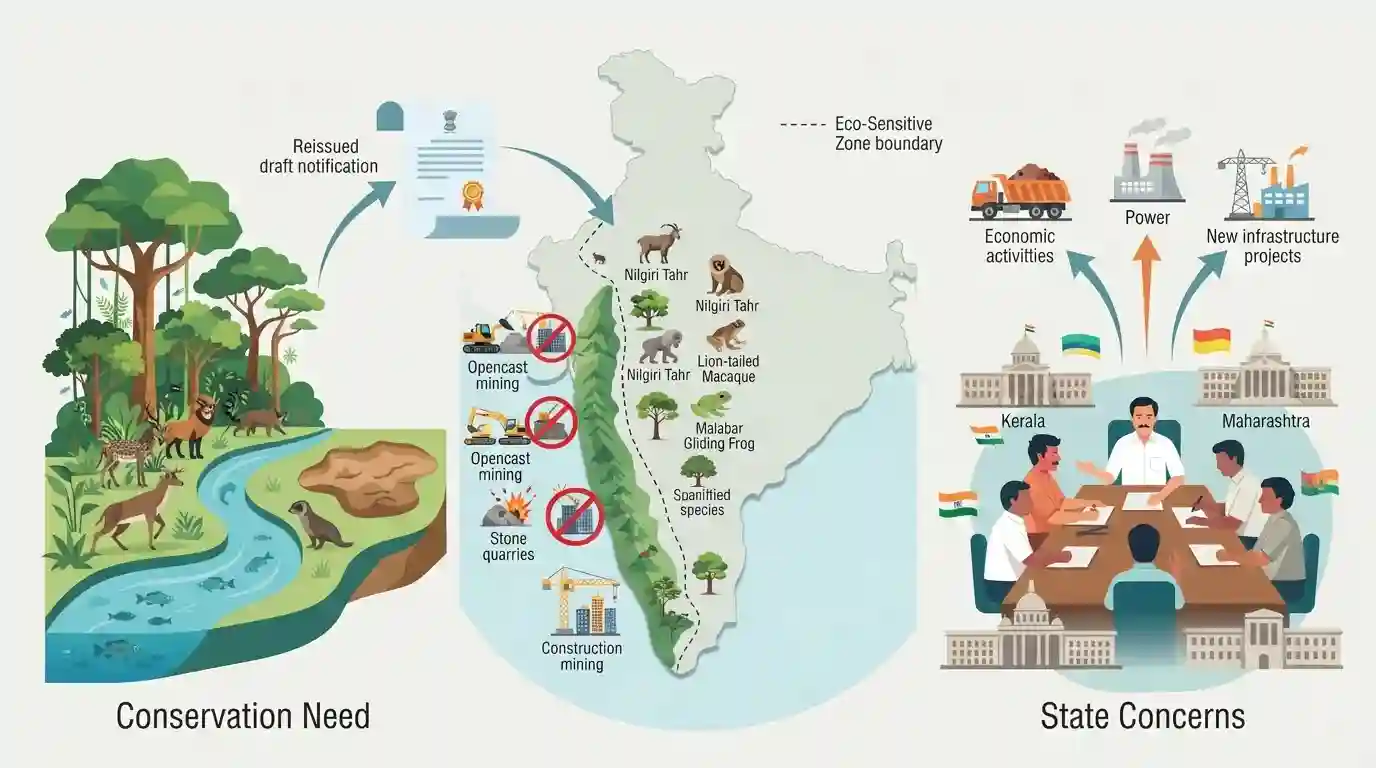
The Centre has reissued the draft notification for declaring Eco-Sensitive Zones (ESZs) along the Western Ghats to protect its unique biodiversity. This move comes amid a continuing deadlock with the concerned state governments over regulatory measures affecting mining, quarrying, and developmental activities.
Key Points
- The Union Ministry has reissued notifications concerning the Western Ghats Eco-Sensitive Zone (ESZ), aiming to protect fragile ecosystems amidst prolonged disagreements with western Himalayan and peninsular states like Kerala, Karnataka, and Maharashtra.
- The Western Ghats span across six states—Gujarat, Maharashtra, Goa, Karnataka, Kerala, and Tamil Nadu—and are recognized as a global biodiversity hotspot.
- Disputes mainly center around restrictions on mining, quarrying, large-scale construction, and thermal power projects within designated ESZ boundaries to balance development with conservation.
Important Terms
Gadgil Committee

An apex expert panel headed by ecologist Madhav Gadgil (2011) that recommended declaring the entire Western Ghats an Ecologically Sensitive Area with strict bans on mining, quarrying, and large hydro projects.
UPSC context
MPSC Paper I (Geography & Environment) - Important committees on biodiversity conservation and sustainable development in India.
Kasturirangan Committee
An expert working group headed by K. Kasturirangan (2012) that recommended protecting roughly 37% of the Western Ghats (around 60,000 sq km) as an Eco-Sensitive Area while permitting select developmental projects.
UPSC context
MPSC Paper I/Environment - Evaluates developmental pressures versus ecological security in mountain ecosystems.
Environment (Protection) Act, 1986
Legislation enacted in 1986 empowering the Central government to take measures to protect and improve the quality of the environment, including declaring Eco-Sensitive Zones.
UPSC context
MPSC Polity & Environment - Tests core environmental statutes, statutory powers, and regulatory frameworks.
Ministry of Environment, Forest and Climate Change
The nodal ministry of the Union government tasked with formulating national environmental policies, forest conservation, wildlife protection, and issuing Eco-Sensitive Zone notifications.
UPSC context
MPSC Governance & Current Affairs - Institutional framework of environmental administration in India.
Static Concepts Connected
What are the key differences between the Gadgil Committee and Kasturirangan Committee reports on the Western Ghats?
- Gadgil Approach: Gadgil Panel (2010) recommended classifying the entire Western Ghats as an Ecologically Sensitive Zone (ESZ 1, 2, 3) with graded restrictions.
- Kasturirangan Approach: Kasturirangan Panel (2013) recommended bringing only 37% of the total Western Ghats area under the Ecologically Sensitive Area (ESA) category.
- Methodology: Kasturirangan used satellite remote sensing for demarcation, while Gadgil relied heavily on participatory grassroots inputs and local biodiversity data.
Cross-Topic Patterns
Western Ghats ESZ vs State Land Revenue Laws
While the Kasturirangan report uses satellite mapping to designate 37% of the Ghats as ESA, state revenue departments push back citing livelihood impacts on plantation owners in Kerala and Karnataka.
Gadgil vs Kasturirangan Committee Recommendations
The Gadgil and Kasturirangan committees form the bedrock of MPSC questions comparing holistic grassroots environmentalism versus developmental trade-offs under the Environment Protection Act.

Expect MPSC statement-based questions contrasting Gadgil (entire region ESZ) and Kasturirangan (37% ESA via satellite mapping) reports.
Linked PYQs · 3
Linked PYQs · 3
- 2017MPSC_PRELIMSGS1
Which of the following mountains are considered as one of the top biodiversity hot spots ?
- 2025MPSC_PRELIMSGS1
Which of the following acronyms has been used by Biologists to describe the factors that threaten to biodiversity ?
- 2022MPSC_PRELIMSGS1
Biosphere reserves are demarcated into ________.
