Centre reissues notification on Western Ghats Eco-Sensitive Zones
Source:The Hindu ↗
Why It Matters
Crucial for MPSC aspirants tracking environmental governance, central-state disputes over resource management, and conservation frameworks like the Western Ghats Eco-Sensitive Zone notifications.
Summary
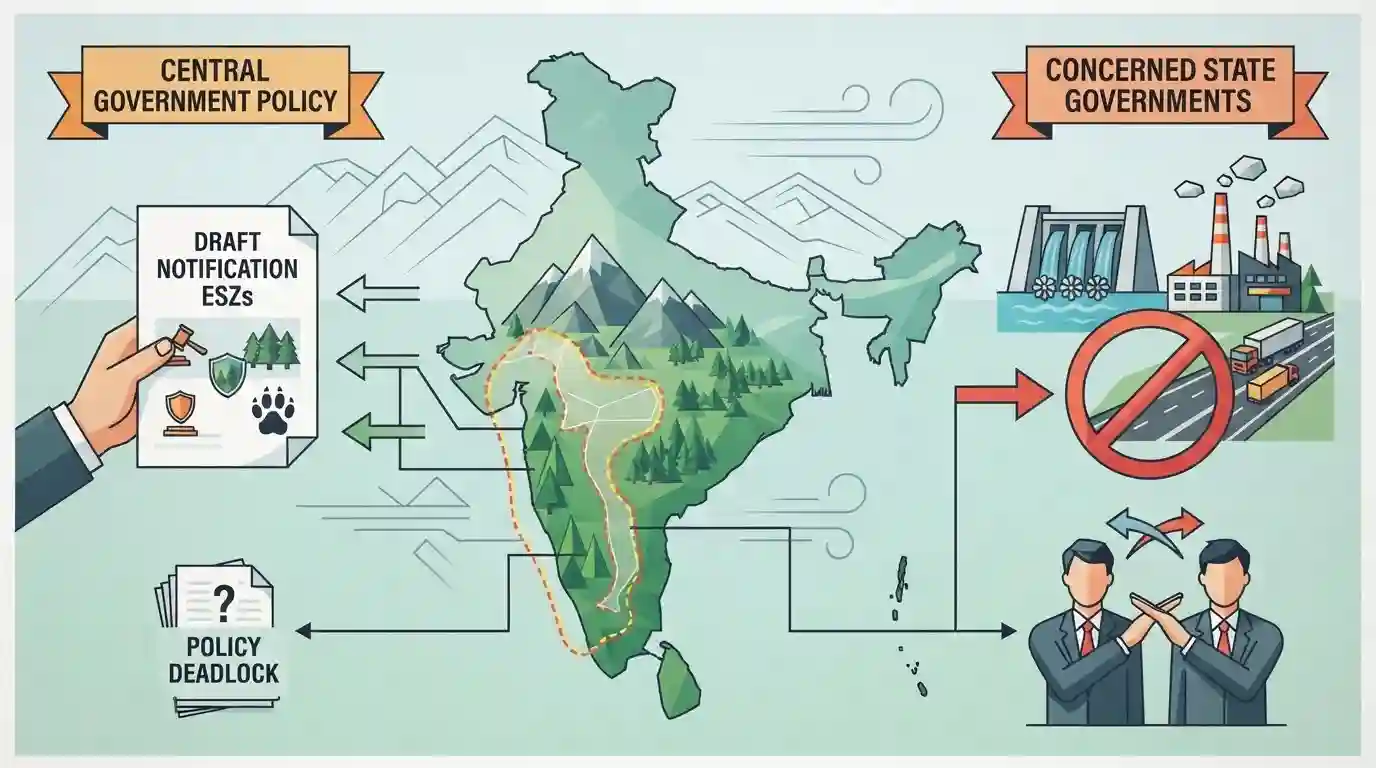
The Central government has reissued the draft notification for declaring Eco-Sensitive Zones (ESZs) along the Western Ghats, rekindling debates amid ongoing friction and policy deadlocks with the concerned State governments regarding environmental restrictions versus developmental needs.
Key Points
- The Union Ministry has reissued notifications declaring Eco-Sensitive Zones (ESZs) in the Western Ghats, aiming to protect biodiversity hotspots.
- The move faces continued resistance and deadlock from several Western Ghats-spanning states (including Maharashtra, Kerala, Karnataka, Goa, Gujarat, and Tamil Nadu) concerning developmental restrictions.
- The Western Ghats stretch across six states and are globally recognized as a premier biodiversity hotspot.
- Two major committees, Gadgil (WGEEP) and Kasturirangan (HLWG), previously laid out frameworks for Western Ghats conservation.
Important Terms
Eco-Sensitive Zone notification

Areas notified by the Ministry of Environment, Forest and Climate Change around Protected Areas, National Parks, and Sanctuaries under the Environment (Protection) Act, 1986, to act as a shock absorber for protected ecosystems.
UPSC context
Environment & Ecology (GS Paper III): Important for questions on biodiversity conservation, environmental laws, and friction between development and conservation in ecologically fragile regions like the Western Ghats.
Gadgil Committee Report
An expert panel headed by Madhav Gadgil (2011) that recommended declaring the entire Western Ghats as an Ecologically Sensitive Area, dividing it into zones with strict restrictions on industrial and developmental activities.
UPSC context
Environment & Geography (GS Paper I & III): Evaluated for its radical conservation approach, decentralized environmental governance, and comparison with subsequent committees.
Kasturirangan Committee Report
A High-Level Working Group chaired by K. Kasturirangan (2013) that proposed bringing 37% of the Western Ghats under an Ecologically Sensitive Area, balancing environmental protection with local developmental needs.
UPSC context
Environment & Biodiversity (GS Paper III): Crucial for studying sustainable development models, policy tradeoffs, and regional resistance in Western Ghats states.
Ministry of Environment, Forest and Climate Change
The apex central government ministry responsible for planning, promoting, and coordinating environmental and forestry policies, including the implementation of the Environment (Protection) Act, 1986.
UPSC context
Governance & Environment (GS Paper II & III): Tests structural roles of nodal central ministries in formulating rules, handling federal deadlocks, and notifying environmental safeguards.
Static Concepts Connected
What are the key differences between the Gadgil and Kasturirangan committees on the Western Ghats?
- Gadgil Committee: WGEEP recommended dividing the entire Western Ghats into three Ecologically Sensitive Zones (ESZ 1, 2, 3) with stringent restrictions across the board.
- Kasturirangan Committee: HLWG recommended bringing only 37% of the Western Ghats (natural landscape) under the Ecologically Sensitive Area (ESA) tag, prohibiting mining and red industries there.
- Legal Basis: Both committees functioned under the overarching framework of the Environment (Protection) Act, 1986.
Cross-Topic Patterns
Western Ghats ESZ vs Cooperative Federalism
The debate between Madhav Gadgil's total ecological coverage and Kasturirangan's balanced 37% model directly tests the intersection of sustainable development goals and federal polity tensions in MPSC mains.

Expect a statement-based question comparing Gadgil (WGEEP) and Kasturirangan (HLWG) committee recommendations for the Western Ghats.
Linked PYQs · 1
Linked PYQs · 1
- 2017MPSC_PRELIMSGS1
Which of the following mountains are considered as one of the top biodiversity hot spots ?
