Kharif crops minimum support price revision and diversification
Source:Indian Express ↗
Why It Matters
Minimum Support Price (MSP) is a foundational topic for UPSC, touching upon farmer incomes, cropping patterns, inflation, and food security. The differential MSP increases—modest for paddy, higher for millets—illustrate practical government interventions aimed at agricultural sustainability and crop diversification.
Summary
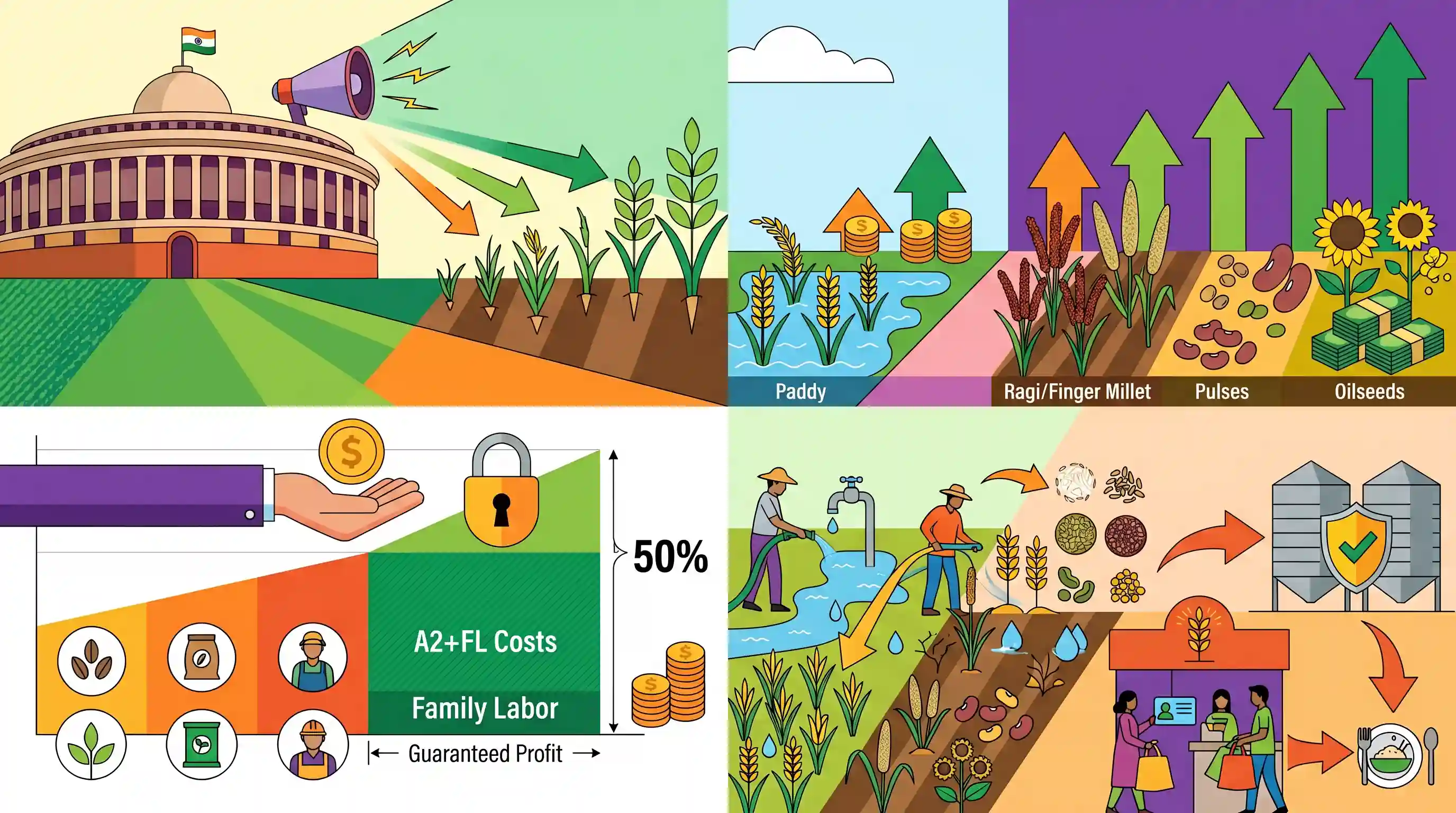
The Union Government announced increased Minimum Support Prices (MSP) for 14 mandated Kharif crops for the upcoming 2025-26 season. While the benchmark paddy MSP was hiked by 3% (₹69) to ₹2,369 per quintal, the highest absolute increase was reserved for Ragi (Finger Millet). This pricing strategy underscores the government's ongoing effort to guarantee a return of at least 50% over the all-India weighted average cost of production (A2+FL), while strategically using differential pricing to encourage farmers to diversify away from water-intensive staples toward millets, pulses, and oilseeds.
Key Points
- The Cabinet Committee on Economic Affairs (CCEA) approved the Minimum Support Price (MSP) for 14 Kharif crops for the 2025-26 marketing season.
- Paddy MSP saw a modest increase of ₹69 (approx. 3%), bringing it to ₹2,369 per quintal.
- The highest increase was announced for Ragi (Finger Millet), reflecting a continued policy push toward crop diversification and the promotion of nutritious millets (Shree Anna).
- The MSP hikes are aligned with the Union Budget principle of fixing the MSP at a minimum of 1.5 times the all-India weighted average cost of production (A2+FL).
- The differential remuneration strategy is designed to gently disincentivize water-guzzling crops like paddy in favor of pulses, oilseeds, and coarse cereals.
Important Terms
Minimum Support Price (MSP)

The minimum price at which the government purchases 22 mandated crops and sugarcane (FRP) from farmers to prevent distress sales and ensure income stability.
UPSC context
GS-III: Issues related to direct/indirect farm subsidies, MSP, and food security. Focuses on government market interventions.
Commission for Agricultural Costs and Prices (CACP)
An expert body under the Ministry of Agriculture that recommends MSPs for mandated crops after analyzing production costs, market trends, and demand-supply dynamics.
UPSC context
GS-III: Agricultural pricing policy. Tests knowledge of institutional frameworks for price discovery and farmer welfare.
Cabinet Committee on Economic Affairs (CCEA)
The highest executive body chaired by the Prime Minister that reviews CACP recommendations to grant final approval for MSP hikes and other major economic policies.
UPSC context
GS-II: Executive bodies and decision-making; GS-III: Economic policy. Tests the hierarchy of government approvals.
A2+FL Cost
The current cost benchmark for MSP, comprising actual paid-out expenses (seeds, chemicals, hired labor) plus the imputed value of unpaid family labor.
UPSC context
GS-III: Farm subsidies and MSP calculation. Tests understanding of different cost concepts (A2 vs A2+FL vs C2).
Kharif Crops
Monsoon-season crops sown in June-July and harvested in September-October, including water-intensive staples like paddy and hardy crops like millets and oilseeds.
UPSC context
GS-III: Major crops and cropping patterns. Tests seasonal agricultural cycles and crop classification in India.
Prelims Trap
The government fixes MSP at 1.5 times the comprehensive cost of production (C2) as recommended by the Swaminathan Committee.
The government uses the 'A2+FL' formula (paid-out costs + family labour) for its 1.5x guarantee, NOT the comprehensive 'C2' cost which includes imputed rent and interest.
Static Concepts Connected
What are the three cost calculation formulas evaluated for MSP?
- A2: Covers all direct paid-out costs incurred by the farmer on seeds, fertilizers, pesticides, hired labour, leased-in land, and fuel.
- A2+FL: Includes A2 plus the imputed value of unpaid family labour. This is the official baseline cost formula used by the government.
- C2: A comprehensive cost that includes A2+FL plus the imputed rental value of owned land and interest on fixed capital assets.
How is the MSP regime administratively structured in India?
- Crop Count: The MSP regime officially covers 22 mandated crops (14 Kharif, 6 Rabi, 2 commercial). Sugarcane is covered separately under the Fair and Remunerative Price (FRP).
- Recommending Body: The Commission for Agricultural Costs and Prices (CACP), an attached office of the Ministry of Agriculture, recommends the prices.
- Approving Body: The Cabinet Committee on Economic Affairs (CCEA), chaired by the Prime Minister, takes the final decision and approves the MSP.
Cross-Topic Patterns
MSP policies and Groundwater Depletion
High MSP and assured procurement for water-intensive paddy incentivizes its cultivation in semi-arid states like Punjab and Haryana, directly linking agricultural pricing policy to severe groundwater exhaustion.
Millets & Climate-Smart Agriculture
Differential MSP hikes favoring Ragi and coarse cereals connect to the 'Shree Anna' initiative, aligning India's nutritional security with climate-smart agriculture to reduce the overall water footprint.

Expect a 2026 Prelims multi-statement question linking MSP cost formulas (A2+FL vs C2), crop diversification, and CCEA/CACP roles.
Linked PYQs · 5
Linked PYQs · 5
- 2018PrelimsGS1
Consider the following: 1. Areca nut 2. Barley 3. Coffee 4. Finger millet 5. Groundnut 6. Sesamum 7. Turmeric The Cabinet Committee on Economic Affairs has announced the Minimum Support Price for which of the above?
- 2023PrelimsGS1
Consider the following statements: 1. The Government of India provides Minimum Support Price for niger (Guizotia abyssinica) seeds. 2. Niger is cultivated as a Kharif crop. 3. Some tribal people in India use niger seed oil for cooking. How many of the above statements are correct?
- 2019PrelimsGS1
With reference to the cultivation of Kharif crops in India in the last five years, consider the following statements: 1. Area under rice cultivation is the highest. 2. Area under the cultivation of jowar is more than that of oilseeds. 3. Area of cotton cultivation is more than that of sugarcane. 4. Area under sugarcane cultivation has steadily decreased. Which of the statements given above are correct?
- 2017MainsGS3
How do subsidies affect the cropping pattern, crop diversity and economy of farmers? What is the significance of crop insurance, minimum support price and food processing for small and marginal farmers?
- 2018MainsGS3
What do you mean by Minimum Support Price (MSP)? How will MSP rescue the farmers from the low income trap?
