Centre Directs States to Accelerate LPG to PNG Household Transition
Source:The Hindu ↗
આ શા માટે મહત્વનું છે
This development is a classic example of how global geopolitical conflicts directly influence India's domestic energy policy and administrative machinery. It illustrates the real-world vulnerability of India's import-dependent energy security (specifically via maritime chokepoints like the Strait of Hormuz) and highlights the legislative (Essential Commodities Act) and administrative (district-level supply officers) mechanisms leveraged to drive structural domestic transitions.
સારાંશ
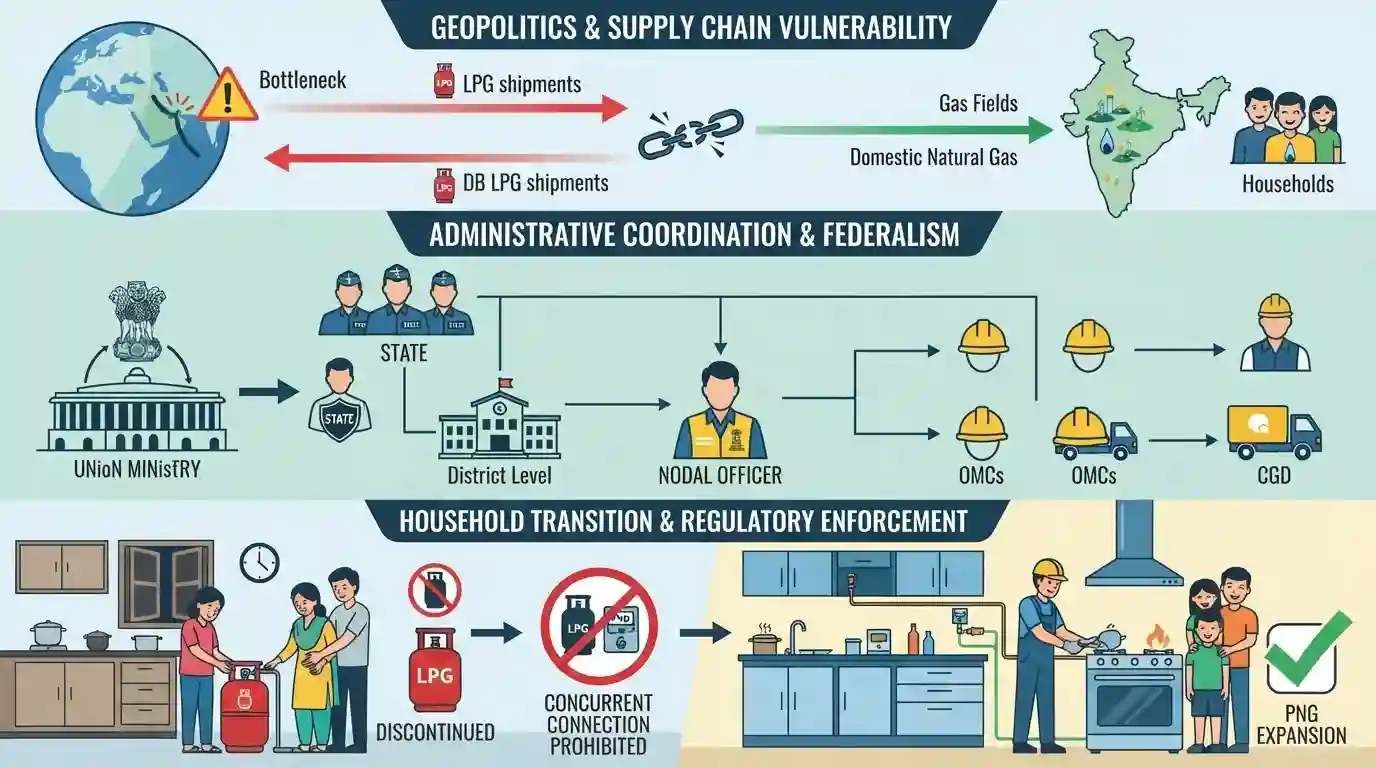
The Union Petroleum Ministry has directed States and Union Territories to provide district-level administrative coordination to accelerate the transition of Indian households from LPG to Piped Natural Gas (PNG). Following supply chain vulnerabilities exposed during the West Asia crisis—which disrupted LPG imports transiting through the strategic Strait of Hormuz—the government is relying on domestic natural gas allocations to insulate local consumers. Under the Essential Commodities Act, new regulatory orders prohibit households from holding concurrent LPG and PNG connections. To enforce this, district-level nodal officers from the Department of Food and Civil Supplies will work with city gas entities and oil marketing companies to secure permissions, manage consumer transitions, and expedite PNG expansion.
મુખ્ય મુદ્દા
- The Petroleum Ministry has written to State Chief Secretaries to fast-track the shift of households from Liquefied Petroleum Gas (LPG) to Piped Natural Gas (PNG) by deploying district-level administrative support.
- The administrative push asks States and UTs to designate a nodal officer (not below the rank of district supply officer from the Department of Food and Civil Supplies) to associate with local PNG Coordination Committees (PCCs) and resolve local issues like right of way/use and consumer grievances.
- The policy transition was triggered by the West Asia crisis which severely disrupted India's imported LPG supply chains. Since much of India's imported cooking gas originates from Qatar, Saudi Arabia, the UAE, and Kuwait, it is highly vulnerable to maritime chokepoint risks in the Strait of Hormuz.
- Domestic PNG proved highly resilient during the crisis because the segment received priority allocation of domestically produced natural gas, insulating residential consumers from disruptions in imported LNG/LPG cargo flows.
- To enforce this transition, the government has notified the Natural Gas and Petroleum Products Distribution Orders of 2026 and modified LPG Control Orders under the Essential Commodities Act, 1955, legally prohibiting households from simultaneously holding both LPG and PNG connections in areas where PNG is available.
મહત્વપૂર્ણ શબ્દો
Essential Commodities Act, 1955

A central legislation empowering the government to regulate the production, supply, and distribution of essential goods (including petroleum products) to ensure availability at fair prices and prevent hoarding during crises.
UPSC context
GS Paper 2 & 3. Highly relevant for topics on food security, energy security, and inflation control policies.
Natural Gas and Petroleum Products Distribution Orders of 2026
A 2026 regulatory framework mandating the transition from LPG to PNG where infrastructure exists, prohibiting simultaneous connections, and providing legal backing for discontinuing LPG to non-compliant users.
UPSC context
GS Paper 2 & 3. Demonstrates aggressive policy interventions to ensure national energy security and reduce import dependence.
Petroleum and Natural Gas Regulatory Board (PNGRB)
A statutory body constituted under the PNGRB Act of 2006, responsible for regulating the refining, storage, transportation, and distribution of downstream petroleum products and natural gas in India.
UPSC context
GS Paper 2 (Statutory Bodies) & GS 3 (Infrastructure). Frequently tested on its specific mandate, which excludes crude oil production.
PNG Coordination Committees (PCCs)
Geographically mapped committees set up by city gas entities and public-sector oil marketing companies to facilitate the LPG-to-PNG transition through household identification, issuing notices, and organizing consumer outreach.
UPSC context
GS Paper 2 (Governance & Federalism). Illustrates decentralized administrative coordination and last-mile public service delivery.
Oil Marketing Companies (OMCs)
Public or private enterprises engaged in the wholesale and retail distribution of petroleum products and natural gas. In India, they implement government fuel supply directives and manage logistics.
UPSC context
GS Paper 3 (Economy & Energy). Crucial for understanding fuel distribution networks, retail pricing mechanisms, and energy transitions.
પ્રિલિમ્સ ટ્રેપ
India maintains national strategic reserves for LPG similar to its Strategic Petroleum Reserves for crude oil.
India has Strategic Petroleum Reserves (SPR) only for crude oil, managed by ISPRL. It does not maintain state-controlled strategic reserves for LPG, making it highly vulnerable to short-term maritime supply shocks.
સંલગ્ન સ્થિર ખ્યાલો
What is the statutory framework of the Essential Commodities Act (ECA), 1955?
- Core Objective: The Act empowers the Central government to control the production, supply, distribution, and pricing of commodities deemed 'essential' to prevent hoarding and price spikes.
- Enforcement Delegation: While the central government issues regulatory orders, the actual administrative enforcement and implementation lie with the State and UT administrations.
- Dynamic List: The list of essential commodities is dynamic; the Centre can add or remove items based on market realities and supply emergency situations.
Why is the Strait of Hormuz a critical global energy chokepoint?
- Geographic Location: It is a narrow waterway connecting the Persian Gulf with the Gulf of Oman and the Arabian Sea, through which over 20% of global petroleum passes.
- Indian Dependency: India is highly dependent on this strait, as it transits over 80% of its imported LPG and more than half of its LNG imports.
- Security Vulnerability: Geopolitical conflicts in West Asia frequently lead to threats of closure or shipping disruptions, causing immediate price volatility and supply security challenges.
આંતર-વિષય પેટર્ન
Chokepoint vulnerability and energy diplomacy
Dependency on Hormuz for LPG forces India to diversify imports to Atlantic and African suppliers, reshaping bilateral energy diplomacy beyond traditional Gulf partners.
Administrative federalism in infrastructure projects
National infrastructure transitions depend entirely on local district supply officers resolving Right of Way (RoW) disputes, highlighting the ground-level reality of cooperative federalism.

Legal backing of energy transitions (ECA 1955) combined with Hormuz chokepoint risks likely to feature in a multi-statement question.
સંલગ્ન PYQ · 4
સંલગ્ન PYQ · 4
- 2025MainsGS2
"Energy security constitutes the dominant kingpin of India's foreign policy, and is linked with India's overarching influence in Middle Eastern countries.” How would you integrate energy security with India's foreign policy trajectories in the coming years?
- 2017MainsGS2
The question of India's Energy Security constitutes the most important part of India's economic progress. Analyze India's energy policy cooperation with West Asian countries.
- 2019PrelimsGS1
Consider the following statements : 1. Petroleum and Natural Gas Regulatory Board (PNGRB) is the first regulatory body set up by the Government of India. 2. One of the tasks of PNGRB is to ensure competitive markets for gas. 3. Appeals against the decisions of PNGRB go before the Appellate Tribunals for Electricity. Which of the statements given above are correct?
- 2026PrelimsGS1
Ships from which of the following countries have to cross the Strait of Hormuz to reach out to the Indian Ocean ? 1. Bahrain 2. Syria 3. Qatar 4. Egypt Select the answer using the code given below :
