Fund Utilization and Federal Coordination in Agricultural Schemes
Source:The Hindu ↗
Why It Matters
The article highlights practical challenges in fiscal federalism and the execution of Centrally Sponsored Schemes (CSS). Understanding the bottlenecks in fund utilization and Centre-State coordination is crucial for GS2 answers on federalism, as well as GS3 answers on agricultural interventions and subsidies.
Summary
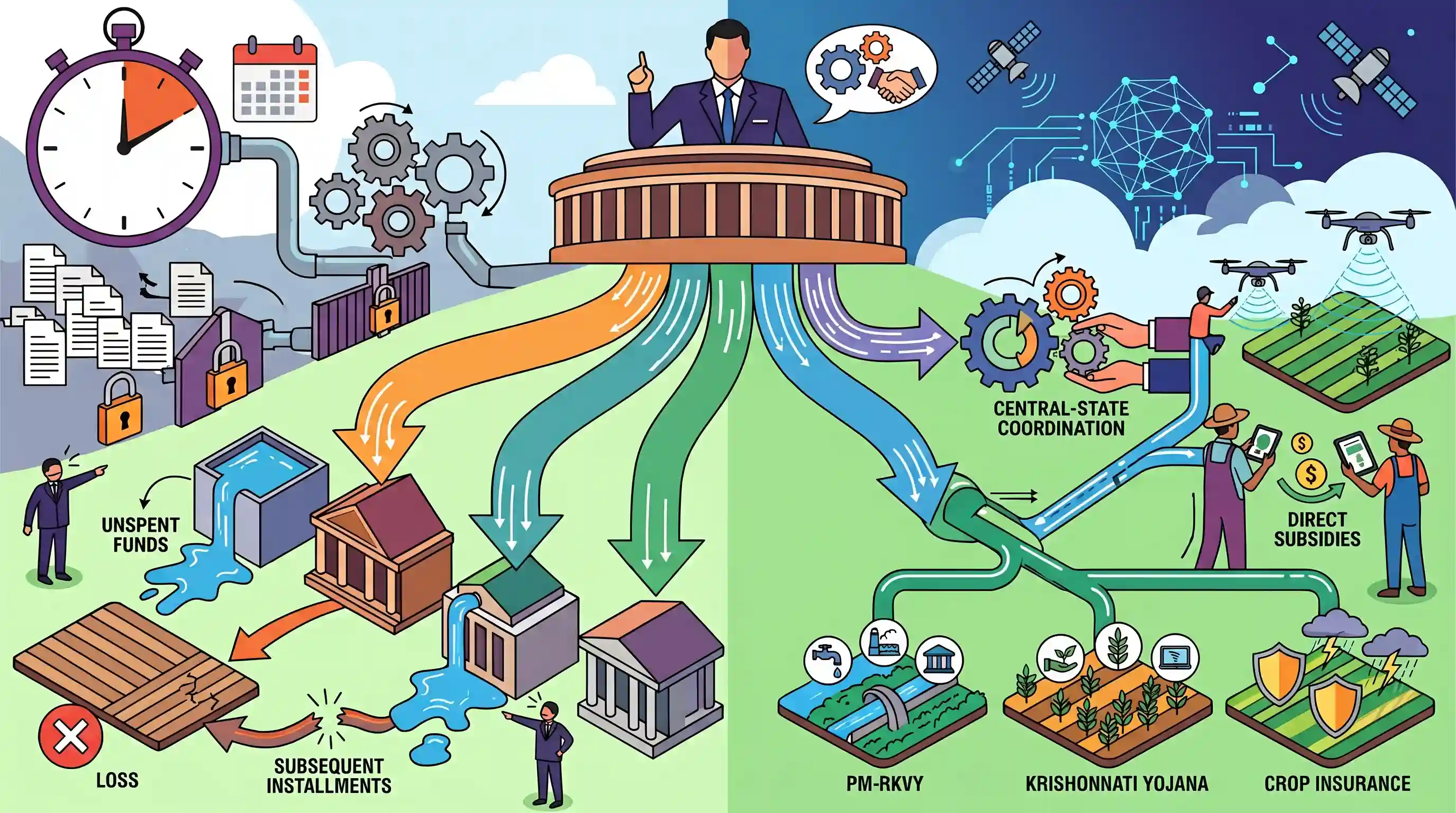
Union Agriculture Minister Shivraj Singh Chouhan has urged State governments to ensure timely utilization of funds allocated for central agriculture schemes before the March deadline. Warning that delays create administrative bottlenecks and hold up subsequent central instalments, he stressed that unspent budgets ultimately result in losses for the States. The review highlighted the need to expedite implementation and prompt verification for schemes such as PM-RKVY, Krishonnati Yojana, PM-KISAN, and crop insurance, while also calling for better Central-State coordination.
Key Points
- Union Agriculture Minister Shivraj Singh Chouhan urged States to spend allocated agriculture funds before March to prevent administrative bottlenecks and delays in subsequent central instalments.
- Delayed spending on central agricultural schemes directly results in financial and programmatic losses for the States.
- The review meeting focused on the progress of PM-RKVY, Krishonnati Yojana, PM-KISAN, and crop insurance, stressing prompt farmer verification and expanded coverage.
- The Centre emphasized ensuring the availability and balanced use of seeds and fertilizers, alongside strengthening Central-State coordination for effective agricultural support.
Important Terms
Pradhan Mantri Rashtriya Krishi Vikas Yojana (PM-RKVY)

A Centrally Sponsored Scheme providing states flexibility to design and implement agricultural development projects. Recently restructured as an umbrella scheme focusing on sustainable agriculture and state-specific strategic planning.
UPSC context
GS Paper 3 (Agriculture) and Paper 2 (Federalism). Tests knowledge of state-led decentralization and infrastructure development.
Krishonnati Yojana (KY)
An umbrella Centrally Sponsored Scheme aimed at achieving food security and agricultural self-sufficiency. It integrates sub-missions like the National Food Security Mission and Digital Agriculture Mission to enhance productivity.
UPSC context
GS Paper 3 (Agriculture/Food Security). Tests understanding of productivity-focused missions and consolidation of central initiatives.
PM-KISAN (Pradhan Mantri Kisan Samman Nidhi)
A Central Sector Scheme (100% Union-funded) providing ₹6,000 annual direct income support to landholding farmer families. Benefits are transferred in three installments of ₹2,000 via Direct Benefit Transfer.
UPSC context
GS Paper 3 (Direct Farm Subsidies). Tests knowledge of DBT impact, rural economy, and social safety nets for farmers.
Pradhan Mantri Fasal Bima Yojana (PMFBY)
A voluntary Central Sector crop insurance scheme protecting farmers against risks like natural calamities and pests. It features uniform low premiums (2% Kharif, 1.5% Rabi, 5% Commercial/Horticultural).
UPSC context
GS Paper 3 (Risk Management). Focuses on implementation challenges, technological usage in loss assessment, and federal sharing of subsidies.
Ministry of Agriculture and Farmers Welfare
The nodal Union ministry responsible for formulating and implementing national policies for the agricultural sector. It coordinates with states to execute flagship schemes and double farmers' income.
UPSC context
GS Paper 2 (Government Policies). Fundamental for understanding administrative structures and nodal agencies for agrarian policy execution.
Prelims Trap
"PM-RKVY and PM-KISAN are both Central Sector Schemes, meaning they are 100% funded by the Union Government."
PM-KISAN is a Central Sector Scheme (100% Union funded), but PM-RKVY is a Centrally Sponsored Scheme (CSS) requiring cost-sharing between the Centre and States.
Static Concepts Connected
How does the Single Nodal Agency (SNA) model reform CSS funding?
- PFMS integration: States must designate one SNA and open a single nodal account for each CSS integrated with the Public Financial Management System.
- Just-in-time disbursal: Prevents idle parking of money by ensuring the Centre releases subsequent installments only after previous balances are utilized.
- State matching share: The Centre releases its share only after the State government has transferred its proportionate matching share to the SNA account.
What is the 'Cafeteria Approach' in Centrally Sponsored Schemes like PM-RKVY?
- State autonomy: Instead of rigid central guidelines, States can select specific components from a menu of sub-schemes based on their unique agro-climatic needs.
- Fund reallocation: States have the flexibility to shift allocated funds from one component to another within the umbrella scheme to maximize local utility.
Cross-Topic Patterns
CSS bottlenecks & Fiscal Federalism
Delays in state matching grants often stall CSS funds. The SNA model on PFMS enforces strict fund-routing rules, making it a critical GS2 fiscal federalism case study.
PM-KISAN & AI-driven e-Governance
PM-KISAN’s AI-powered face authentication for e-KYC removes the need for OTPs or physical biometrics, linking GS3 agriculture direct benefit transfers to GS2 e-governance advancements.

Expect a 2026 Prelims multi-statement question linking the SNA model, PFMS integration, and Central vs Centrally Sponsored Schemes.
Linked PYQs · 3
Linked PYQs · 3
- 2025MainsGS2
Examine the evolving pattern of Centre-State financial relations in the context of planned development in India. How far have the recent reforms impacted the fiscal federalism in India?
- 2024MainsGS2
What changes has the Union Government recently introduced in the domain of Centre-State relations ? Suggest measures to be adopted to build the trust between the Centre and the States and for strengthening federalism.
- 2016MainsGS3
Given the vulnerability of Indian agriculture to vagaries of nature, discuss the need for crop insurance and bring out the salient features of the Pradhan Mantri Fasal Bima Yojana (PMFBY).
