Draft rules for rural employment guarantee scheme transition
Source:The Hindu ↗
Why It Matters
The replacement of MGNREGA marks one of the most significant shifts in India's rural welfare and poverty alleviation policy. It touches heavily on Centre-State financial relations due to the new funding formula and illustrates the increasing integration of digital technology in public service delivery and accountability.
Summary
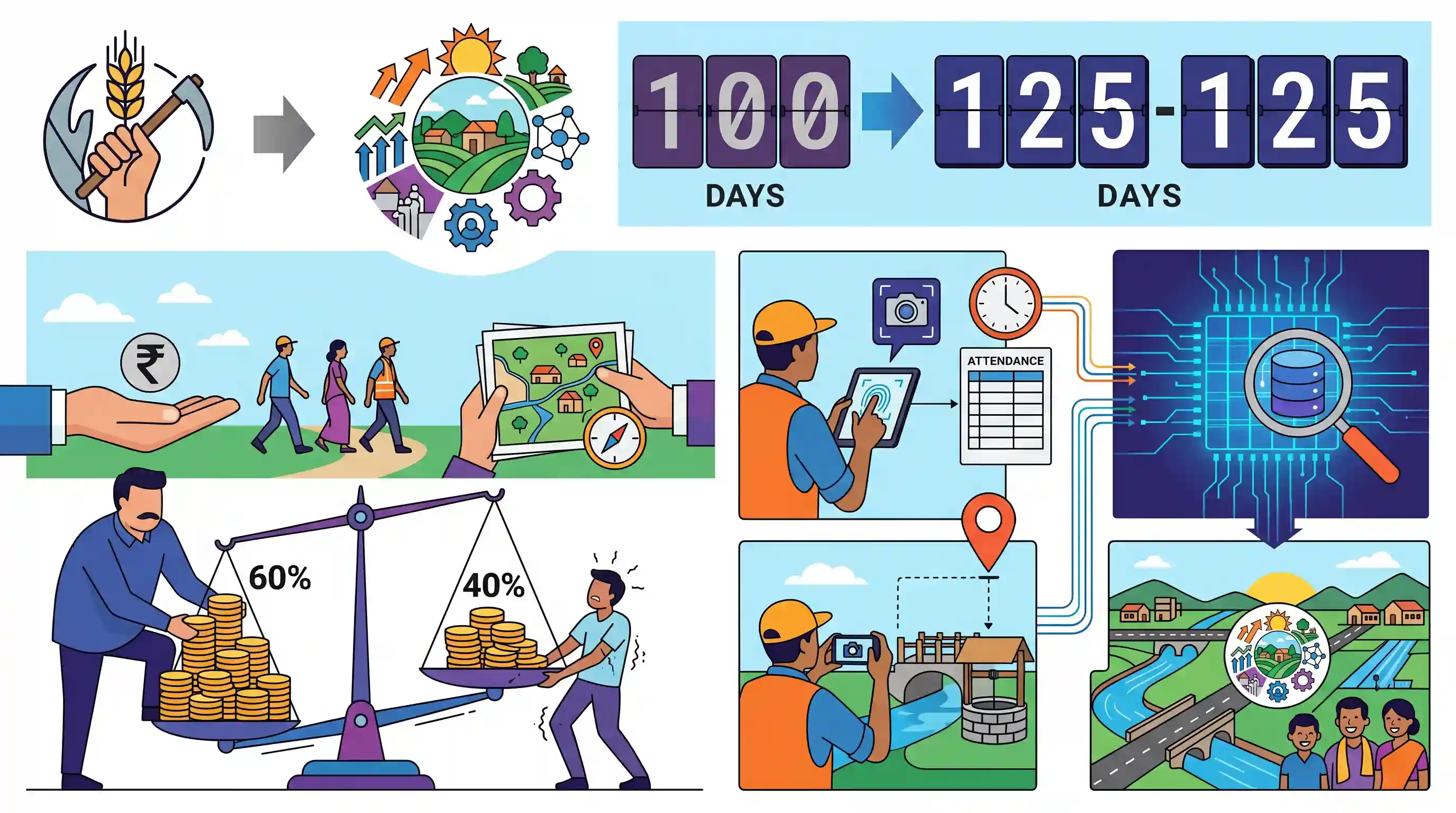
The Union Rural Development Ministry has released draft rules for the Viksit Bharat – Guarantee for Rozgar and Ajeevika Mission (Gramin) Act, 2025 (VB-G RAM G), which will replace the Mahatma Gandhi National Rural Employment Guarantee Act (MGNREGA). The new framework increases the employment guarantee to 125 days but shifts the scheme from a purely rights-based entitlement to a budget-capped, allocation-based model driven by Gram Panchayat planning. It introduces a 60:40 Centre-State funding ratio, raising concerns over the financial burden on states. Additionally, it heavily incorporates e-governance mechanisms, such as mandatory digital attendance and asset geo-tagging, to improve transparency.
Key Points
- The draft rules for VB-G RAM G have been published, detailing the transition from MGNREGA.
- The new scheme raises the guaranteed employment entitlement from 100 to 125 days per rural household annually.
- VB-G RAM G shifts from an open-ended rights-based approach to a capped, allocation-based framework emphasizing village planning and asset creation.
- The funding structure adopts a 60:40 ratio between the Centre and States, shifting more financial responsibility to state governments.
- The new rules mandate extensive digital monitoring, including Aadhaar-based payments, digital attendance, and geo-tagging, to bolster accountability.
Important Terms
VB-G RAM G Act, 2025

A 2025 legislation replacing MGNREGA, guaranteeing 125 days of rural manual work. It shifts to a budget-capped, state-shared funding model (60:40) with enhanced digital oversight.
UPSC context
GS Paper II (Welfare Schemes) and Paper III (Employment). Key for understanding structural shifts in rural social security.
MGNREGA
The 2005 law that provided a legal guarantee of 100 days of unskilled work to rural households. It was primarily demand-driven and fully funded by the Centre for wages.
UPSC context
GS Paper II/III. Acts as a baseline for comparing new rural welfare paradigms and rights-based entitlements.
Centrally Sponsored Scheme (CSS)
A fund-sharing model where the Union and States divide costs. VB-G RAM G uses a 60:40 ratio, unlike the previous wage-funding model which was 100% Central.
UPSC context
GS Paper II (Federalism). Tests understanding of fiscal relations and the financial burden of welfare on states.
Gram Panchayat
The village-level local government body. Under VB-G RAM G, it serves as the primary authority for planning, worker registration, and project execution through mandatory 'Viksit' plans.
UPSC context
GS Paper II (Panchayati Raj). Highlights decentralization and the implementation role of the third tier of government.
Normative Allocation
A fixed, objective fund allocation determined by the Centre for each state. This replaces the open-ended, demand-based funding of previous rural employment schemes.
UPSC context
GS Paper III (Indian Economy/Budgeting). Tests knowledge of fiscal discipline vs. demand-based social security.
Viksit Gram Panchayat Plan (VGPP)
A localized development roadmap prepared by Panchayats. Under the 2025 Act, all rural works must originate from these plans to ensure thematic focus and infrastructure convergence.
UPSC context
GS Paper II (Governance). Evaluates the move toward integrated, bottom-up planning in rural development.
Prelims Trap
VB-G RAM G remains an open-ended, rights-based scheme where the Centre fully funds unskilled wage labour.
Aspirants may wrongly project MGNREGA's features onto the new Act. VB-G RAM G shifts to a budget-capped, allocation-based model and introduces a 60:40 Centre-State funding ratio.
Static Concepts Connected
How does the Indian Constitution approach the 'Right to Work'?
- Article 41 (DPSP): Directs the State to secure the right to work within the limits of its economic capacity and development.
- Statutory, not Fundamental: It is not a Fundamental Right under Part III, but has been operationalized as a statutory legal right via employment guarantee acts.
What distinguishes Centrally Sponsored Schemes (CSS) from Central Sector Schemes?
- Funding Structure: CSS have shared funding (often 60:40 or 90:10), whereas Central Sector schemes are 100% funded by the Union government.
- Implementation Mechanism: CSS are executed by State governments, while Central Sector schemes are directly implemented by Central government ministries.
Cross-Topic Patterns
CSS restructuring and State fiscal stress
The shift to a 60:40 ratio for rural employment mirrors broader trends in rationalizing Centrally Sponsored Schemes, escalating state financial burdens and triggering GS2 fiscal federalism debates.
E-governance mandates vs Welfare exclusion
Mandatory Aadhaar-based payments (ABPS) and digital attendance link to persistent GS2/GS3 concerns over technology-induced exclusion errors and digital divides among the rural poor.

Expect a 2026 Mains GS2 question analyzing the shift from rights-based to allocation-based welfare models and its impact on fiscal federalism.
Linked PYQs · 4
Linked PYQs · 4
- 2011PrelimsGS1
Among the following who are eligible to benefit from the “Mahatma Gandhi National Rural Employment Guarantee Act”?
- 2019MainsGS2
Performance of welfare schemes that are implemented for vulnerable sections is not so effective due to absence of their awareness and active involvement at all stages of policy process. Discuss.
- 2025MainsGS2
Examine the evolving pattern of Centre-State financial relations in the context of planned development in India. How far have the recent reforms impacted the fiscal federalism in India?
- 2023MainsGS2
e-governance, as a critical tool of governance, has ushered in effectiveness, transparency and accountability in governments. What inadequacies hamper the enhancement of these features ?
