Indirect Taxation Restructuring and GST Slab Reduction
Source:The Hindu ↗
Why It Matters
The transition to fewer GST slabs represents a long-awaited second-generation tax reform. By simplifying the structure and eliminating cesses, it intends to improve compliance, boost consumption, and reduce working capital blockages caused by inverted duty structures, while testing the consensus mechanisms of the GST Council.
Summary
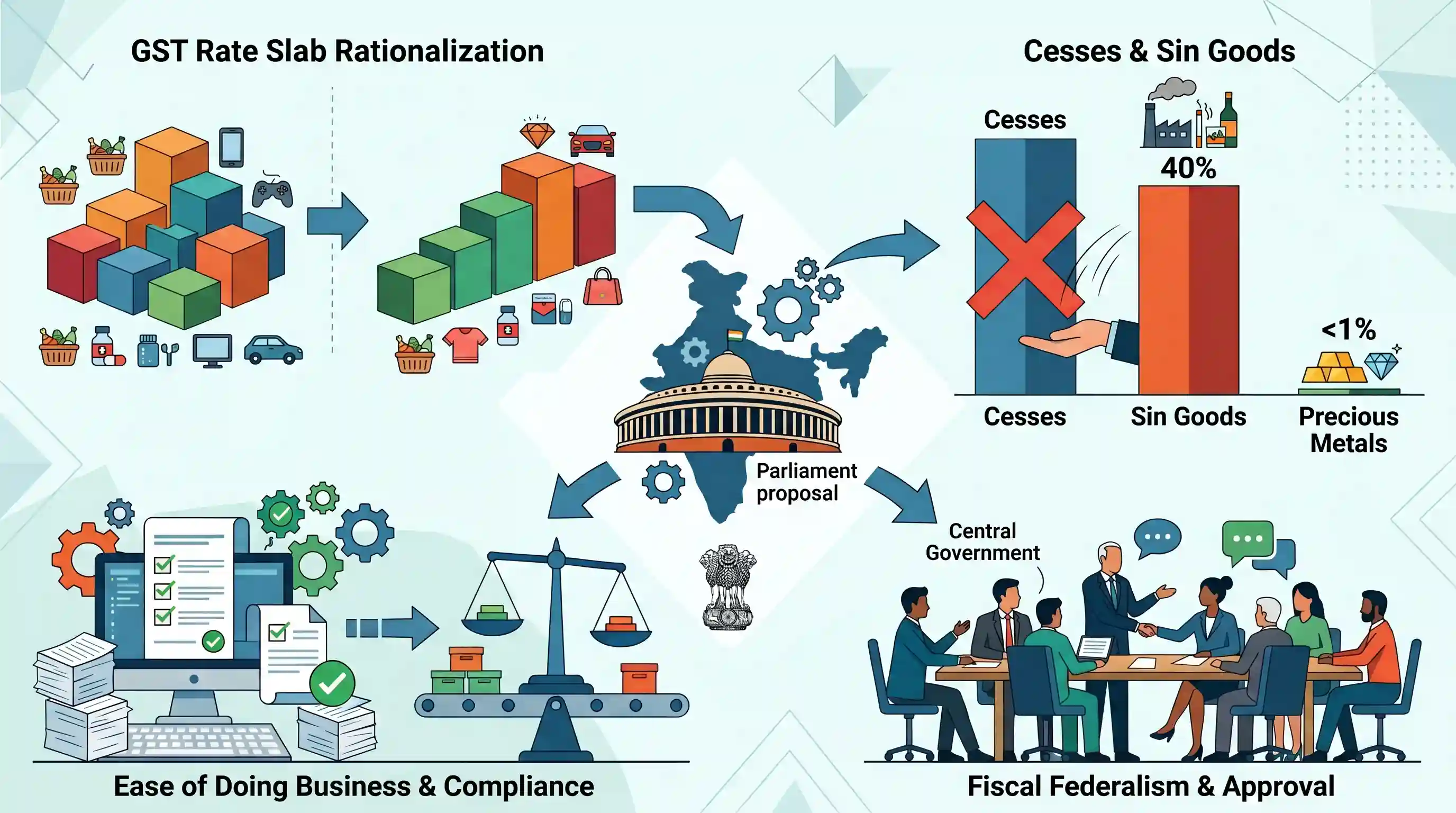
The Central Government has proposed a sweeping overhaul of India's Goods and Services Tax (GST) framework by eliminating the 12% and 28% tax slabs. Under the proposed next-generation reforms, the regime will rely primarily on 5% and 18% slabs, significantly lowering taxes on items of common use. Cesses will be completely abolished, with five to seven "sin" goods such as tobacco facing a straightforward 40% tax rate. A concessional rate of below 1% will apply to precious metals. Beyond rate rationalisation, the reforms seek to ease compliance through pre-filled returns and resolve the inverted duty structure. Since taxation falls under cooperative federalism, the proposal is currently with a state-represented Group of Ministers (GoM) for approval.
Key Points
- The Centre proposes to slash the current four-tier GST structure down to two primary slabs: 5% and 18%.
- The 12% and 28% slabs will be abolished, shifting 99% of goods in the 12% category to 5%, and 90% of 28% category items to 18%.
- All cesses will be removed. Only a few sin goods like tobacco and gutka will attract a new high rate of 40%.
- A special concessional rate below 1% is proposed for precious metals like gold and silver.
- Other reforms include fixing the inverted duty structure to free up working capital and introducing pre-filled GST returns.
- These proposals are currently under review by a Group of Ministers (GoM) comprised of state representatives, as implementation requires consensus.
Important Terms
Goods and Services Tax (GST)

A comprehensive, multi-stage, destination-based indirect tax levied on the supply of goods and services, subsuming most central and state taxes to create a unified national market.
UPSC context
GS Paper III (Economy). Fundamental for understanding India's fiscal architecture, tax reforms, and the 'One Nation One Tax' concept.
GST Council
A constitutional body under Article 279A, chaired by the Union Finance Minister, responsible for making recommendations on GST rates, exemptions, and administrative rules.
UPSC context
GS Paper II (Polity) & GS Paper III (Economy). Tests knowledge of cooperative federalism and constitutional bodies.
Group of Ministers (GoM)
Committees of state ministers appointed by the GST Council to examine specific issues (like rate rationalisation) and provide recommendations before final Council decisions.
UPSC context
GS Paper III (Economy). Relevant for understanding the consultative process and consensus-building in fiscal policy.
Inverted Duty Structure
A situation where the tax rate on raw materials (inputs) is higher than the rate on the finished product (outputs), leading to unutilised Input Tax Credit.
UPSC context
GS Paper III (Economy). Tests understanding of tax distortions, manufacturing competitiveness, and Ease of Doing Business.
Rate Rationalisation
The process of simplifying the GST structure by reducing the number of tax slabs and adjusting rates to ensure revenue neutrality and consumer relief.
UPSC context
GS Paper III (Economy). High-priority topic regarding indirect tax reform and inflation management.
Sin Goods
Taxes levied on goods considered socially undesirable or harmful, such as tobacco or aerated drinks, typically taxed at the highest rates.
UPSC context
GS Paper III (Economy). Relevant for taxation policy on demerit goods and revenue generation.
Prelims Trap
"Under an inverted duty structure, the final manufactured goods are taxed at higher GST rates than the raw materials."
It is the exact opposite. An inverted duty structure occurs when inputs (raw materials) are taxed at higher rates than the final output.
Static Concepts Connected
What is the constitutional and voting structure of the GST Council?
- Article 279A: Inserted via the 101st Constitutional Amendment Act, mandating a joint forum of the Centre and States.
- Voting Weightage: The Centre's vote holds 1/3rd weight, while all States combined hold 2/3rd weight in meetings.
- Majority Threshold: All decisions require a minimum 3/4th (75%) majority of the weighted votes cast.
How does the 'Inverted Duty Structure' impact businesses?
- Definition: It arises when the tax rate on raw material inputs is higher than the tax rate on final outward supplies.
- Input Tax Credit: This anomaly leads to a continuous, trapped accumulation of unutilized Input Tax Credit (ITC) for the producer.
- Working Capital: It blocks crucial working capital for manufacturers, making domestic goods less competitive and prompting demands for rate rationalisation.
Cross-Topic Patterns
GST Council & SC Federalism Rulings
The GoM review process recalls the SC's 'Mohit Minerals' judgment, which ruled that GST Council recommendations are fundamentally persuasive and not strictly binding on Parliament or State Legislatures.
Sin Goods & GST Compensation Cess
The proposed abolition of cesses marks the final policy shift away from the GST Compensation Cess era (2017-2022), transitioning to a flat 40% rate for sin goods.

Expect a multi-statement Prelims question linking GST rate rationalisation, the inverted duty structure, and Article 279A voting weights.
Linked PYQs · 5
Linked PYQs · 5
- 2019MainsGS3
Enumerate the indirect taxes which have been subsumed in the Goods and Services Tax (GST) in India. Also, comment on the revenue implications of the GST introduced in India since July 2017.
- 2020MainsGS3
Explain the rationale behind the Goods and Services Tax (Compensation to States) Act of 2017. How has COVID-19 impacted the GST compensation fund and created new federal tensions?
- 2025MainsGS2
Examine the evolving pattern of Centre-State financial relations in the context of planned development in India. How far have the recent reforms impacted the fiscal federalism in India?
- 2018PrelimsGS1
Consider the following items : 1. Cereal grains hulled 2. Chicken eggs cooked 3. Fish processed and canned 4. Newspapers containing advertising material Which of the above items is/are exempted under GST (Goods and Services Tax)?
- 2017PrelimsGS1
What is/are the most likely advantages of implementing 'Goods and Services Tax (GST)'? 1. It will replace multiple taxes collected by multiple authorities and will thus create a single market in India. 2. It will drastically reduce the 'Current Account Deficit' of India and will enable it to increase its foreign exchange reserves. 3. It will enormously increase the growth and size of economy of India and will enable it to overtake China in the near future. Select the correct answer using the code given below:
