Mumbai Marina Project for Maritime Tourism Growth
Source:Indian Express ↗
Why It Matters
Provides a concrete, contemporary example of a hybrid investment model (combining EPC and PPP) for infrastructure development, directly relevant to GS3 Investment Models and Infrastructure topics. Also highlights the economic diversification of India's coastal resources.
Summary
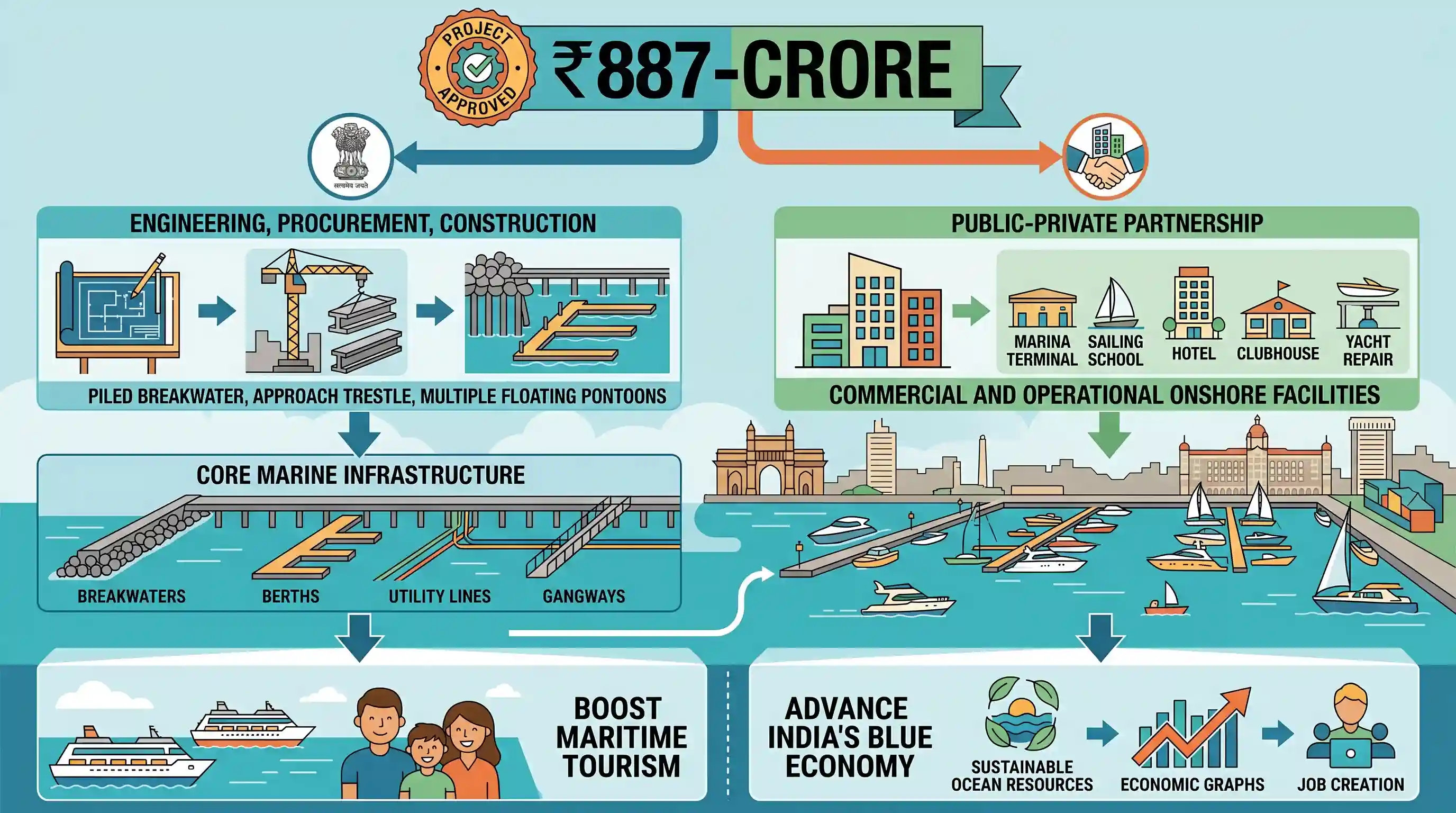
The Ministry of Ports, Shipping and Waterways has cleared a ₹887-crore project to develop a marina in Mumbai Harbour, aiming to boost maritime tourism and advance India's Blue Economy goals. The project is notable for its hybrid execution model: the Mumbai Port Authority will handle core marine infrastructure via the EPC route, while a private partner will develop commercial and operational onshore facilities under a PPP arrangement.
Key Points
- The Union government approved a ₹887-crore project to develop a world-class marina at Princess Dock in Mumbai Harbour.
- The project employs a hybrid investment model, splitting responsibilities between public engineering and private commercial development.
- Mumbai Port Authority will invest ₹470 crore via the Engineering, Procurement, and Construction (EPC) model to build core marine infrastructure like breakwaters and pontoons.
- A private operator will invest ₹417 crore through a Public-Private Partnership (PPP) to develop and operate onshore facilities, including commercial spaces and yacht maintenance areas.
- The marina is expected to berth over 400 yachts, generate around 2,000 jobs, and significantly boost India's Blue Economy and maritime tourism footprint.
Important Terms
Blue Economy

Sustainable use of ocean resources for economic growth, improved livelihoods, and jobs while preserving the health of ocean ecosystems.
UPSC context
GS-3 (Economy/Environment): Key for sustainable development and harnessing India's 7,517 km coastline potential.
EPC (Engineering, Procurement, and Construction) Model
A project delivery model where a private contractor handles design, procurement, and construction, while the government provides the entire funding.
UPSC context
GS-3 (Investment Models): Crucial for understanding government-led infrastructure spending when private capital is risk-averse.
Public-Private Partnership (PPP)
A long-term cooperative arrangement between a government agency and a private sector company to finance, build, and operate public infrastructure.
UPSC context
GS-3 (Investment Models): Core topic testing risk-sharing, private efficiency, and modern infrastructure financing (BOT, HAM).
Mumbai Port Authority (MbPA)
The statutory body managing Mumbai's port, currently pivoting from cargo operations to waterfront regeneration and maritime tourism under Master Plan 2047.
UPSC context
GS-3 (Infrastructure): Relevant for port-led development, land monetization, and urban coastal revitalization.
Maritime Tourism
Sustainable sea and coast-based tourism including cruises, yachting, and water sports, aimed at economic diversification and coastal development.
UPSC context
GS-3 (Economy) & GS-1 (Geography): Focuses on untapped economic potential and geographic advantages of India's maritime zones.
Ministry of Ports, Shipping and Waterways (MoPSW)
The apex ministry responsible for formulating policies and regulations for ports, shipping, and inland waterways in India.
UPSC context
GS-2 (Governance) & GS-3 (Infrastructure): Central to Sagarmala, Maritime India Vision 2030, and Blue Economy initiatives.
Prelims Trap
The entire Rs 887-crore Mumbai marina project is being executed under a Public-Private Partnership (PPP) model where the private entity bears all financial risk.
The project is a hybrid model. The government bears the financial risk for the core marine infrastructure (EPC), while the private sector handles only the onshore commercial facilities (PPP).
Static Concepts Connected
How do EPC and PPP (BOT) models differ in infrastructure financing?
- EPC Model: The government funds the project completely and bears all financial risk. The private entity is simply hired to design and build the facility.
- BOT (PPP) Model: The private entity finances, builds, and operates the facility for a concession period to recover costs, thereby bearing the financial and demand risks.
- Hybrid Execution: Often used in complex projects where the state funds unviable core infrastructure (EPC) and the private sector develops profitable auxiliary facilities (PPP).
How did the Major Port Authorities Act, 2021 change port administration in India?
- Tariff Autonomy: The Act decentralized decision-making by replacing the Tariff Authority for Major Ports (TAMP), allowing port boards to fix their own tariffs based on market forces.
- Corporate Board Structure: Major ports were transformed from trust-managed entities to corporate-style boards, granting them greater financial autonomy to directly invest in EPC or structure PPPs.
Cross-Topic Patterns
Hybrid models in Blue Economy
India is moving beyond traditional cargo ports to develop coastal economic multipliers like maritime tourism, utilizing hybrid financing to balance sovereign capital with private operational efficiency.
Legislative backing for Port Autonomy
The Mumbai Port's direct ₹470 crore EPC investment demonstrates the decentralized financial power granted to port boards under the Major Port Authorities Act, 2021.

A 2026 GS3 question may ask you to evaluate how hybrid investment models (EPC + PPP) are driving India's Blue Economy infrastructure.
Linked PYQs · 3
Linked PYQs · 3
- 2022MainsGS3
Why is Public Private Partnership (PPP) required in infrastructural projects ? Examine the role of PPP model in the redevelopment of Railway Stations in India.
- 2013MainsGS3
Adoption of PPP model for infrastructure development of the country has not been free of criticism. Critically discuss pros and cons of the model.
- 2014MainsGS3
Explain how Private Public Partnership arrangements, in long gestation infrastructure projects, can transfer unsustainable liabilities to the future. What arrangements need to be put in place to ensure that successive generations' capacities are not compromised?
