Tribal Ministry Shifts Rehabilitation Responsibility to Madhya Pradesh
Source:The Hindu ↗
Why It Matters
The Ken-Betwa project is India's first major river interlinking project. Its execution brings to the forefront the critical governance challenges surrounding the displacement of vulnerable tribal populations, the enforcement of statutory frameworks like the Forest Rights Act, and the balance between infrastructure development and indigenous rights.
Summary
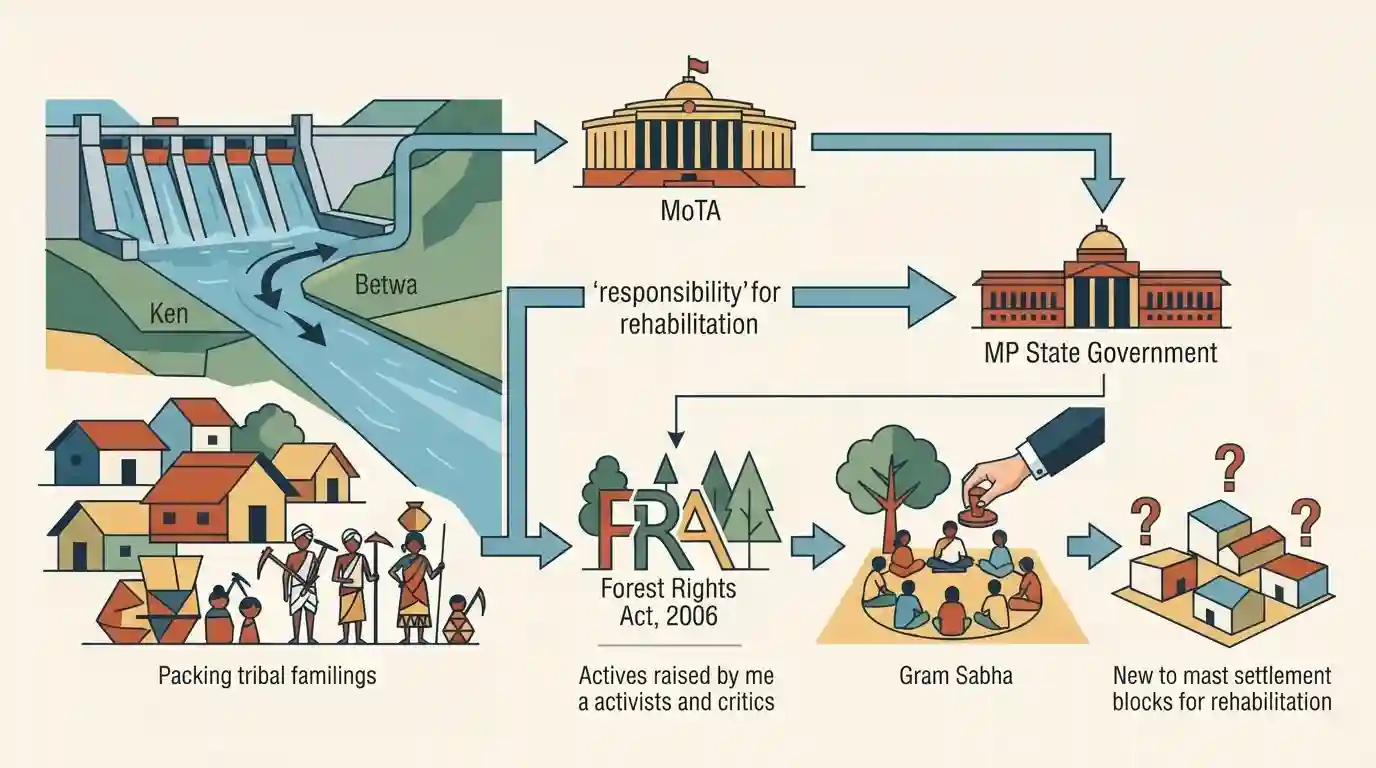
The Union Ministry of Tribal Affairs (MoTA) has shifted the responsibility of rehabilitating tribal communities and traditional forest dwellers displaced by the Ken-Betwa river linking project to the Madhya Pradesh State Government. The infrastructure project, executed by the National Water Development Agency (NWDA) under the Jal Shakti Ministry, is expected to displace around 5,000 households in Chhatarpur district. Critics and activists have raised concerns over the bypassing of the Forest Rights Act (FRA), 2006, highlighting that mandatory Gram Sabha consent and settlement of forest rights claims were not completed before the project was advanced.
Key Points
- The Ken-Betwa river linking project in Madhya Pradesh will displace approximately 5,000 households, largely comprising tribal communities and traditional forest dwellers in the Chhatarpur district.
- The Union Ministry of Tribal Affairs (MoTA) has clarified that the State Government is responsible for rehabilitating the displaced people and implementing the Forest Rights Act (FRA), despite MoTA being the nodal ministry.
- Activists allege significant violations of the FRA, asserting that mandatory consent from Gram Sabhas was bypassed before securing project clearances.
- The project, managed by the National Water Development Agency (NWDA) under the Jal Shakti Ministry, faces criticism for proceeding without adequately settling forest rights claims as previously mandated by the Forest Advisory Committee (FAC).
Important Terms
Scheduled Tribes and Other Traditional Forest Dwellers (Recognition of Forest Rights) Act, 2006 (FRA)

A landmark legislation recognizing the historical rights of forest-dwelling tribal communities and other traditional forest dwellers over forest resources, ensuring land tenure, livelihood, and food security.
UPSC context
GS2/GS3 (Governance/Environment). Tests knowledge of tribal rights, forest management, and the crucial role of Gram Sabhas in displacement issues.
Ken-Betwa River Interlinking Project
India's first major inter-basin river linking project, aiming to transfer surplus water from the Ken river in Madhya Pradesh to the Betwa river in Uttar Pradesh to irrigate the drought-prone Bundelkhand region.
UPSC context
GS1/GS3 (Geography/Environment). Frequently tested for its ecological impact on Panna Tiger Reserve and the broader debate on river interlinking.
National Water Development Agency (NWDA)
An autonomous society under the Ministry of Jal Shakti, established in 1982 to study, plan, and implement the interlinking of rivers and optimize water resource utilization across India.
UPSC context
GS2/GS3 (Statutory Bodies/Water Management). Key for questions on river basin planning and the institutional framework behind national water projects.
Union Ministry of Tribal Affairs (MoTA)
The nodal central ministry created in 1999 to oversee the policy, planning, and coordination of programs for the development of India's Scheduled Tribes and the implementation of the Forest Rights Act.
UPSC context
GS2 (Social Justice/Governance). Relevant for understanding institutional mechanisms protecting vulnerable sections and centre-state administrative responsibilities.
Prelims Trap
Projects of national importance, such as major river-interlinking works, are legally exempt from requiring Gram Sabha consent under the Forest Rights Act, 2006.
The FRA, 2006 does not provide any statutory exemption for 'national importance' projects from the mandatory requirement of Gram Sabha consent and settlement of rights prior to forest diversion.
Static Concepts Connected
What is the three-tier institutional structure for determining forest rights under the FRA, 2006?
- Gram Sabha: Initiates the process for determining the nature and extent of individual or community forest rights.
- Sub-Divisional Committee: Screens the resolutions passed by the Gram Sabha and forwards them to the district level.
- District Level Committee: Acts as the final authority to approve and record the forest rights decisions.
What are the two major components of India's National Perspective Plan for river interlinking?
- Peninsular Component: Focuses on southern rivers, divided into four parts including interlinking Mahanadi-Godavari-Krishna-Cauvery and Ken-Betwa.
- Himalayan Component: Envisages building storage reservoirs on major Ganga-Brahmaputra tributaries in India and Nepal to link them.
Cross-Topic Patterns
River Interlinking vs. Tiger Conservation
The Ken-Betwa link submerges crucial core areas of the Panna Tiger Reserve, illustrating the structural trade-off between water-security infrastructure and biodiversity protection under the Wildlife Protection Act.
Federalism and Environmental Clearances
The division of rehabilitation responsibilities between MoTA and the MP government demonstrates how decentralized statutory obligations (FRA) often clash with centralized infrastructural execution.

Panna Tiger Reserve ecology, Ken-Betwa hydrology, and Gram Sabha veto power under FRA 2006 are highly likely to feature in Prelims 2026.
Linked PYQs · 5
Linked PYQs · 5
- 2023MPPSC_PRELIMSGS1
Which of the following rivers of Madhya Pradesh flows in three states?
- 2020MPPSC_PRELIMSGS1
Betwa river originate from
- 2021MPPSC_PRELIMSGS1
| List-I (Tributaries) | List-II (Rivers) | |---------------------|----------------| | A. Betwa | ii. Yamuna | | B. Kshipra | iii. Narmada | | C. Vainganga | iv. Godavari | | D. Tawa | i. Chambal | Codes:
- 2025MPPSC_PRELIMSGS1
In which Article of the Indian Constitution is there a provision of reservation of seats for Scheduled Tribes in the State Assembly?
- 2020MPPSC_PRELIMSGS1
The provision of reservation of seats for Scheduled Tribes in Municipalities in Madhya Pradesh has been made under which of the following Articles of the Constitution of India?
