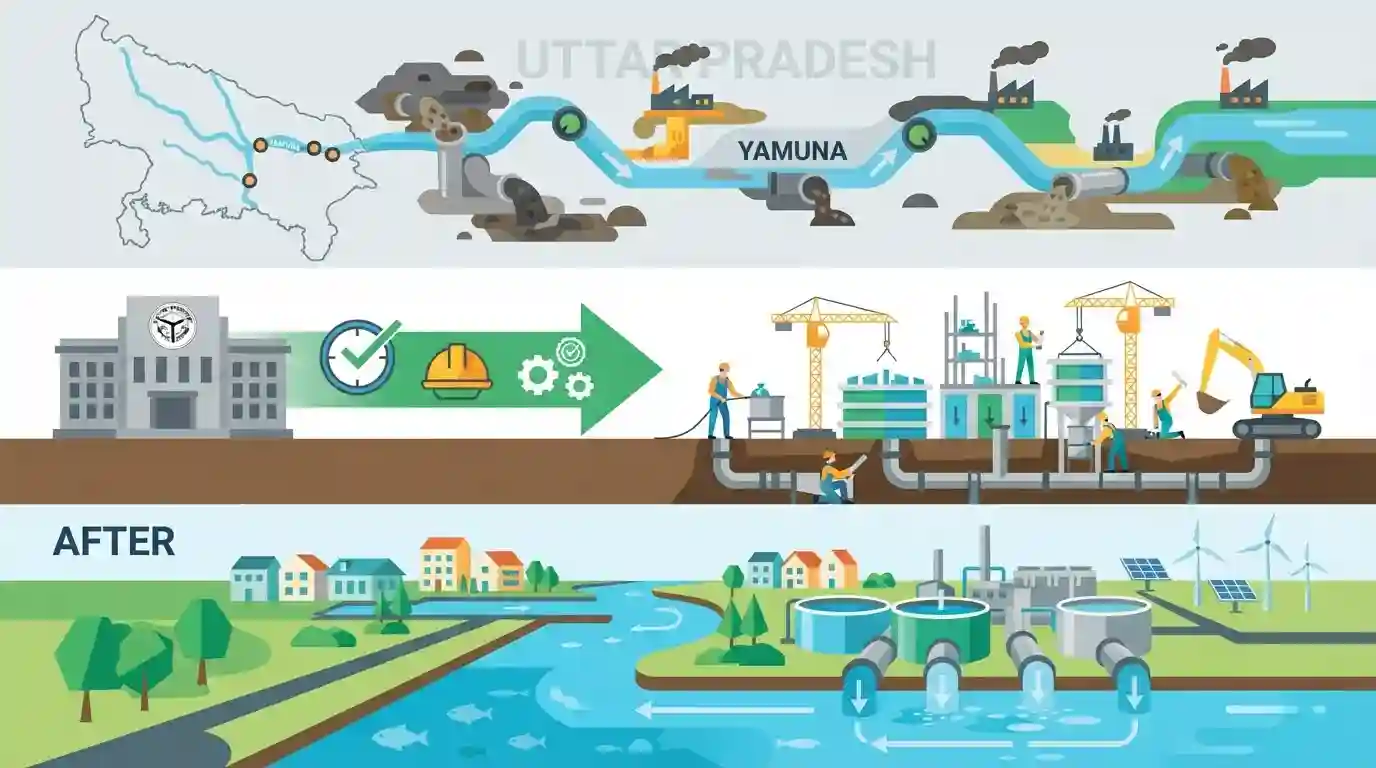
Centre Directs UP to Fast Track Yamuna Sewage Projects
Source:swarajyamag ↗
Why It Matters
Crucial for UPPSC aspirants tracking state-specific environmental initiatives, river rejuvenation programs (Yamuna/Ganga), and urban sanitation projects under central mandates.
Summary
The Centre has directed Uttar Pradesh to accelerate sewage infrastructure projects to reduce pollution levels in the Yamuna River, emphasizing timely execution of treatment plants and environmental compliance.
Key Points
- The Central Government has directed the Uttar Pradesh administration to fast-track ongoing sewage infrastructure projects aimed at curbing heavy pollution in the Yamuna River.
- The focus is on plugging untreated domestic sewage and industrial effluents flowing into the river stretches passing through the state.
- Efforts are integrated with national schemes like Namami Gange and urban infrastructure upgrades to improve biochemical oxygen demand (BOD) and water quality.
Important Terms
Namami Gange Programme

An Integrated Conservation Mission approved as a flagship program by the Union Government in June 2014 to accomplish the twin objectives of effective abatement of pollution and conservation and rejuvenation of the National River Ganga and its tributaries like the Yamuna.
UPSC context
Relevant for GS Paper III (Environment, Conservation, and Pollution Control). Frequently tested in UPPSC for river rejuvenation schemes and state-level sewage management.
AMRUT Scheme
A flagship urban renewal mission launched by the Ministry of Housing and Urban Affairs to establish infrastructure that could ensure adequate robust sewage networks, water supply, and stormwater drainage in urban areas.
UPSC context
Crucial for UPPSC GS Paper I & III (Urbanization, Infrastructure, and Government Policies). Tests knowledge of urban basic services and wastewater management.
Prelims Trap
Namami Gange Programme is restricted strictly to the main stem of the River Ganga, excluding its tributaries like Yamuna.
Aspirants often confuse Namami Gange as exclusively a Ganga basin project, overlooking its mandate over major tributaries like the Yamuna, Hindon, and Kali rivers in states like UP.
Static Concepts Connected
What are the key parameters used to measure water pollution in rivers under Indian environmental standards?
- BOD (Biochemical Oxygen Demand):: Measures the amount of dissolved oxygen needed by aerobic biological organisms to break down organic material present in a given water sample at certain temperature over a specific time period.
- Dissolved Oxygen (DO):: Crucial for aquatic life; lower levels indicate heavy organic pollution and high microbial activity in water bodies.
- CPCB Standards:: Set by the Central Pollution Control Board (CPCB) to monitor river health across major river basins like Ganga and Yamuna.
Cross-Topic Patterns
River Conservation + Urban Decentralization
Namami Gange and AMRUT convergence models frequently appear in both environment and state governance sections.

Expect a multi-statement question on Namami Gange components, BOD parameters, and urban local body roles in UP river pollution control.
Linked PYQs · 2
Linked PYQs · 2
- 2018UPPSC_PRELIMSGS1
Which of the following rivers of Uttar Pradesh has been declared a 'Biological Disaster' due to environmental pollution?
- 2022UPPSC_PRELIMSGS1
The main purpose of 'Ganga Action Plan' project, launched in 1985, was
