Union government stand against creamy layer criteria in SC ST quotas
Source:The Hindu ↗
কেন এটি গুরুত্বপূর্ণ
This development is highly relevant for GS2 as it involves ongoing judicial and political debates around affirmative action, the "creamy layer" concept, and the constitutional separation of powers (Parliament's exclusive right to modify SC/ST lists). It also connects to recent landmark rulings on sub-categorisation, essential for answers on social justice and vulnerable sections.
সারসংক্ষেপ
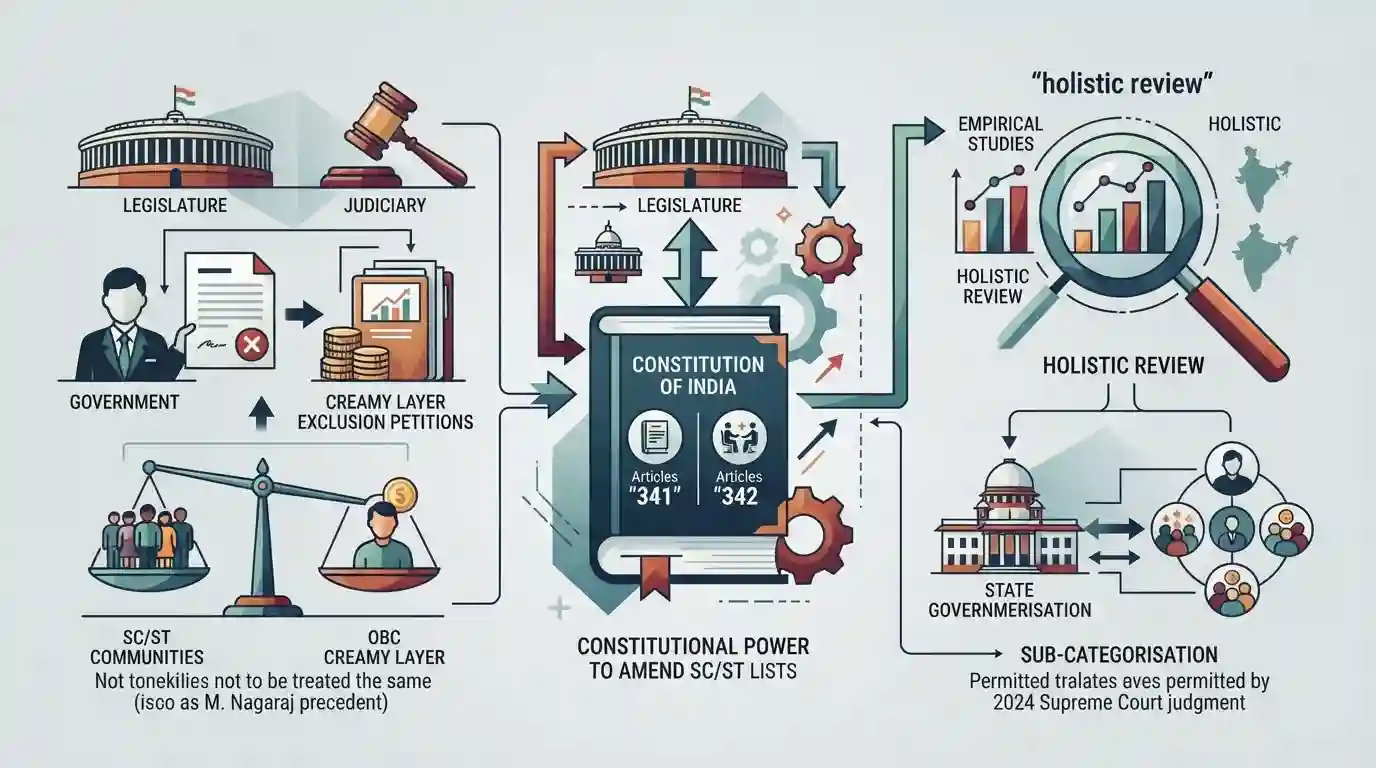
The Union government filed an affidavit in the Supreme Court opposing petitions that seek to introduce an income-based "creamy layer" exclusion for Scheduled Castes (SCs) and Scheduled Tribes (STs) in reservations. The Ministry of Social Justice and Empowerment argued that judicial precedents, including the M. Nagaraj case, do not mandate applying the creamy layer principle to SCs and STs in the same manner as OBCs. The Centre emphasized that only Parliament has the constitutional power (under Articles 341 and 342) to alter the SC/ST lists. While acknowledging that most welfare schemes already use a financial means test, the government asserted that changing the reservation policy for jobs and education would require a holistic review based on thorough empirical studies. This development follows the 2024 landmark Supreme Court judgment that permitted the sub-categorisation of SCs and STs by state governments.
মূল বিষয়
- The Union government has strongly opposed petitions in the Supreme Court seeking an income-based "creamy layer" exclusion for Scheduled Castes (SCs) and Scheduled Tribes (STs).
- The Centre argued that the creamy layer principle, which applies to Other Backward Classes (OBCs), does not constitutionally or legally apply to SCs and STs according to existing judicial precedents.
- The Ministry of Social Justice and Empowerment emphasized that under Articles 341 and 342 of the Constitution, only Parliament has the authority to add or remove communities from the SC/ST lists.
- While most welfare schemes for SCs/STs already have a financial "means test", the government stated that introducing economic criteria for job and education quotas requires comprehensive empirical data and a holistic review, not judicial intervention.
- The issue gained traction after the 2024 Supreme Court ruling in State of Punjab vs Davinder Singh, which allowed state-level sub-categorisation within SC/ST lists to ensure equitable distribution of benefits, with Justice Gavai suggesting the need to identify a creamy layer.
গুরুত্বপূর্ণ শব্দ
State of Punjab vs Davinder Singh case

A landmark 2024 Supreme Court ruling holding that sub-classification within Scheduled Castes and Scheduled Tribes is constitutionally permissible, allowing state governments to target the most backward communities within these lists for quotas.
UPSC context
GS Paper II (Polity & Social Justice); crucial for questions on reservation policies, affirmative action, and federal-state power dynamics.
M. Nagaraj case
A landmark 2006 Supreme Court verdict that upheld the constitutional validity of reservations in promotions for SCs and STs, but imposed conditions including demonstrating underrepresentation, administrative efficiency, and applying the creamy layer principle.
UPSC context
GS Paper II (Polity & Governance); essential for understanding judicial criteria, reservation in promotion, and historical evolution of creamy layer.
Article 341
A constitutional provision that empowers the President to notify the list of Scheduled Castes (SCs) for a state or union territory, and mandates that only Parliament can subsequently alter or amend this list.
UPSC context
GS Paper II (Indian Constitution); vital for understanding structural protections, the definition of Scheduled Castes, and federal legislative powers.
Article 342
A constitutional provision that empowers the President to notify the list of Scheduled Tribes (STs) for a state or union territory, and vests exclusive authority in Parliament to make subsequent modifications to it.
UPSC context
GS Paper II (Indian Constitution); highly relevant for tribal welfare, identifying Scheduled Tribes, and legislative separation of powers.
প্রিলিমস ফাঁদ
Under the 2024 Davinder Singh ruling, state governments can exclude advanced SC/ST sub-castes from the Presidential list using a financial creamy layer.
States can only sub-classify for reservation distribution under Articles 15(4)/16(4). Only Parliament can amend the Presidential list (Articles 341(2)/342(2)) to include or exclude any community.
সংযুক্ত স্থির ধারণা
How are SC and ST lists constitutionally notified and altered?
- Presidential Notification: Under Articles 341(1) and 342(1), the President specifies SCs/STs for each State/UT after consulting the respective Governor.
- Parliamentary Authority: Only Parliament, under Articles 341(2) and 342(2), has the exclusive power to include or exclude communities from the notified lists.
- State-Specific Status: SC/ST status is strictly state-specific; recognition in one State does not automatically apply in another due to localized socio-economic differences.
What is the evolution of the Creamy Layer doctrine?
- Indra Sawhney Case: The 1992 Indra Sawhney judgment introduced the creamy layer to exclude socially advanced members of OBCs from quotas, exempting SCs/STs.
- Promotions Exception: The Supreme Court in Jarnail Singh (2018) extended the creamy layer concept to SC/STs specifically in the context of promotions, not initial recruitments.
- Educational Admissions: The Ashoka Kumar Thakur (2008) ruling clarified that the creamy layer does not apply to SC/STs in educational institutions.
আন্তঃবিষয় প্যাটার্ন
Federalism vs. Centralised Reservation Lists
Examines how state-level sub-classification under Davinder Singh (2024) interacts with the Union's exclusive control over notifying Scheduled Castes and Scheduled Tribes under Articles 341 and 342.
Judicial Review vs. Legislative Prerogative
The debate highlights tension between judicial directives advocating for equity within backward classes and the executive's reliance on empirical data before implementing policy shifts.

Distinction between state sub-categorisation and Parliament's exclusive power under Articles 341/342 is a prime 2026 Prelims theme.
সংযুক্ত PYQ · 2
সংযুক্ত PYQ · 2
- 2024PrelimsGS1
Consider the following statements : 1. It is the Governor of the State who recognizes and declares any community of that State as a Scheduled Tribe. 2. A community declared as a Scheduled Tribe in a State need not be so in another State. Which of the statements given above is/are correct?
- 2018MainsGS2
Whether National Commission for Scheduled Castes (NCSC) can enforce the implementation of constitutional reservation for the Scheduled Castes in the religious minority institutions? Examine.
