Citizenship Amendment Rules And OCI Registration Digitalization
Source:The Hindu ↗
Why It Matters
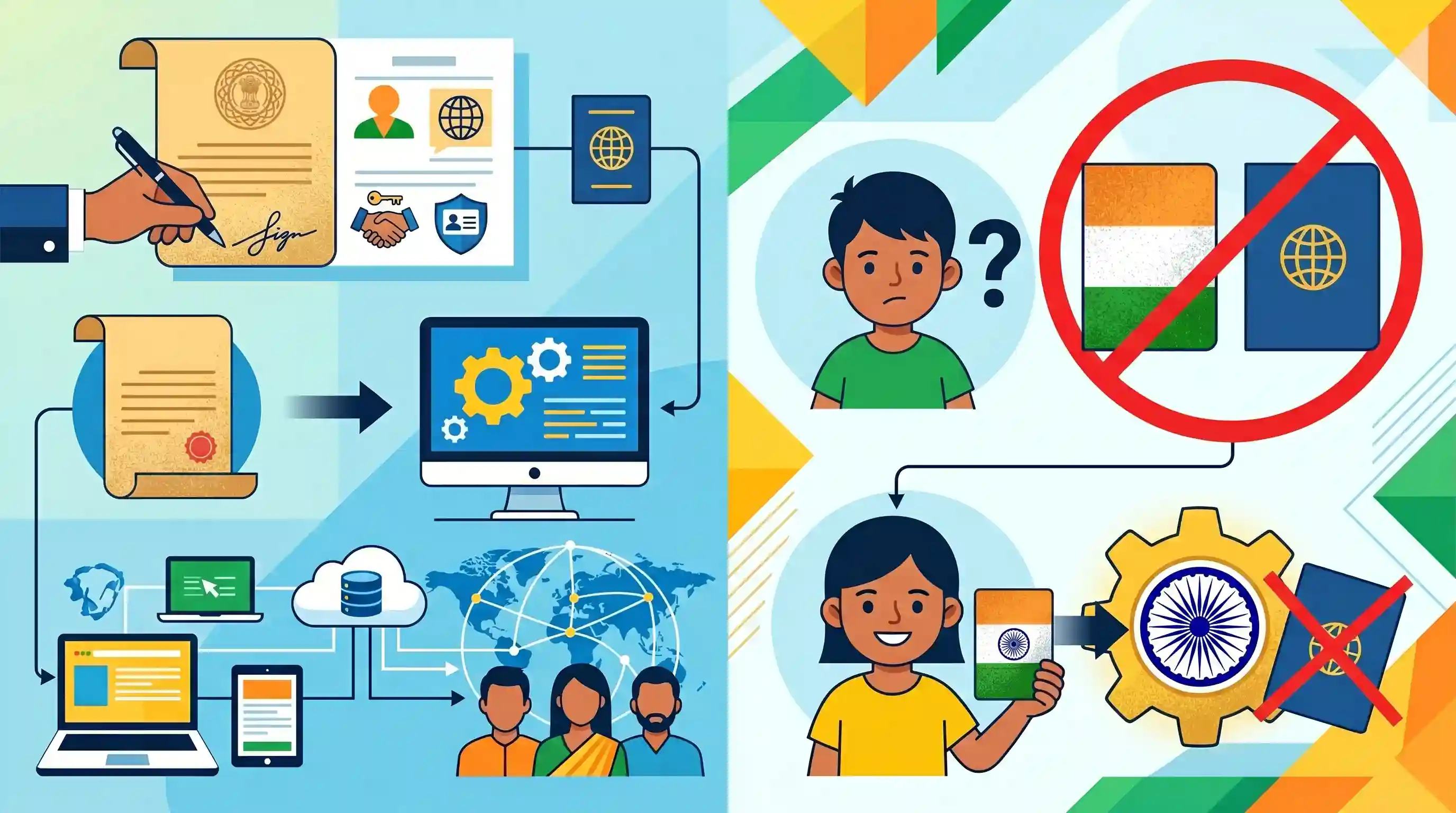
The amendment is significant for the Indian diaspora as it transitions OCI and citizenship applications to digital platforms. Further, it legally clarifies the status of dual passports for minors, reinforcing constitutional and statutory mandates against dual citizenship in India.
Summary
The Centre has notified the Citizenship (Amendment) Rules, 2026, amending the 2009 rules to digitize processes for Overseas Citizen of India (OCI) cardholders and citizenship applications. A key addition is a specific proviso stipulating that minor children applying for Indian citizenship cannot hold passports from any other country concurrently with an Indian passport, reinforcing India's strict stance against dual citizenship.
Key Points
- The Centre has notified the Citizenship (Amendment) Rules, 2026, which amend the Citizenship Rules, 2009.
- The amendment introduces a digital shift for various processes related to Overseas Citizen of India (OCI) cardholders and citizenship applications, streamlining administrative procedures.
- A specific proviso has been added regarding minors: a minor child cannot hold the passport of any other country while holding an Indian passport.
- This change reinforces India's strict prohibition of dual citizenship and clarifies the rules for minors seeking Indian citizenship.
Important Terms
Citizenship Act, 1955

The primary legal framework for acquisition and termination of Indian citizenship, enacted by Parliament under powers granted by Articles 5–11 of the Constitution.
UPSC context
GS Paper II (Governance/Constitution). Core law for citizenship eligibility, OCI registration, and termination of nationality.
Citizenship (Amendment) Rules, 2026
A 2026 update to the 2009 rules that mandates online-only OCI applications, introduces electronic OCI (e-OCI) registrations, and clarifies that minor children cannot hold dual passports.
UPSC context
GS Paper II (Executive/Governance). Reflects India's shift toward e-governance and its strict legal stance against dual citizenship.
Overseas Citizen of India (OCI) scheme
A residency status for foreign nationals of Indian origin, providing a lifelong visa and various economic rights without political rights or agricultural land ownership.
UPSC context
GS Paper II (Diaspora). Key mechanism for engaging the Indian diaspora; tests understanding of the PIO-OCI merger and rights limitations.
Ministry of Home Affairs (MHA)
The nodal Indian ministry responsible for internal security, border management, and the administration of citizenship laws, including the notification of new citizenship rules.
UPSC context
GS Paper II (Polity/Statutory Bodies). Central authority for citizenship processing, foreigner registration (FRRO), and national security vetting.
Citizenship Rules, 2009
The principal set of regulations governing the procedural aspects of acquiring, registering, and renouncing Indian citizenship, which are periodically amended by the central government.
UPSC context
GS Paper II (Governance). Provides the procedural blueprint for how the 1955 Act is implemented in practice.
Prelims Trap
"The OCI scheme grants dual citizenship status to the Indian diaspora for specific economic and educational purposes."
OCI is not dual citizenship; it is merely a life-long visa. India strictly prohibits dual citizenship under Article 9, even for minors.
Static Concepts Connected
What specific rights are denied to an Overseas Citizen of India (OCI)?
- Political rights: Cannot vote in elections or hold constitutional posts like President, Vice President, or Supreme Court/High Court Judge.
- Public employment: Cannot secure public employment or government jobs without specific exemptions.
- Property rights: Cannot purchase agricultural or plantation properties in India, though they can inherit them.
How does the Constitution regulate Indian citizenship?
- Article 9: Voluntarily acquiring a foreign citizenship automatically and immediately terminates Indian citizenship.
- Article 11: Empowers Parliament with the exclusive, absolute power to make laws regarding citizenship acquisition and termination.
- Single Citizenship: India strictly follows a single citizenship framework despite its federal structure.
Cross-Topic Patterns
e-Governance in Consular Services
The digital shift for OCI registration highlights the broader push under Digital India to integrate statutory consular services, making e-Governance a core component of diaspora diplomacy.
Identity vs. Citizenship proofs
UPSC often tests the distinction between documents proving identity/residency (Aadhaar, NPR) and those strictly proving constitutional citizenship under the Citizenship Act, 1955.

Expect a Prelims multi-statement question interlinking Article 9, new rules on minors' dual passports, and exact OCI vs NRI rights.
Linked PYQs · 4
Linked PYQs · 4
- 2020MainsGS2
Indian diaspora has a decisive role to play in the politics and economy of America and European Countries'. Comment with examples.
- 2023MainsGS2
Indian diaspora has scaled new heights in the West. Describe its economic and political benefits for India.
- 2018PrelimsGS1
Consider the following statements: 1. Aadhaar card can be used as a proof of citizenship or domicile. 2. Once issued, Aadhaar number cannot be deactivated or omitted by the Issuing Authority. Which of the statements given above is/are correct?
- 2022MainsGS2
“Right of movement and residence throughout the territory of India are freely available to the Indian citizens, but these rights are not absolute.” Comment.
