Centre merges Project Tiger and Project Elephant schemes
Source:Indian Express ↗
ఇది ఎందుకు ముఖ్యం
The merger of Project Tiger and Project Elephant touches upon core issues of wildlife governance, biodiversity management, resource allocation, and consultative policymaking in India, making it crucial for GS3 Environment and Governance sections.
సారాంశం
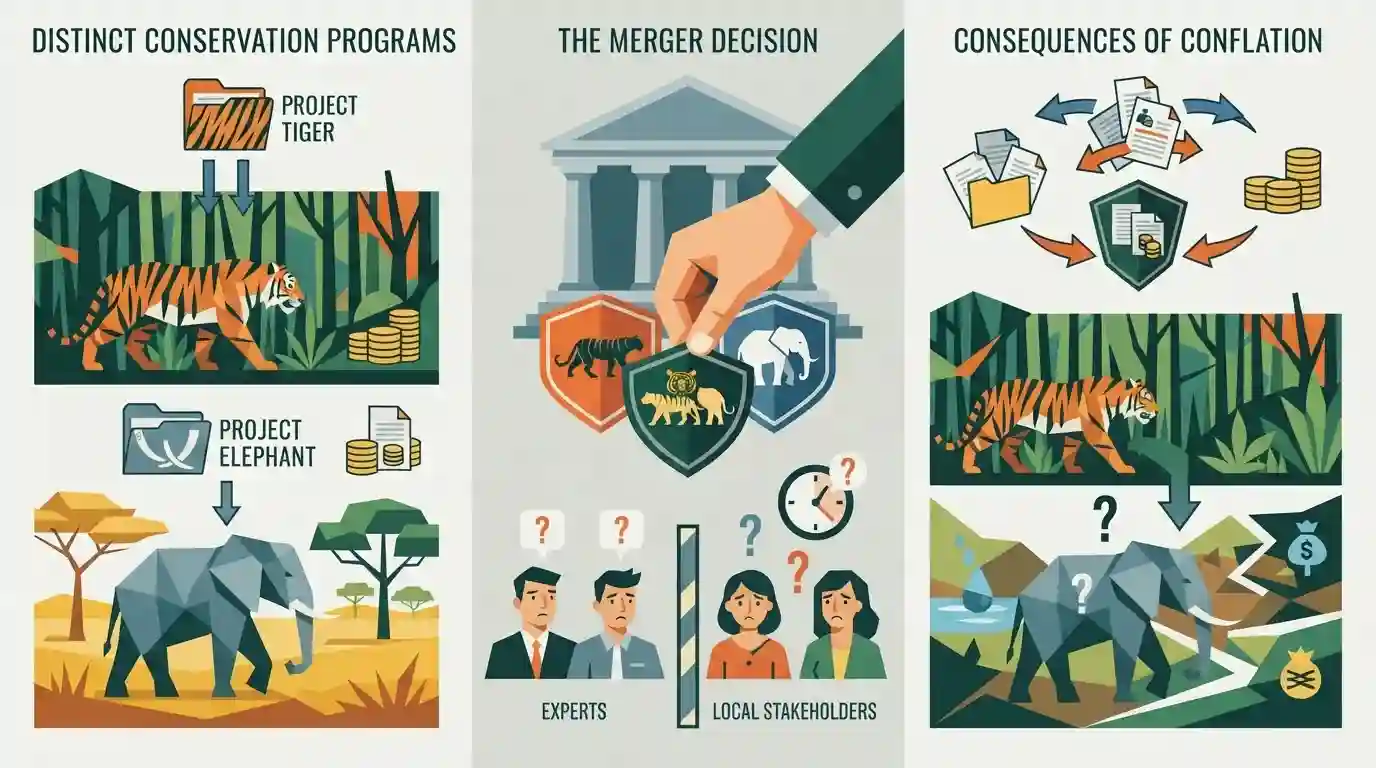
The Central government has controversially merged two of India's premier wildlife conservation programs, Project Tiger and Project Elephant, into a single administrative division without holding prior consultations with experts or stakeholders. Critics argue this move could adversely affect elephant conservation efforts by conflating their distinct habitat needs and funding requirements with those of tigers.
ముఖ్య అంశాలు
- The Centre has merged Project Tiger and Project Elephant into a single umbrella scheme ('Project Tiger and Elephant') without prior legislative or public discussion.
- Conservationists and experts have raised concerns that combining the two distinct flagship schemes could dilute focus, funding, and administrative strategies tailored specifically to elephants.
- The merger integrates the budgetary allocations and administrative management of India's apex conservation initiatives for its national animal (tiger) and heritage animal (elephant).
- Criticism highlights a lack of consultative policymaking and transparency regarding how funds and human resources will be partitioned between the two species.
ముఖ్యమైన పదాలు
Project Tiger

Centrally sponsored scheme launched in 1973 to ensure a viable tiger population in India, focusing on core-buffer habitat management, anti-poaching, and scientific monitoring.
UPSC context
UPSC Prelims/Mains (GS Paper III): Important wildlife conservation initiatives, protected area management, and biodiversity trends.
Project Elephant
Centrally sponsored scheme launched in 1992 to protect Asian elephants, their habitats, and migratory corridors, as well as address human-elephant conflict.
UPSC context
UPSC Prelims/Mains (GS Paper III): Wildlife conservation schemes, megafauna protection, and human-wildlife conflict.
Wild Life (Protection) Act, 1972
Landmark legislation enacted in 1972 providing legal frameworks, protective schedules, and penalties for the conservation of wild animals, birds, and plant species.
UPSC context
UPSC Prelims/Mains (GS Paper III): Environmental legislation, statutory bodies, and wildlife protection legal architecture.
National Tiger Conservation Authority (NTCA)
Statutory body established under the Wildlife (Protection) Act, 1972, tasked with providing administrative oversight and legal backing to tiger conservation projects in India.
UPSC context
UPSC Prelims/Mains (GS Paper III): Statutory environmental bodies, their composition, and functions in wildlife management.
Ministry of Environment, Forest and Climate Change
The apex federal ministry in India responsible for policy formulation, implementation, and coordination regarding environmental protection, forestry, and wildlife conservation.
UPSC context
UPSC Prelims/Mains (GS Paper II/III): Government ministries, administrative policy decisions, and environmental governance frameworks.
ప్రిలిమ్స్ ఉచ్చు
Both Project Tiger and Project Elephant operate under identical statutory authorities created by amendments to the Wild Life (Protection) Act, 1972.
Aspirants might assume both Project Tiger and Project Elephant have identical statutory backing under the Wildlife Protection Act, whereas NTCA is statutory while Project Elephant lacks a direct statutory equivalent.
అనుసంధానమైన స్థిర భావనలు
What is the statutory backing and administrative structure of Project Tiger and Project Elephant in India?
- Project Tiger Status: Project Tiger was launched in 1973 as a centrally sponsored scheme; its administrative arm, the National Tiger Conservation Authority (NTCA), was given statutory status via the 2006 Wildlife (Protection) Amendment Act.
- Project Elephant Status: Project Elephant was launched in 1992 as a centrally sponsored scheme but lacks an independent statutory authority equivalent to the NTCA, operating primarily through administrative mechanisms.
- National Status: The elephant is recognized as India's National Heritage Animal, whereas the tiger holds the status of India's National Animal.
అంతర-అంశ నమూనాలు
Wildlife Schemes + Executive Overreach + Federalism
The merger of specialized wildlife schemes raises parallel questions of federal accountability, executive discretion, and non-consultative policymaking seen in environmental legislations.
Project Elephant + Infrastructure Corridors + Habitat Fragmentation
Elephant corridors face linear intrusion challenges distinct from tiger territories, making a merged budgetary umbrella problematic for distinct ecological management plans.

Expect a statement-based prelims question on statutory backing of NTCA vs. Project Elephant, or the administrative merger implications.
అనుసంధాన PYQలు · 2
అనుసంధాన PYQలు · 2
- 2020PrelimsGS1
Among the following Tiger Reserves, which one has the largest area under "Critical Tiger Habitat"?
- 2026PrelimsGS1
With reference to Madhav National Park, which of the following statements is/are correct ? 1. It was declared a Tiger Reserve in India in 2025. 2. Sakhya Sagar, which is designated as a Ramsar Site, is situated within this National Park. 3. Its area is shared between Madhya Pradesh and Rajasthan. Select the answer using the code given below :
