Vishwas 2026 Scheme Launched for EPFO Provident Fund Disputes
Source:The Hindu ↗
কেন এটি গুরুত্বপূর্ণ
This scheme represents a pragmatic regulatory shift towards cooperative and voluntary compliance in India's labour regime. By rationalizing penalties and leveraging digital grievance resolution, it directly feeds into the broader narrative of Ease of Doing Business (EoDB) and the transition toward the implementation of the four Labour Codes (specifically the Code on Social Security, 2020).
সারসংক্ষেপ
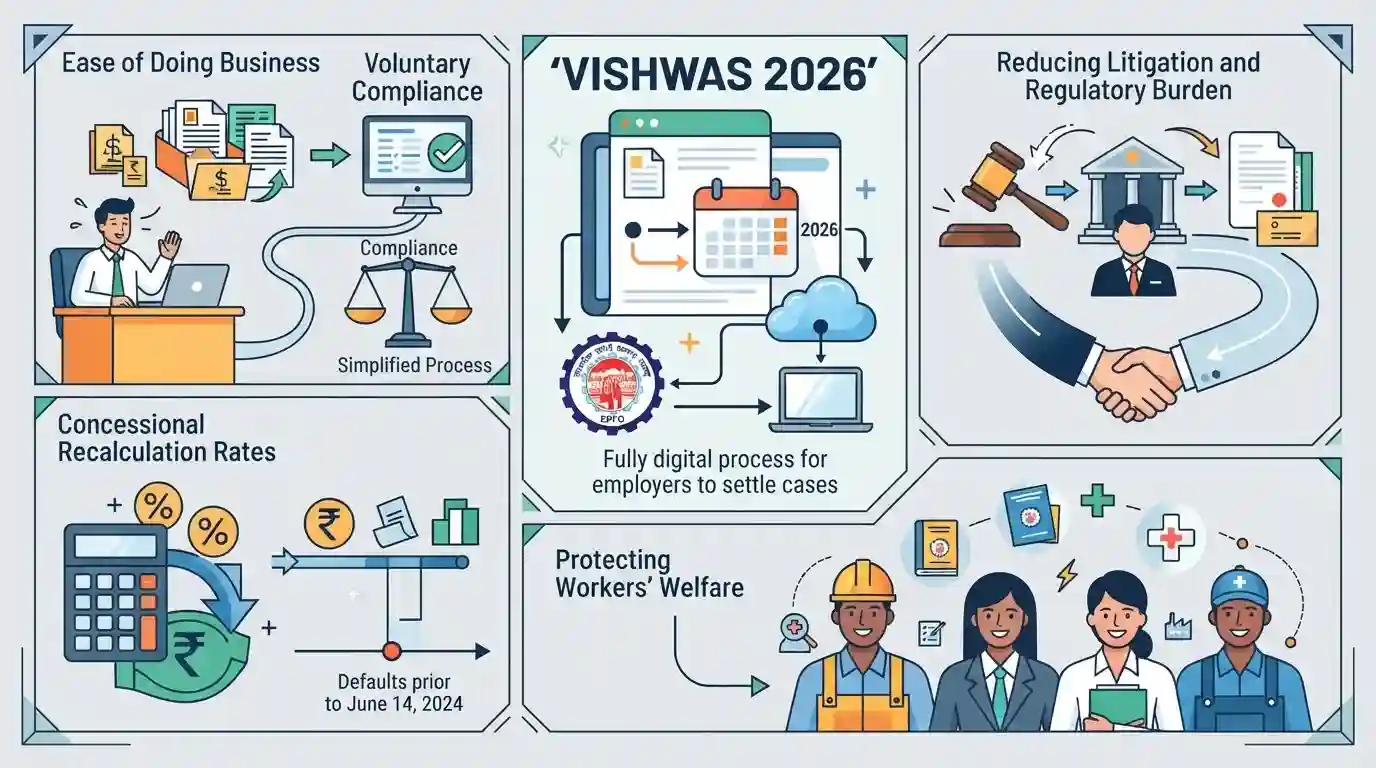
The Union Ministry of Labour and Employment has launched 'Vishwas 2026', a six-month, one-time dispute resolution scheme administered by the EPFO. The scheme allows employers to settle pending provident fund penalty and damages cases through a fully digital process. By offering concessional recalculation rates for defaults occurring prior to June 14, 2024, the government aims to encourage voluntary compliance, reduce long-pending litigation under the 1952 Act and the 2020 Code on Social Security, and facilitate the ease of doing business while protecting workers' welfare.
মূল বিষয়
- The Union Ministry of Labour and Employment has launched 'Vishwas 2026', a one-time dispute resolution scheme administered by the Employees' Provident Fund Organisation (EPFO), effective from June 29, 2026.
- The primary objective of the scheme is to facilitate amicable settlement of disputes involving penalties/damages levied on employers, promoting voluntary compliance, and reducing pending litigation while safeguarding employees' interests.
- It targets disputes under Section 14B of the Employees' Provident Funds and Miscellaneous Provisions Act, 1952, and Section 128 of the Code on Social Security, 2020.
- The scheme provides a fully digital, transparent, and time-bound settlement process that will remain operational for a period of six months from its notification.
- Under 'Vishwas 2026', damages or penalties for defaults pertaining to the period prior to June 14, 2024, will be recalculated at concessional rates to incentivize quick resolution: 0.25% per month for defaults up to 2 months; 0.50% per month for defaults of 2 to less than 4 months; and 1% per month for defaults exceeding 4 months.
- The scope of eligible disputes is broad, covering cases challenged in judicial forums, pending recovery certificates (RRC), cases with issued notices but no final orders, and cases where notices for damages are yet to be issued.
গুরুত্বপূর্ণ শব্দ
Vishwas 2026

A one-time, six-month dispute resolution scheme launched by the EPFO in 2026 to help employers settle pending provident fund penalty and damages cases at concessional rates through a fully digital process.
UPSC context
GS Paper III (Indian Economy & Labor Reforms); tests initiatives for ease of doing business and compliance.
EPF Scheme, 2026
A modernized provident fund framework notified under the Code on Social Security, 2020, replacing the 1952 scheme to streamline compliance, voluntary contributions, and digital record-keeping.
UPSC context
GS Paper III (Indian Economy); tests recent changes in social security regulations and digital governance in labor.
Code on Social Security, 2020
One of India’s four new labour codes that consolidates nine central laws to extend social security benefits, including provident funds and pensions, to organized, unorganized, gig, and platform workers.
UPSC context
GS Paper II (Social Justice) and GS Paper III (Economy); tests labor reforms and social protection.
Employees' Provident Fund Organisation (EPFO)
A statutory body under the Union Ministry of Labour and Employment that administers India's mandatory provident fund, pension, and deposit-linked insurance schemes for the organized workforce.
UPSC context
GS Paper III (Economy) & GS Paper II (Statutory Bodies); tests welfare institutions and retirement security.
Employees' Provident Funds and Miscellaneous Provisions Act, 1952
A key social security legislation in India that mandates compulsory retirement savings, pension support, and life insurance benefits for employees in establishments with 20 or more workers.
UPSC context
GS Paper II (Government Policies) and GS Paper III; tests historical social security frameworks for labor.
Union Ministry of Labour and Employment
The central government ministry responsible for protecting workers' interests, enforcing labour laws, ensuring social security, and promoting employment opportunities across both organized and unorganized sectors.
UPSC context
GS Paper II (Governance); tests executive ministries overseeing labor welfare, industrial relations, and social security.
প্রিলিমস ফাঁদ
Vishwas 2026 allows employers to settle disputes by seeking waivers on their primary, core provident fund contribution liabilities.
The scheme only recalculates damages and penalties (under Section 14B/128) at concessional rates; it does not waive or reduce the core principal provident fund contributions due to workers.
সংযুক্ত স্থির ধারণা
What is the Code on Social Security, 2020?
- Consolidation: Amalgamates nine central labor laws, including the EPF Act 1952, Maternity Benefit Act, and Unorganised Workers' Social Security Act.
- Universal Coverage: Expands the definition of employees to formally include gig workers, platform workers, and unorganized sector workers for social security benefits.
- Social Security Fund: Establishes a Social Security Fund to fund welfare schemes for unorganized and platform workers.
What is the constitutional framework governing labor in India?
- Seventh Schedule: Labor falls under the Concurrent List (List III) of the Seventh Schedule, enabling both Centre and States to legislate.
- Directive Principles (DPSPs): Article 41 (Right to work and public assistance) and Article 42 (Just and humane work conditions) guide state policies on labor welfare.
আন্তঃবিষয় প্যাটার্ন
Concurrent List + Labour Reforms
The transition of social security schemes relies on the Concurrent List, requiring synchronized state-level notifications to prevent jurisdictional bottlenecks in implementing the 2020 Codes.
Alternative Dispute Resolution + Fiscal Governance
Using short-term amnesty windows (like Vishwas 2026, following Vivad se Vishwas) reflects a growing governance trend of clearing legacy dispute backlogs to improve ease of doing business.

Transition to the 2020 Social Security Code and new EPFO withdrawal/minimum balance rules will likely feature as a core MSQ in 2026.
সংযুক্ত PYQ · 2
সংযুক্ত PYQ · 2
- 2021PrelimsGS1
With reference to casual workers employed in India, consider the following statements : 1. All casual workers are entitled for Employees Provident Fund coverage. 2. All casual workers are entitled for regular working hours and overtime payment. 3. The government can by a notification specify that an establishment or industry shall pay wages only through its bank account. Which of the above statements are correct?
- 2024MainsGS3
Discuss the merits and demerits of the four 'Labour Codes' in the context of labour market reforms in India. What has been the progress so far in this regard?
