Centre Issues Notification to Conduct Decennial Census in 2027
Source:Indian Express ↗
Why It Matters
The Census determines the statistical foundation for governance, welfare delivery, and political representation. For UPSC aspirants, understanding the direct linkage between the 2027 Census, the lifting of the delimitation freeze, and the realization of women's political reservation is critical for GS-2 (Polity and Social Justice) and GS-1 (Population dynamics).
Summary
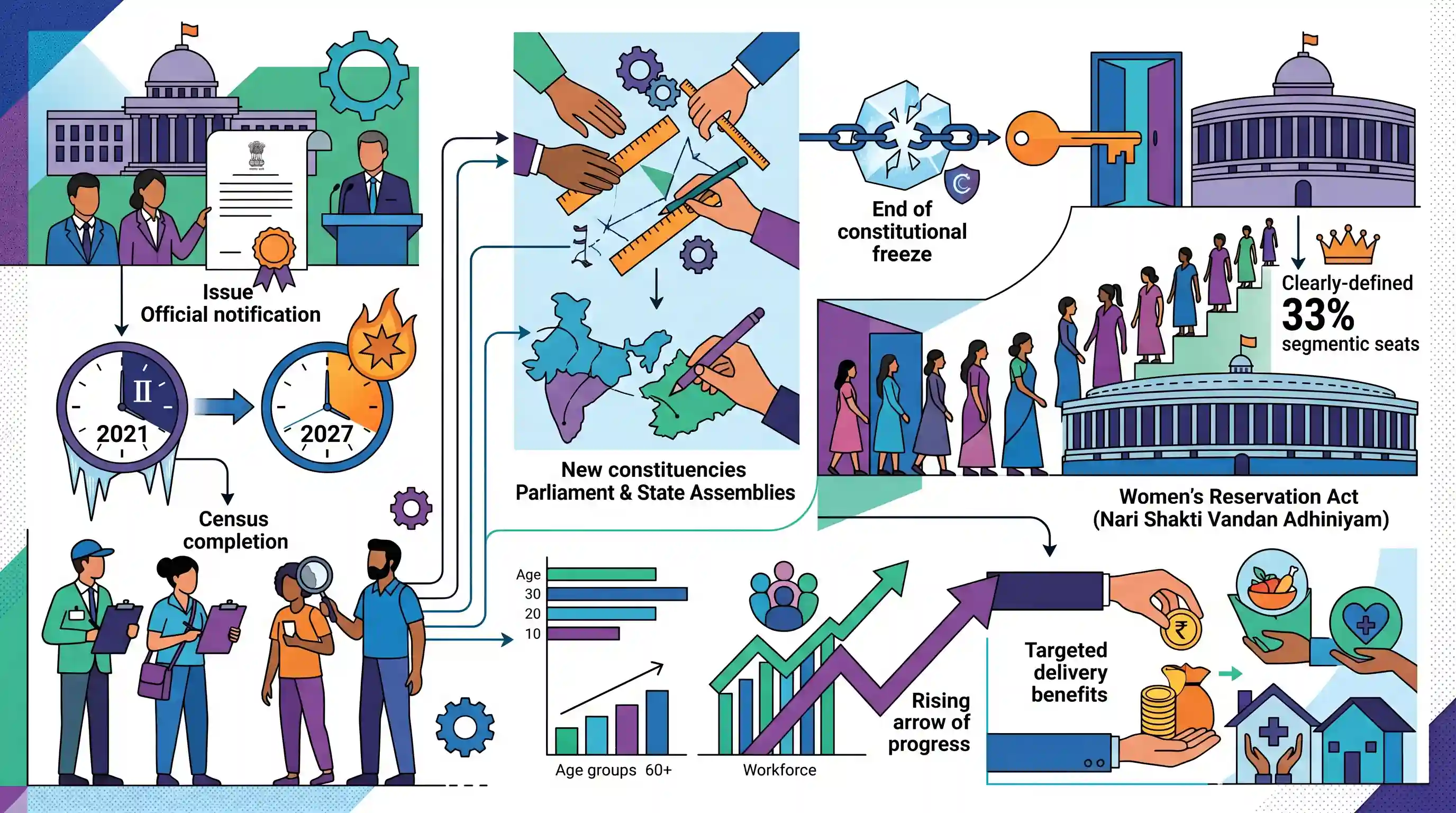
The Centre has issued a notification scheduling the next decennial Census for the year 2027, formally shifting the timeline of the delayed 2021 exercise. This decision holds immense political and administrative significance. The completion of the 2027 Census will trigger the delimitation of parliamentary and state assembly constituencies, as the current constitutional freeze on altering constituency boundaries applies until the publication of the first census conducted after 2026. Furthermore, the implementation of the Nari Shakti Vandan Adhiniyam (Women's Reservation Act)—which promises 33% reservation for women in the Lok Sabha and state assemblies—is legally tethered to the completion of this upcoming delimitation. The delayed data collection also impacts the mapping of India's demographic dividend and the targeted delivery of welfare policies.
Key Points
- The Union Government has officially issued a notification to conduct the decennial Census in 2027, replacing the delayed 2021 Census.
- The Census was originally indefinitely postponed citing the COVID-19 pandemic and subsequent administrative delays.
- The 2027 Census is crucial as it will lift the freeze on delimitation (which is pegged to the first census after 2026), leading to the redrawing of Lok Sabha and State Assembly constituencies.
- The implementation of the Nari Shakti Vandan Adhiniyam, which mandates a 33% reservation for women in legislative bodies, is contingent upon the completion of this post-2026 delimitation exercise.
Important Terms
Nari Shakti Vandan Adhiniyam

Formally the 106th Constitutional Amendment Act, 2023, it mandates 33% reservation for women in the Lok Sabha and State Legislative Assemblies, including Delhi, implemented following the post-2026 census and delimitation.
UPSC context
GS Paper II (Polity/Governance); tests knowledge of gender-based affirmative action and constitutional amendments.
Delimitation Commission
An independent, high-powered body appointed by the President to redraw boundaries of territorial constituencies based on the latest census data to ensure equal representation ('one person, one vote').
UPSC context
GS Paper II (Parliament/Elections); critical for understanding seat allocation and federal balance between states.
Census Act, 1948
The legal framework governing the conduct of the decennial population survey. It ensures the confidentiality of individual data and mandates that citizens provide truthful information to census officials.
UPSC context
GS Paper II (Governance); tests the statutory basis for administrative exercises and data privacy in India.
84th Constitutional Amendment Act, 2001
The constitutional change that extended the freeze on altering the total number of seats in the Lok Sabha and State Assemblies until after the first census following the year 2026.
UPSC context
GS Paper II (Indian Constitution); essential for understanding the timeline of electoral reforms and delimitation.
Representation of the People Act, 1950
A law providing the legal basis for seat allocation in legislatures, the preparation of electoral rolls, and the procedure for redrawing the boundaries of constituencies (delimitation).
UPSC context
GS Paper II (Elections); directly mentioned in the UPSC syllabus under "Salient features of the RPA."
Registrar General and Census Commissioner of India
An office under the Ministry of Home Affairs responsible for conducting the decennial Census and maintaining the National Population Register (NPR).
UPSC context
GS Paper II (Governance); important for knowing the institutional machinery behind major national surveys.
Prelims Trap
The Nari Shakti Vandan Adhiniyam comes into effect immediately upon the publication of the 2027 Census data.
The women's reservation is strictly contingent upon the completion of the delimitation exercise that follows the Census, not the mere publication of the Census itself.
Static Concepts Connected
What is the constitutional basis and authority of the Delimitation Commission?
- Constitutional Mandate: Under Article 82 of the Constitution, Parliament enacts a Delimitation Act after every census to readjust the allocation of seats and territorial constituencies.
- Absolute Authority: Its orders have the force of law, take effect on a date specified by the President, and cannot be challenged in any court.
- Composition: Appointed by the President, it typically comprises a retired Supreme Court judge, the Chief Election Commissioner, and respective State Election Commissioners.
What is the legal and constitutional framework governing the Census in India?
- Union Subject: Population Census is exclusively a Union subject, listed under Entry 69 of the Union List in the Seventh Schedule (Article 246).
- Statutory Backing: The exercise is legally conducted under the provisions of the Census Act, 1948, ensuring a statutory basis for the data collection.
- Data Confidentiality: The 1948 Act guarantees absolute data confidentiality; individual census information cannot be accessed by other government agencies or used as evidence in courts.
Cross-Topic Patterns
Delimitation vs. Fiscal Federalism
Impending delimitation raises concerns among southern states that their successful population control measures will inadvertently reduce their parliamentary representation and alter federal resource allocation.
Welfare Targeting and Stale Data
Delayed data collection creates systemic exclusion errors in schemes like the National Food Security Act, highlighting the link between decennial census updates and effective poverty targeting.

Expect a 2026 prelims question interlinking the 84th and 106th Amendments with the unchallengeable powers of the Delimitation Commission.
Linked PYQs · 4
Linked PYQs · 4
- 2011PrelimsGS1
India is regarded as a country with “Demographic Dividend”. This is due to
- 2024MainsGS1
What is the concept of a 'demographic winter'? Is the world moving towards such a situation? Elaborate.
- 2023MainsGS2
Discuss the contribution of civil society groups for women's effective and meaningful participation and representation in state legislatures in India.
- 2019MainsGS1
“Empowering women is the key to control population growth.” Discuss.
