Government issues notice to Telegram over digital content piracy
Source:Indian Express ↗
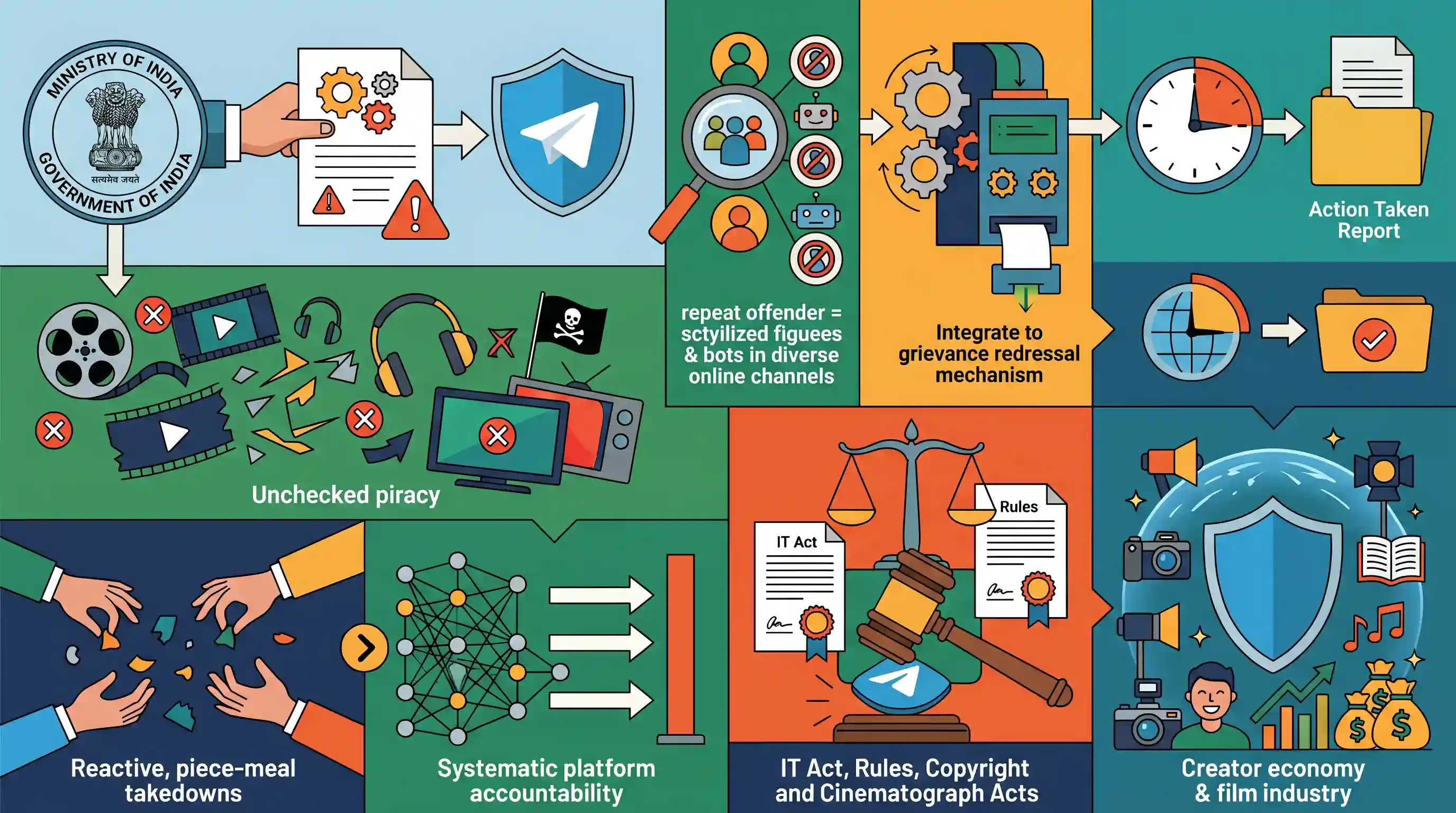
Why It Matters
This development highlights the evolving Indian regulatory landscape on intermediary liability and cybersecurity. It marks a shift from reactive content moderation to proactive platform accountability under the IT Rules, 2021. It carries high significance for Mains GS-3 (Internal Security/Technology) regarding how encrypted platforms handle illegal activities, and Economy/S&T regarding the protection of intellectual property rights (IPR) and creator economies against digital piracy.
Summary
The Ministry of Information and Broadcasting (I&B) has served a formal notice to Telegram over the unchecked circulation of pirated films, OTT media, and audio-visual material on its platform. Telegram has been directed to take decisive corrective action, target repeat infringers (channels, bots, and admins), establish a clear grievance redressal mechanism, and submit an Action Taken Report (ATR) within 15 days. Highlighting a critical regulatory shift from reactive, piece-meal takedowns to systematic platform accountability, the government warned Telegram that a purely passive response violates the due diligence requirements mandated for intermediaries under the IT Act, 2000, and IT Rules, 2021. The notice also emphasized that copyright infringement constitutes a criminal offense under the Copyright Act, 1957, and the Cinematograph Act, 1952. This regulatory push is meant to shield India's rapidly growing creator economy and film industry from the financial ravages of digital piracy.
Key Points
- The Ministry of Information and Broadcasting (I&B) issued a directive to the instant messaging platform Telegram to curb the widespread dissemination of pirated films, OTT content, and other audio-visual material on its platform.
- Telegram has been ordered to take corrective measures and submit an Action Taken Report (ATR) within 15 days, which must outline the systems established for proactive detection, reporting, access disabling, and removal of infringing content.
- The notice demands that Telegram act against repeat infringers, including channels, groups, bots, accounts, administrators, and associated entities, and share details of its grievance redressal mechanism for law enforcement and content creators.
- This directive signals a major policy shift from a piecemeal, channel-by-channel takedown approach (under which over 3,000 Telegram channels were previously blocked) to a platform accountability-based framework.
- The I&B Ministry reminded Telegram that under the IT Act, 2000 and the IT Rules, 2021, intermediaries must actively demonstrate due diligence. Relying purely on reactive, government-initiated takedowns is insufficient to qualify for intermediary safe harbour protections.
- The Ministry emphasized that copyright infringement is a criminal offense under the Copyright Act, 1957 and the Cinematograph Act, 1952, warning that non-compliance could invite stringent legal action.
- The intervention aims to protect the economic interests of India's creator economy, broadcasting sector, OTT platforms, filmmakers, and distributors who lose substantial revenues to digital piracy.
Important Terms
Information Technology Act, 2000

India's primary legislation governing cybercrime, e-commerce, digital signatures, and electronic records, establishing the baseline legal framework for digital activities and platform regulations.
UPSC context
GS Paper 3 (Cyber Security) and GS Paper 2 (Governance). Essential for understanding state regulatory powers and digital governance frameworks in India.
Information Technology (Intermediary Guidelines and Digital Media Ethics Code) Rules, 2021
Subordinate legislation under the IT Act mandating due diligence, grievance redressal, and compliance standards for social media intermediaries, OTT platforms, and digital news publishers to retain immunity.
UPSC context
GS Paper 2 (Polity and Governance) and GS Paper 3 (Cyber Security). Tests understanding of social media regulation, safe harbour, and privacy vs security.
Copyright Act, 1957
The primary law protecting intellectual property rights (IPR) of original literary, dramatic, musical, artistic works, cinematograph films, and sound recordings in India, granting exclusive rights to creators.
UPSC context
GS Paper 3 (Intellectual Property Rights). Vital for analyzing piracy, economic rights of creators, and India's compliance with global IPR standards.
Cinematograph Act, 1952
The central legislation governing the certification, exhibition, and regulation of films in India, establishing the Central Board of Film Certification (CBFC) and prescribing anti-piracy penal provisions.
UPSC context
GS Paper 2 (Polity) and GS Paper 3 (Economy). Relevant for regulatory bodies, censorship debates, and the economic impacts of digital film piracy.
Telegram
A cloud-based instant messaging application operating as a digital intermediary, under intense scrutiny regarding accountability, encryption challenges, and the potential loss of safe harbour protections.
UPSC context
GS Paper 3 (Internal Security/Cyber Security). Serves as a key case study on intermediary liability, content moderation, and state regulatory enforcement.
Prelims Trap
Only MeitY holds the statutory authority to issue notices or direct content takedowns to digital intermediaries under India's IT framework.
While MeitY administers Part II (intermediary guidelines), MIB administers Part III (digital news/OTT) and holds explicit powers to direct takedowns of pirated films under the Cinematograph (Amendment) Act, 2023.
Static Concepts Connected
What is 'Safe Harbour' protection under Section 79 of the IT Act, 2000?
- Conditional Immunity: Protects intermediaries from legal liability for unlawful third-party content hosted on their platforms, provided they act as neutral pipelines.
- Due Diligence Mandate: Platforms must strictly adhere to the government-prescribed due diligence requirements to claim this legal shield.
- Takedown Timeline: Immunity is lost if the intermediary fails to expeditiously remove access to unlawful content within 36 hours of receiving 'actual knowledge'.
How is administrative oversight split under the IT Rules, 2021?
- MeitY Jurisdiction: Administers Part II of the rules, focusing on general intermediary due diligence, social media platforms, and cyber security reporting.
- MIB Jurisdiction: Administers Part III, which regulates the Code of Ethics, content classification, and grievance redressal for digital news and OTT platforms.
Cross-Topic Patterns
IPR enforcement vs. Encryption privacy
Enforcing proactive piracy detection on messaging apps forces a shift toward scanning group contents, raising concerns over user privacy, mass surveillance, and end-to-end encryption.
Creative economy as soft power
Plugging economic leakages from digital piracy directly boosts the domestic revenue of the creative sector, augmenting India's soft power exports and formal employment.

2026 exam may test the dual control of IT Rules 2021 alongside criminal penalties introduced by the Cinematograph (Amendment) Act 2023.
Linked PYQs · 3
Linked PYQs · 3
- 2024MainsGS3
Social media and encrypting messaging services pose a serious security challenge. What measures have been adopted at various levels to address the security implications of social media? Also suggest any other remedies to address the problem.
- 2014MainsGS3
In a globalized world, Intellectual Property Rights assume significance and are a source of litigation. Broadly distinguish between the terms-Copyrights, Patents and Trade Secrets.
- 2020PrelimsGS1
In India, under cyber insurance for individuals, which of the following benefits are generally covered, in addition to payment for the loss of funds and other benefits? 1. Cost of restoration of the computer system in case of malware disrupting access to one's computer 2. Cost of a new computer if some miscreant wilfully damages it, if proved so 3. Cost of hiring a specialized consultant to minimize the loss in case of cyber extortion 4. Cost of defence in the Court of Law if any third party files a suit Select the correct answer using the code given below:
