Centre Issues Guidelines to Colocate Anganwadis with Schools
Source:The Hindu ↗
Why It Matters
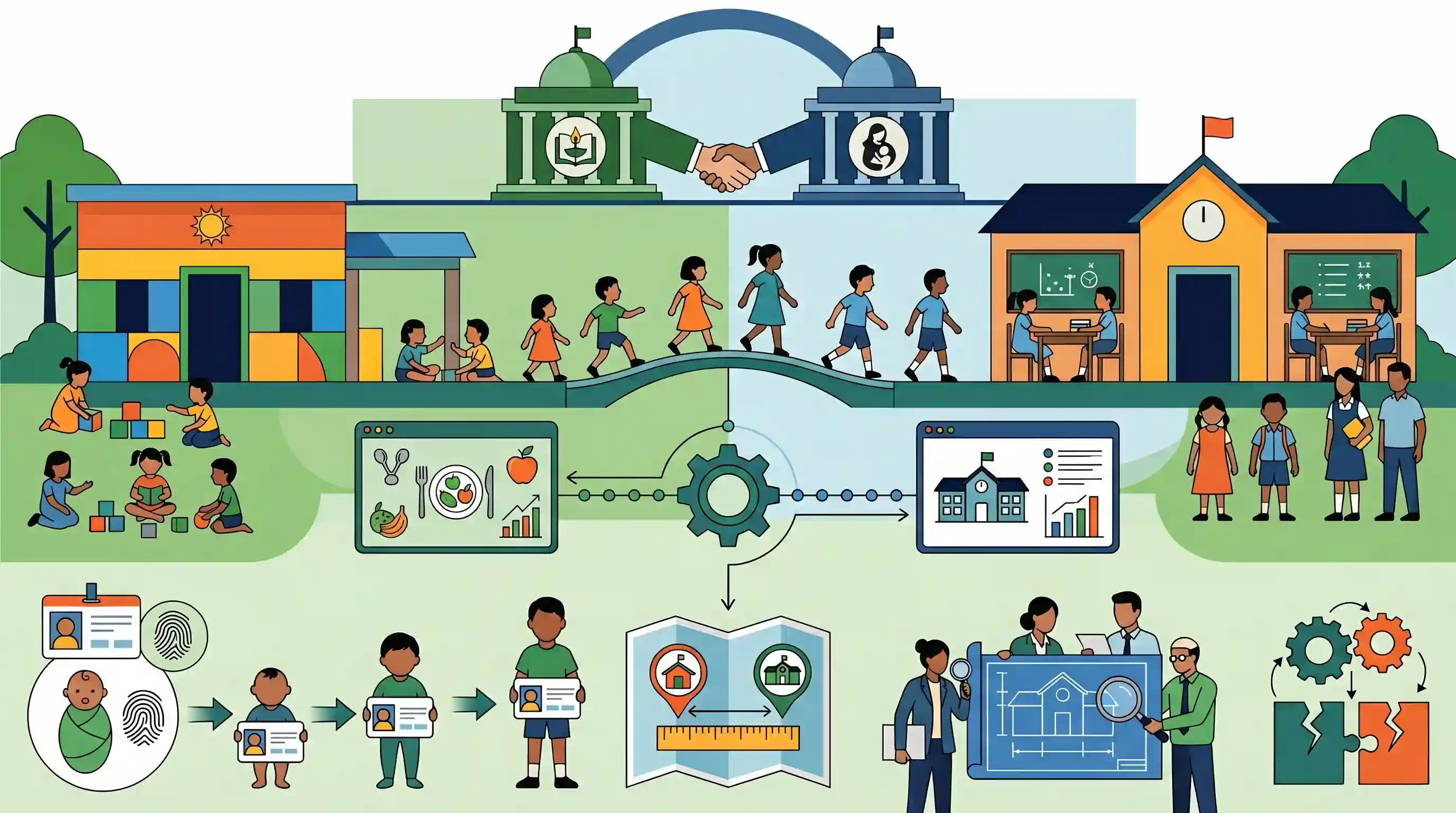
Integrating Anganwadis with primary schools is a significant structural reform in early childhood education. It highlights the practical application of inter-ministerial coordination and e-governance (database interoperability) to improve service delivery and track human resource development from birth.
Summary
The Union government has introduced joint guidelines from the Ministry of Education and the Ministry of Women and Child Development to co-locate 11 lakh Anganwadi Centres with nearby primary schools. This move aims to bridge the gap between early childhood care and formal schooling (Class 1) through curriculum alignment ('Aadharshila') and database interoperability between the Poshan Tracker and UDISE+. Furthermore, the plan includes providing children with a lifelong APAAR ID from birth to streamline tracking and development. The guidelines also establish distance limits to ensure accessibility and mandate the critical evaluation of co-location models to overcome infrastructural and functional convergence challenges.
Key Points
- The Union government has issued guidelines to co-locate nearly 11 lakh Anganwadi Centres (AWCs) with primary schools to ensure continuity in early childhood education.
- The initiative is a collaborative effort between the Ministry of Education and the Ministry of Women and Child Development, promoting curriculum alignment under the 'Aadharshila' framework.
- To avoid data duplication, the Poshan Tracker and UDISE+ databases will be made interoperable, with plans to assign a lifelong APAAR ID to children starting from birth.
- Relocated AWCs must ensure pregnant women and children travel no more than 500 meters in urban areas and 1 km in rural areas, with a maximum of two AWCs co-located in one school.
- The guidelines seek to address current challenges such as limited functional convergence despite physical proximity and the lack of basic facilities for AWCs operating on school premises.
Important Terms
APAAR ID

A lifelong 12-digit "One Nation, One Student ID" under NEP 2020. It digitally stores academic records, credits, and certificates, enabling seamless student mobility across institutions and states through the Academic Bank of Credits.
UPSC context
GS II: Government Policies/Education. Tests understanding of digital governance and student data portability within the national educational ecosystem.
Aadharshila
The National Curriculum for Early Childhood Care and Education (2024) released by MWCD. It provides a 48-week play-based framework for 3-6 year olds in Anganwadis to build foundational literacy and numeracy.
UPSC context
GS II: Education/Social Justice. Tests knowledge of NEP 2020 implementation and strategies to bridge the gap between pre-school and primary education.
Poshan Tracker
A real-time ICT platform for monitoring nutrition service delivery at Anganwadi Centres. It tracks growth indicators like stunting and wasting to ensure transparency and accountability in the Integrated Child Development Services (ICDS).
UPSC context
GS II: Governance/Social Justice. Tests ability to discuss technology's role in addressing malnutrition and improving last-mile welfare delivery.
UDISE+
The Unified District Information System for Education Plus is a real-time digital database for school education. It captures comprehensive data on infrastructure, enrollment, and teachers to support evidence-based planning and policy formulation.
UPSC context
GS II: Education/Governance. Tests awareness of data-driven tools used to assess educational outcomes and infrastructure gaps across India.
Ministry of Education (MoE)
The Union ministry responsible for formulating education policies and overseeing the learning continuum. It collaborates with MWCD to integrate early childhood care (Anganwadis) into the formal primary school framework.
UPSC context
GS II: Governance/Education. Tests knowledge of institutional roles in implementing NEP 2020's foundational learning reforms.
Ministry of Women and Child Development (MWCD)
The nodal ministry for the welfare of women and children. it administers Anganwadi services and the Poshan Tracker, providing critical nutrition, health, and early education to the 0-6 age group.
UPSC context
GS II: Social Justice/Governance. Tests understanding of convergence between welfare and education for vulnerable early childhood populations.
UIDAI
A statutory authority under MeitY that issues Aadhaar numbers. It provides the essential biometric-based authentication infrastructure required for student IDs (APAAR) and tracking nutrition beneficiaries in the Poshan Tracker.
UPSC context
GS II: Statutory Bodies/Polity. Tests knowledge of the institutional framework for digital identity and its role in preventing welfare leakages.
Prelims Trap
APAAR ID is exclusively assigned to students upon entering formal schooling (Class 1) or higher education.
The new guidelines plan to assign the lifelong APAAR ID to children starting from birth or Anganwadi entry to track early childhood development, not just from Class 1.
Static Concepts Connected
What are the core services under the ICDS (Mission Saksham Anganwadi)?
- Health: Immunization, health check-ups, and referral services coordinated with the public health system (MoHFW).
- Nutrition: Supplementary nutrition targeting children (6 months to 6 years), pregnant women, and lactating mothers.
- Pre-school Education: Non-formal early childhood care and education for children aged 3 to 6 years.
How does NEP 2020 alter the educational age framework compared to RTE?
- RTE Act 2009: Guarantees the fundamental right to education specifically for the 6-14 years age group, starting from Class 1.
- NEP 2020: Introduces a 5+3+3+4 structure that explicitly includes 3 years of Early Childhood Care and Education (ages 3-6) within the 'Foundational Stage'.
- Structural Implication: Demands structural and pedagogical integration of Anganwadis (3-6 years) with formal Primary Schools to ensure seamless transition.
Cross-Topic Patterns
DPI & Welfare Database Interoperability
Integrating UDISE+ (Education) with Poshan Tracker (MWCD) reflects the broader push for Digital Public Infrastructure to eliminate administrative silos in targeted welfare delivery.
Cognition, Nutrition & Human Capital
Co-locating Anganwadis and schools addresses a recurring GS2 theme: early childhood malnutrition (hidden hunger) permanently limiting foundational learning and demographic dividend potential.

Prelims 2026 is highly likely to test the functional differences and nodal ministries of APAAR ID, UDISE+, and the Poshan Tracker.
Linked PYQs · 3
Linked PYQs · 3
- 2024MainsGS2
Poverty and malnutrition create a vicious cycle, adversely affecting human capital formation. What steps can be taken to break the cycle ?
- 2023MainsGS2
The crucial aspect of development process has been the inadequate attention paid to Human Resource Development in India. Suggest measures that can address this inadequacy.
- 2024MainsGS2
e-governance is not just about the routine application of digital technology in service delivery process. It is as much about multifarious interactions for ensuring transparency and accountability. In this context evaluate the role of the 'Interactive Service Model' of e-governance.
