Centre issues draft rules to ease tree felling on farmland
Source:The Hindu ↗
Why It Matters
UPSC frequently tests policies that balance economic growth (doubling farmers' income, easing timber trade) with environmental conservation (carbon sinks, climate change mitigation). The transition from restrictive forest laws to liberalized agroforestry policies on non-forest lands is a key theme for GS3 Agriculture and Environment.
Summary
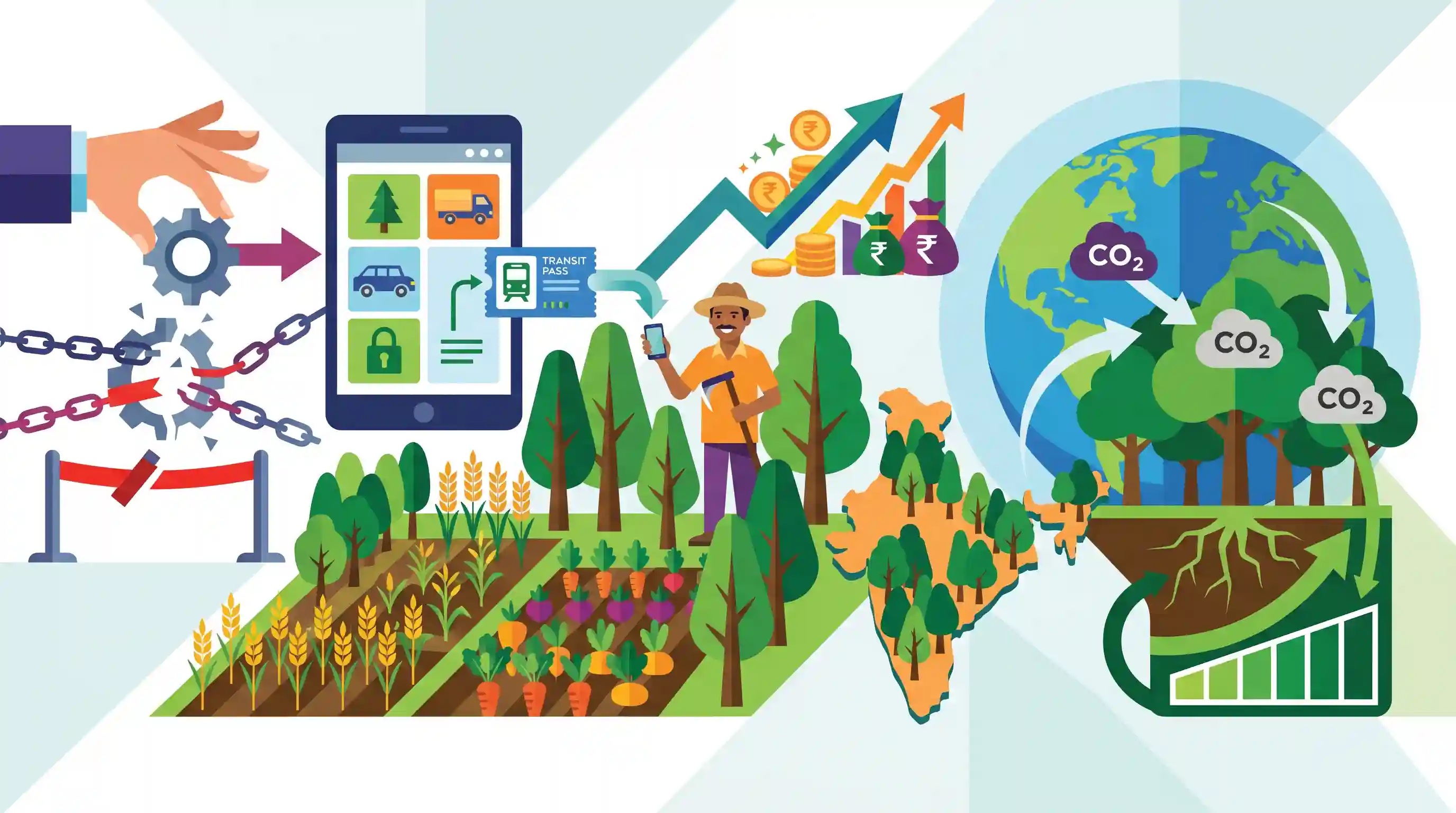
The Union government has released draft rules to simplify the process of felling trees on agricultural and private lands, aiming to significantly boost agroforestry. By removing restrictive bureaucratic hurdles and integrating transit passes with the National Timber Management System (NTMS) portal, the initiative seeks to make tree farming a lucrative option for farmers, thereby helping to double their incomes. Ecologically, this shift encourages the expansion of tree cover outside traditional forests, which is vital for meeting India's Nationally Determined Contributions (NDCs) target of creating an additional carbon sink of 2.5 to 3 billion tonnes of CO2 equivalent by 2030.
Key Points
- The Centre issued draft 'Model Rules for Felling of Trees in Agricultural Lands' to ease regulations on felling trees grown on private and agricultural lands.
- The move aims to promote agroforestry, helping to double farmers' incomes by making tree farming more economically viable and less bureaucratic.
- Timber transport will be streamlined through the National Timber Management System (NTMS) portal to facilitate pan-India movement.
- This policy aligns with India's climate goals to increase tree cover outside forests and create an additional carbon sink of 2.5 to 3 billion tonnes of CO2 equivalent by 2030.
Important Terms
Model Rules for Felling of Trees in Agricultural Lands

Union government guidelines aimed at simplifying the registration, harvesting, and transit of trees grown on private farmlands to reduce bureaucratic delays and incentivize tree farming.
UPSC context
GS-III: Agriculture/Agroforestry. Tests knowledge of regulatory reforms for doubling farmer income and enhancing ecological cover.
National Timber Management System (NTMS)
A unified digital portal for the online registration of plantations and issuance of felling permits and transit passes, ensuring transparency and "Ease of Doing Business" for timber farmers.
UPSC context
GS-II/III: E-Governance in Agriculture. Tests awareness of digital tools used to streamline agricultural logistics and regulatory compliance.
Nationally Determined Contributions (NDCs)
Climate action targets committed under the Paris Agreement. India’s goals include reducing emissions intensity by 45% and creating an additional carbon sink of 2.5–3 billion tonnes of CO2 equivalent by 2030.
UPSC context
GS-III: Environment & Climate Change. Tests understanding of India’s international obligations and domestic mitigation strategies.
Ministry of Environment, Forest and Climate Change (MoEFCC)
The nodal central ministry responsible for formulating and coordinating policies on environmental protection, forest conservation, and climate change mitigation in India.
UPSC context
GS-II: Government Policies. Tests familiarity with the primary institutional body governing India’s environmental and forestry sectors.
Prelims Trap
The Model Rules deregulate tree felling within reserved and protected forests to boost income.
The rules apply strictly to agricultural and private lands to promote agroforestry, not natural forests. Felling in reserved or protected forests remains strictly regulated by conservation laws.
Static Concepts Connected
What is the difference between Agroforestry and Farm Forestry?
- Agroforestry: Integrates trees with crops and/or livestock on the same land to maximize ecological and economic interactions.
- Farm Forestry: Growing trees primarily for commercial timber or fuelwood on private agricultural lands without mandatory crop integration.
What are India's specific forestry commitments under its Nationally Determined Contributions (NDCs)?
- The Target: Creating an additional carbon sink of 2.5 to 3 billion tonnes of CO2 equivalent by 2030.
- The Mechanism: Achieved through increasing both forest and tree cover, placing heavy reliance on expanding Trees Outside Forests (TOF).
Cross-Topic Patterns
Bamboo amendment and non-forest lands
Connects to the 2017 Indian Forest Act amendment removing bamboo grown on non-forest areas from the 'tree' definition, mirroring current deregulation efforts to incentivize private agroforestry.
Digital agriculture via One Nation-One Pass
The National Timber Management System (NTMS) mirrors e-NAM's logic by removing inter-state trade barriers, applying digital public infrastructure to timber transport to maximize farmer profits.

A 2026 prelims question will likely test 'Trees Outside Forests' (TOF) and NTMS as key mechanisms for India's 2030 NDC carbon sink goals.
Linked PYQs · 3
Linked PYQs · 3
- 2019PrelimsGS1
Consider the following statements: 1. As per recent amendment to the Indian Forest Act, 1927, forest dwellers have the right to fell the bamboos grown on forest areas. 2. As per the Scheduled Tribes and Other Traditional Forest Dwellers (Recognition of Forest Rights) Act, 2006, bamboo is a minor forest produce. 3. The Scheduled Tribes and Other Traditional Forest Dwellers (Recognition of Forest Rights) Act, 2006 allows ownership of minor forest produce to forest dwellers. Which of the statements given above is/are correct?
- 2023MainsGS3
How does e-Technology help farmers in production and marketing of agricultural produce? Explain it.
- 2023PrelimsGS1
Consider the following activities: 1. Spreading finely ground basalt rock on farmlands extensively 2. Increasing the alkalinity of oceans by adding lime 3. Capturing carbon dioxide released by various industries and pumping it into abandoned subterranean mines in the form of carbonated waters How many of the above activities are often considered and discussed for carbon capture and sequestration?
