Bill to Increase Supreme Court Judge Strength Introduced in Parliament
Source:The Hindu ↗
কেন এটি গুরুত্বপূর্ণ
This development directly links to Article 124(1) of the Indian Constitution, under which Parliament holds the exclusive power to alter the strength of the Supreme Court. It highlights the executive-legislative measures to counter docket explosion and judicial pendency, and touches upon the legislative process of replacing ordinances (Article 123) with Acts of Parliament.
সারসংক্ষেপ
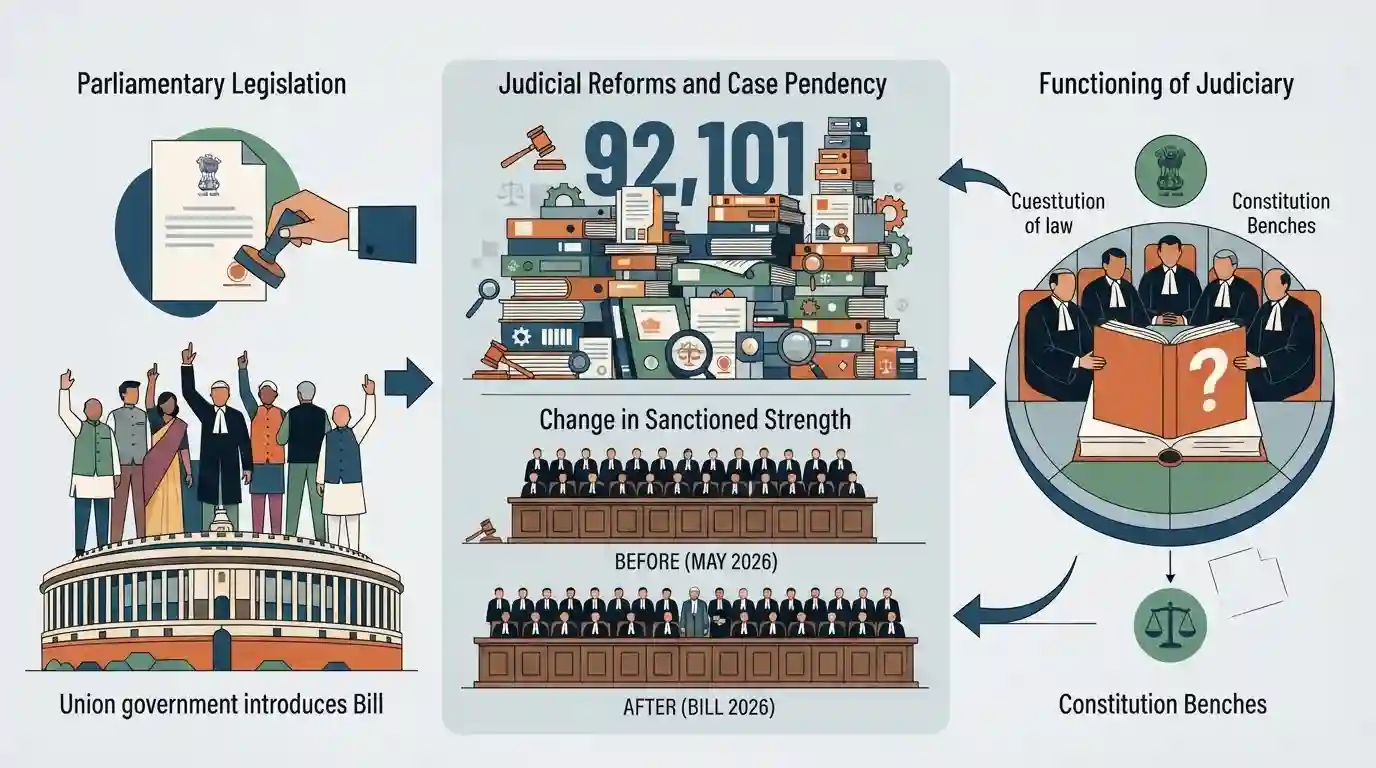
The Union government has introduced the Supreme Court (Number of Judges) Amendment Bill, 2026, in the Lok Sabha to increase the sanctioned strength of Supreme Court judges from 34 to 38 (37 excluding the Chief Justice of India). Replacing an ordinance promulgated in May 2026, the Bill aims to tackle the mounting pendency of cases (92,101 cases as of January 1, 2026) and facilitate the more regular constitution of Constitution Benches to address substantial questions of law.
মূল বিষয়
- The Union government has introduced the Supreme Court (Number of Judges) Amendment Bill, 2026 in the Lok Sabha to increase the court's sanctioned strength from 34 to 38 judges (including the Chief Justice of India).
- The Bill seeks to replace a Presidential Ordinance promulgated in May 2026, under which four judges have already been appointed.
- The expansion is driven by a critical backlog of cases, with pendency at the Supreme Court standing at 92,101 cases as of January 1, 2026.
- In 2025, the gap between case filing (75,410 new cases) and case disposal (65,615 cases) widened, making docket management difficult, especially for older cases and those requiring larger benches.
- The increased strength is expected to help the Chief Justice of India constitute Constitution Benches more regularly to resolve substantial questions of law.
- The financial memorandum estimates a recurring annual expenditure of ₹10.56 crore and a one-time expenditure of ₹3.47 crore to support the four new judicial posts and infrastructure.
গুরুত্বপূর্ণ শব্দ
Supreme Court (Number of Judges) Amendment Bill, 2026

A bill introduced in Parliament to increase the sanctioned strength of the Supreme Court of India from 34 to 38 judges (including the CJI) to tackle mounting case backlog.
UPSC context
GS Paper II: Indian Judiciary. Relates to structural judicial reforms, case pendency management, and parliamentary control over judicial strength.
Supreme Court (Number of Judges) Amendment Ordinance, 2026
An executive order promulgated by the President in May 2026 to temporarily increase the Supreme Court's judge strength, which the subsequent July 2026 parliamentary Bill seeks to replace.
UPSC context
GS Paper II: Executive & Judiciary. Tests the ordinance-making power of the President (Article 123) and legislative replacement processes.
Supreme Court (Number of Judges) Act, 1956
The principal parliamentary legislation that prescribes the maximum number of judges in the Supreme Court of India, amended periodically to scale judicial capacity with caseload demands.
UPSC context
GS Paper II: Parliament & Judiciary. Demonstrates how Parliament exercises its constitutional authority under Article 124(1) to determine judicial strength.
Article 124 of the Constitution of India
The constitutional provision that establishes the Supreme Court of India and empowers Parliament to determine the number of its judges by enacting federal legislation.
UPSC context
GS Paper II: Constitutional Provisions. Crucial for understanding the constitutional origin of the judiciary and the distribution of powers.
Constitution Bench
A special bench of the Supreme Court consisting of five or more judges, constituted under Article 145(3) to decide cases involving substantial questions of constitutional law.
UPSC context
GS Paper II: Judicial Functioning. Tests knowledge of the supreme court’s role as the final interpreter of the Constitution.
Case Pendency
The volume of unresolved judicial matters awaiting disposal across various levels of the judiciary, highlighting structural delays and capacity deficits in India's legal administration.
UPSC context
GS Paper II: Judicial Reforms. A critical governance issue testing analytical skills on judicial backlog, efficiency, and access to justice.
প্রিলিমস ফাঁদ
The President of India has the constitutional authority to increase the sanctioned strength of both the Supreme Court and High Courts.
While Supreme Court strength is strictly increased by Parliament via law (Article 124(1)), High Court strength is determined by the President from time to time (Article 216). Aspirants often conflate these two mechanisms.
সংযুক্ত স্থির ধারণা
Under which constitutional provision is the strength of the Supreme Court of India determined?
- Constitutional Basis: Article 124(1) empowers Parliament to prescribe the number of judges by law. Until Parliament legislates, the Constitution originally fixed it at 8 (CJI + 7 judges).
- Legislative Tool: Parliament regulates and increases this strength by amending the Supreme Court (Number of Judges) Act, 1956.
What is a Constitution Bench and what are its constitutional requirements?
- Minimum Strength: Article 145(3) mandates a minimum of five judges to hear cases involving a substantial question of law as to the interpretation of the Constitution.
- Presidential Reference: They are also constituted for hearing advisory references made by the President of India under Article 143.
- Master of Roster: The Chief Justice of India has the sole prerogative (as Master of the Roster) to constitute these benches and allocate cases to them.
আন্তঃবিষয় প্যাটার্ন
Ordinance route for judicial infrastructure
Using Article 123 to expand judicial strength highlights the executive's role in addressing systemic pendency before parliamentary oversight begins.
Executive-led expansion meets Collegium appointments
Parliament determines the number of posts, but the Collegium retains binding authority over actual appointments, balancing structural administration with judicial independence.

Constitutional distinction between SC strength expansion (Parliament) and HC strength determination (President) likely for Prelims 2026.
সংযুক্ত PYQ · 2
সংযুক্ত PYQ · 2
- 2014PrelimsGS1
The power to increase the number of judges in the Supreme Court of India is vested in
- 2025MainsGS2
Discuss the evolution of collegium system in India. Critically examine the advantages and disadvantages of the system of appointment of the Judges of the Supreme Court of India and that of the USA.
