Centre Introduces AI Verification for Rural Jobs Attendance App
Source:The Hindu ↗
কেন এটি গুরুত্বপূর্ণ
This development is a classic case study for GS2 regarding the intersection of digital public infrastructure, e-governance, transparency, and the challenges of technological inclusion for vulnerable rural populations dependent on welfare schemes like MGNREGS.
সারসংক্ষেপ
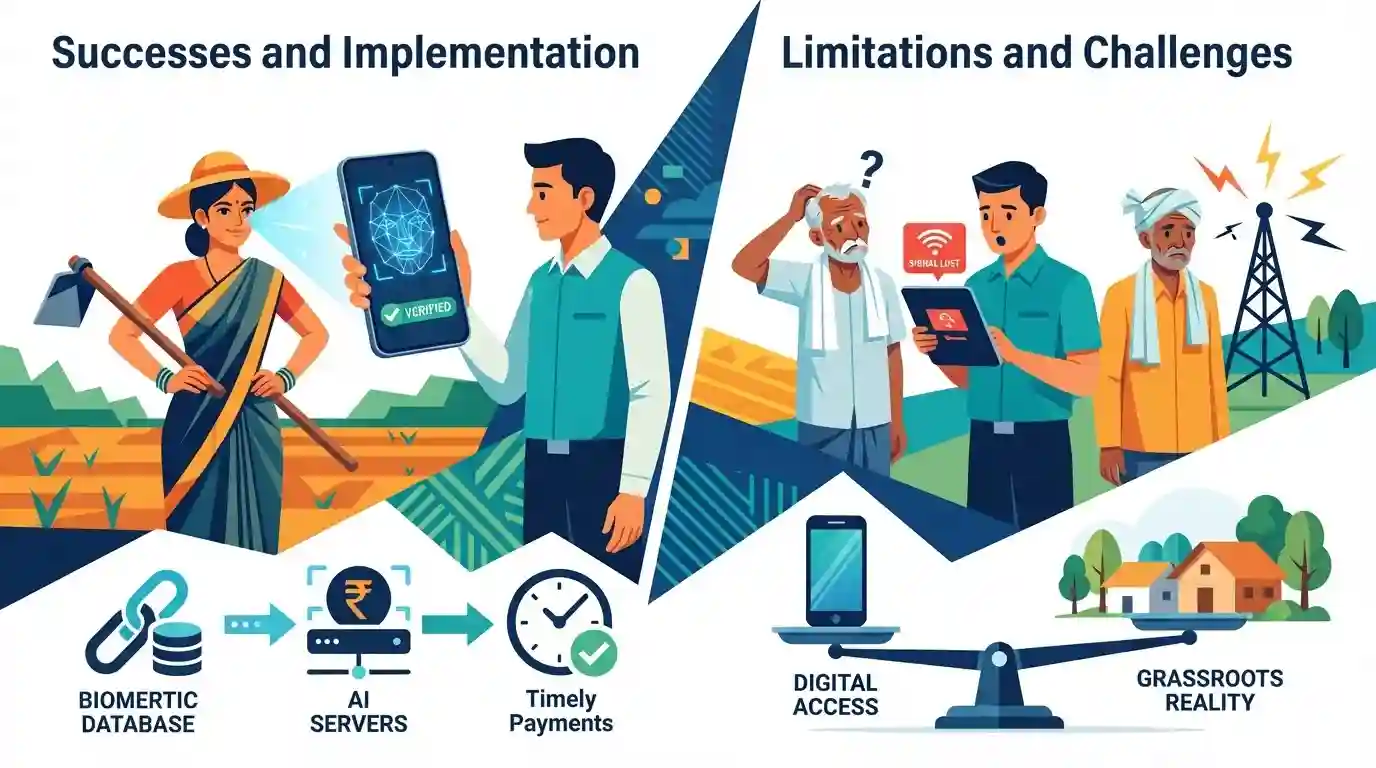
The Central government has introduced an AI-based facial verification upgrade to the attendance application (National Mobile Monitoring System) for the Mahatma Gandhi National Rural Employment Guarantee Scheme (MGNREGS). The move is designed to enhance transparency, prevent fraudulent entries, and curb proxy attendance, though it sparks ongoing debates regarding digital accessibility and grassroots execution challenges in rural welfare schemes.
মূল বিষয়
- The Central government has introduced an Artificial Intelligence (AI)-based facial verification upgrade to the attendance application used for the Mahatma Gandhi National Rural Employment Guarantee Scheme (MGNREGS).
- The upgrade aims to curb proxy attendance, plug leakages, and ensure greater transparency and accountability in the rural jobs scheme.
- It works through the National Mobile Monitoring System (NMMS) app, verifying workers' identities against stored digital database profiles using facial recognition technology.
- While proponents highlight administrative efficiency and reduced corruption, critics and workers' unions have raised concerns regarding digital exclusion, connectivity issues, and technological glitches in rural areas.
গুরুত্বপূর্ণ শব্দ
Mahatma Gandhi National Rural Employment Guarantee Scheme (MGNREGS)

A demand-driven Indian social welfare legislation guaranteeing 100 days of unskilled manual wage employment per financial year to every rural household whose adult members volunteer for such work.
UPSC context
GS Paper II (Welfare Schemes) and GS Paper III (Inclusive Growth). Evaluates rural livelihood security, poverty alleviation, and employment generation in India.
National Mobile Monitoring System (NMMS)
A digital platform launched by the Ministry of Rural Development to capture real-time attendance and geo-tagged photographs of workers at MGNREGS worksites to promote transparency.
UPSC context
GS Paper II (E-governance applications, models, successes, limitations, and potential). Tests the impact and grassroots challenges of digital interventions in public service delivery.
Ministry of Rural Development
The nodal central ministry responsible for the formulation and implementation of policies and rural development programs aimed at poverty alleviation, livelihood security, and infrastructure in India.
UPSC context
GS Paper II (Governance and Institutional Framework). Essential for questions concerning administrative machinery, social sector welfare policies, and central-state coordination.
প্রিলিমস ফাঁদ
The National Mobile Monitoring System app is statutory and mandatory for all gram panchayats to initiate MGNREGS works.
Aspirants often assume MGNREGS work is allocated and tracked entirely through central digital apps, ignoring that statutory demand and local panchayat execution remain decentralised.
সংযুক্ত স্থির ধারণা
What are the statutory provisions and wage-employment guarantees under MGNREGS?
- Legal Guarantee: Guarantees at least 100 days of unskilled manual work in a financial year to every rural household whose adult members volunteer to do unskilled manual work.
- Timebound Provision: Work must be provided within 15 days of applying; failure to do so attracts an unemployment allowance paid by the state government.
- Implementation: Gram Sabhas recommend works, and at least one-third of beneficiaries must be women; wages are linked to the Consumer Price Index for Agricultural Labour (CPI-AL).
আন্তঃবিষয় প্যাটার্ন
E-Governance vs. Rights-Based Welfare Schemes
The deployment of AI-based verification in MGNREGS highlights the tension between modern e-governance transparency tools and the fundamental rights-based guarantee framework of social welfare legislation.
Digital Exclusion and Right to Livelihood
Biometric and facial recognition failures in rural schemes underscore the broader constitutional debate over digital exclusion versus state administrative efficiency under Article 21.

AI verification in welfare schemes + rural digital divide will feature in a mains analytical question on technology vs. inclusion.
সংযুক্ত PYQ · 3
সংযুক্ত PYQ · 3
- 2024MainsGS2
e-governance is not just about the routine application of digital technology in service delivery process. It is as much about multifarious interactions for ensuring transparency and accountability. In this context evaluate the role of the 'Interactive Service Model' of e-governance.
- 2025MainsGS2
e-governance projects have a built-in bias towards technology and back-end integration than user-centric designs. Examine.
- 2023MainsGS2
e-governance, as a critical tool of governance, has ushered in effectiveness, transparency and accountability in governments. What inadequacies hamper the enhancement of these features ?
