Raw Jute MSP Raised for 2026-27 Season
Source:The Hindu ↗
Why It Matters
This article serves as a practical example of the MSP calculation mechanism (1.5 times the cost of production formula) and identifies key institutional bodies like the CCEA and the JCI. These are high-yield topics for both Prelims (Economy/Agriculture facts) and Mains GS3 (Issues related to direct and indirect farm subsidies and minimum support prices). It also touches upon the geographical distribution of a major commercial crop (Jute).
Summary
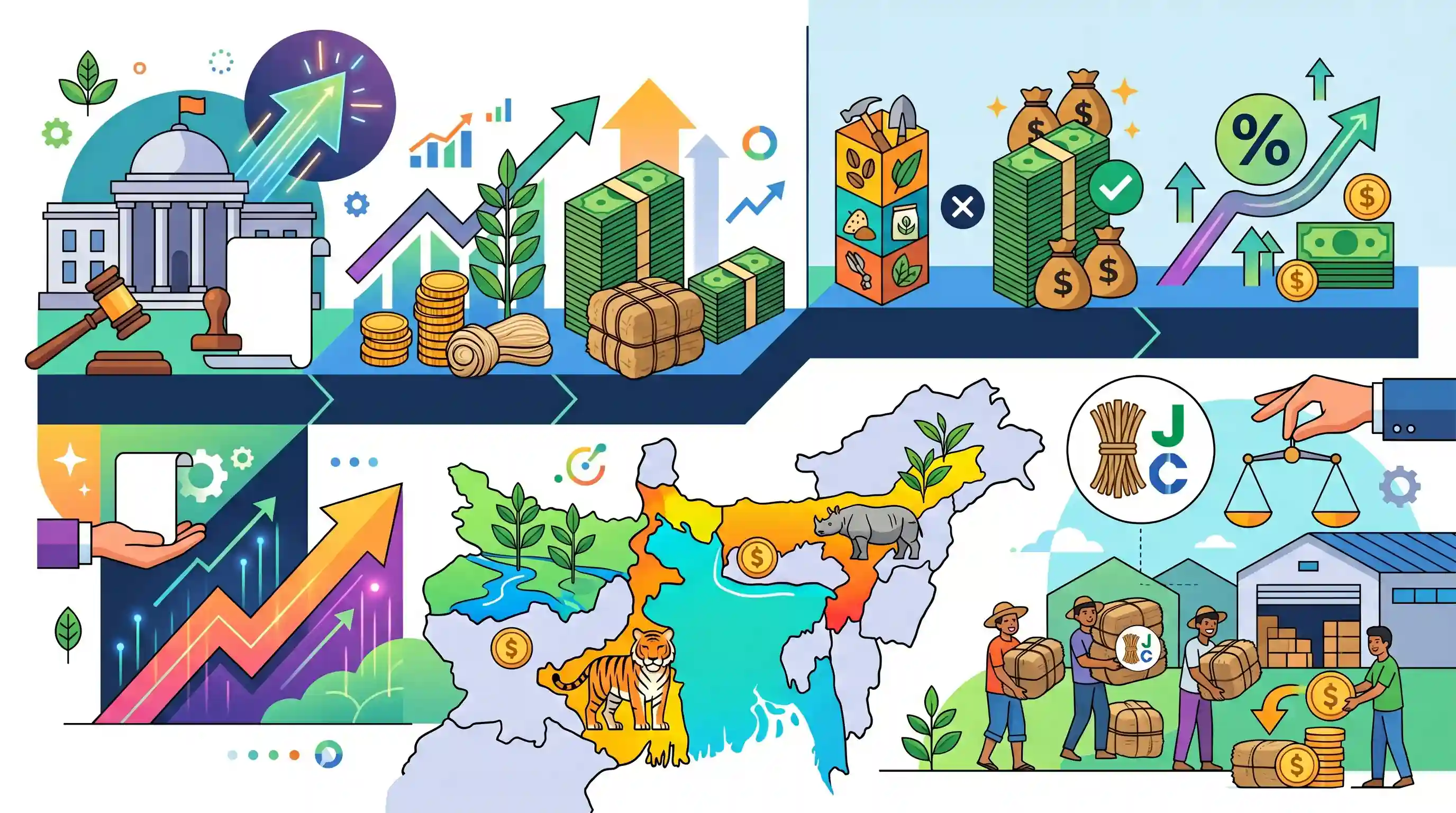
The Cabinet Committee on Economic Affairs (CCEA) has approved an increase in the Minimum Support Price (MSP) for raw jute by ₹275 per quintal for the 2026-27 season, setting the new rate at ₹5,925 per quintal. This hike guarantees a 61.8% return over the all-India weighted average cost of production, adhering to the government's policy of setting MSP at a minimum of 1.5 times the production cost. The move is expected to significantly benefit jute farmers in major producing states like West Bengal and Assam. The Jute Corporation of India (JCI) will undertake the price support operations.
Key Points
- The Cabinet Committee on Economic Affairs (CCEA) has increased the Minimum Support Price (MSP) for raw jute to ₹5,925 per quintal for the 2026-27 season.
- This marks an increase of ₹275 per quintal over the previous season.
- The new MSP ensures a return of 61.8% over the all-India weighted average cost of production, guaranteeing a minimum of 50% profit margin for farmers.
- The pricing aligns with the principle announced in the Union Budget 2018-19, which mandates fixing the MSP at least 1.5 times the all-India weighted average cost of production.
- The Jute Corporation of India (JCI) continues to serve as the nodal agency for price support operations, with the Union government reimbursing any incurred losses.
- The decision primarily benefits jute growers in eastern states, including West Bengal, Assam, Tripura, Bihar, Meghalaya, and Odisha.
Important Terms
Minimum Support Price (MSP)

A guaranteed floor price at which the government purchases crops from farmers, protecting them against market price crashes and distress sales.
UPSC context
GS Paper 3 (Agriculture); essential for understanding government market interventions and farmer welfare policies.
Cabinet Committee on Economic Affairs (CCEA)
A high-level Prime Minister-chaired committee that makes final decisions on major economic policies, investment approvals, and the fixation of agricultural prices.
UPSC context
GS Paper 2 (Governance); tests knowledge of the executive decision-making structure and extra-constitutional bodies.
Commission for Agricultural Costs and Prices (CACP)
An advisory body under the Ministry of Agriculture that recommends MSPs for mandated crops after analyzing production costs and market demand-supply conditions.
UPSC context
GS Paper 3 (Agriculture); vital for institutional questions regarding agricultural price discovery and recommendations.
Jute Corporation of India (JCI)
A central public sector undertaking under the Ministry of Textiles that serves as the nodal agency for raw jute procurement and price support operations.
UPSC context
GS Paper 3 (Agri-marketing); tests awareness of sector-specific nodal agencies for commercial crop procurement.
A2+FL Formula
A cost-of-production formula accounting for actual paid-out expenses (A2) and the imputed value of family labor (FL), forming the basis for MSP calculation.
UPSC context
GS Paper 3 (Agriculture); relates to the Swaminathan Commission’s 1.5x cost-plus-margin recommendation for remunerative pricing.
Prelims Trap
"The Food Corporation of India (FCI) or NAFED acts as the nodal agency for MSP procurement of commercial crops like Jute."
While FCI and NAFED handle most foodgrains and pulses, raw jute procurement under MSP is strictly the mandate of the Jute Corporation of India (JCI), operating under the Ministry of Textiles.
Static Concepts Connected
How does the CACP calculate production costs for MSP recommendations?
- A2 Cost: Actual paid-out costs incurred by the farmer for inputs like seeds, fertilizers, pesticides, hired labor, and fuel.
- A2+FL Cost: Includes A2 plus the imputed value of unpaid family labor. The government's formula of setting MSP at 1.5 times the production cost uses this benchmark.
- C2 Cost: The comprehensive cost that includes A2+FL plus the foregone rent on owned land and interest on fixed capital. Farmers often demand MSP based on this.
What are the geographical requirements for Jute cultivation?
- Climate: Requires a hot and humid tropical climate with temperatures between 24°C and 35°C and high relative humidity (80-90%).
- Rainfall: Thrives in heavy rainfall of 120-150 cm; standing water is particularly beneficial during the early growth and retting stages.
- Soil: Requires well-drained, fertile alluvial soil, particularly in delta regions (like the Gangetic plain) where fresh silt is deposited annually.
Cross-Topic Patterns
Jute Packaging Materials Act (JPMA)
MSP hikes for jute are directly linked to the Jute Packaging Materials Act (JPMA), which mandates 100% foodgrains and 20% sugar be packed in jute bags to ensure assured domestic demand.
Plastic bans and the Golden Fibre
As India phases out single-use plastics, Jute's relevance shifts from traditional bagging to high-value eco-friendly textiles, linking agricultural minimum support prices to broader environmental and sustainability mandates.

Expect a Prelims 2026 match-the-following question pairing cash crops (Jute, Cotton, Copra) with their nodal procurement agencies.
Linked PYQs · 5
Linked PYQs · 5
- 2018PrelimsGS1
Consider the following: 1. Areca nut 2. Barley 3. Coffee 4. Finger millet 5. Groundnut 6. Sesamum 7. Turmeric The Cabinet Committee on Economic Affairs has announced the Minimum Support Price for which of the above?
- 2020PrelimsGS1
Consider the following statements: 1. In the case of all cereals, pulses and oil-seeds, the procurement at Minimum Support Price (MSP) is unlimited in any State/UT of India. 2. In the case of cereals and pulses, the MSP is fixed in any State/UT at a level to which the market price will never rise. Which of the statements given above is/are correct?
- 2020PrelimsGS1
In India, which of the following can be considered as public investment in agriculture? 1. Fixing Minimum Support Price for agricultural produce of all crops 2. Computerization of Primary Agricultural Credit Societies 3. Social Capital development 4. Free electricity supply to farmers 5. Waiver of agricultural loans by the banking system 6. Setting up of cold storage facilities by the governments Select the correct answer using the code given below:
- 2019PrelimsGS1
The economic cost of food grains to the Food Corporation of India is Minimum Support Price and bonus (if any) paid to the farmers plus
- 2011PrelimsGS1
The lower Gangetic plain is characterised by humid climate with high temperature throughout the year. Which one among the following pairs of crops is most suitable for this region?
