Union budget enhances financial allocations for state development
Source:The Hindu ↗
Why It Matters
Provides a clear, contemporary example of fiscal federalism in practice, showcasing how Central grants and tax devolution under the Union Budget directly impact state-level infrastructure and welfare coverage. Valuable for GS-2 answers on Centre-State relations and evaluating government schemes.
Summary
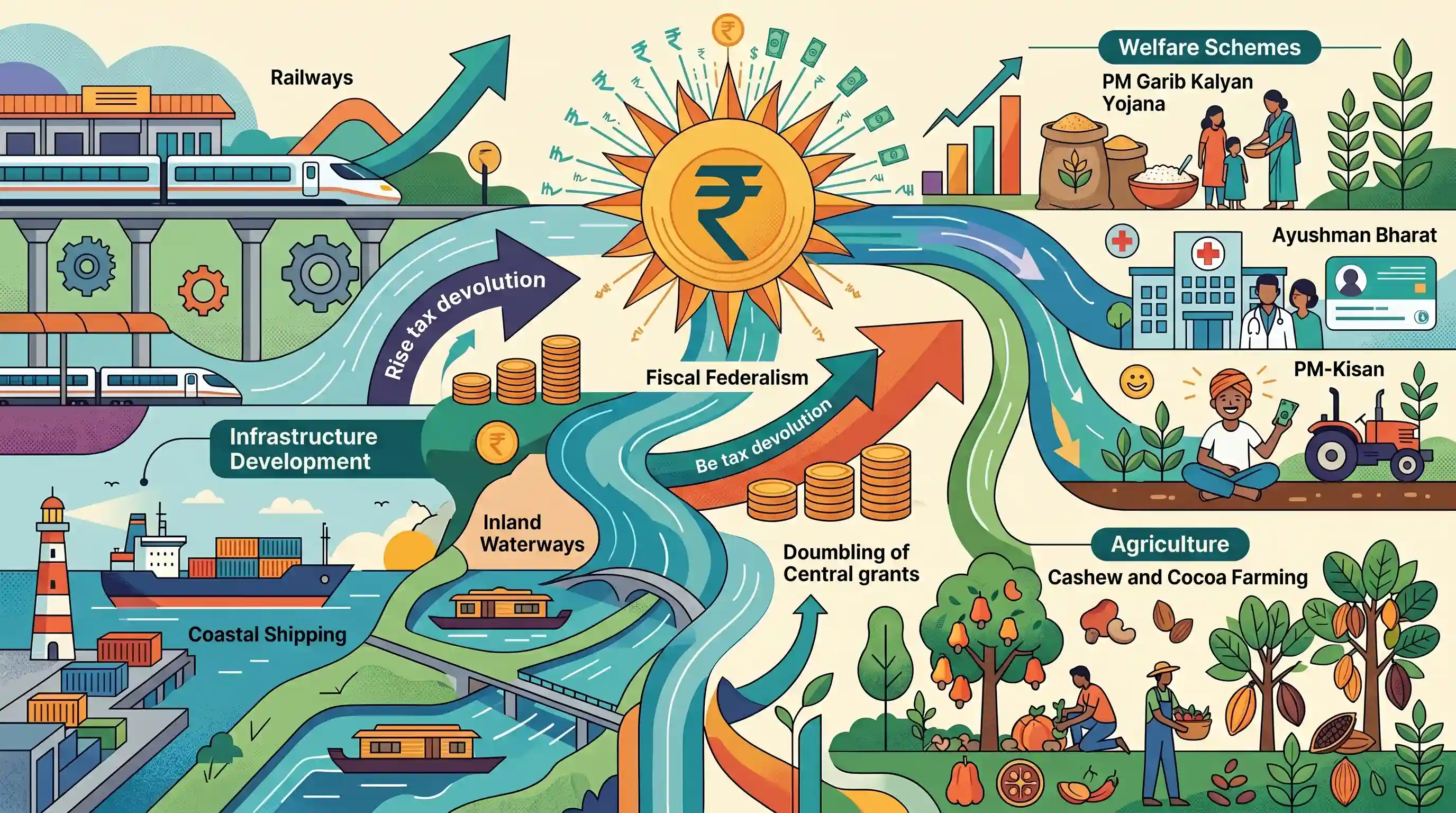
The Union Budget has significantly increased financial allocations for Kerala, highlighting a 33% rise in tax devolution and a doubling of Central grants to nearly ₹26,000 crore. The funds are directed towards comprehensive state development encompassing infrastructure (railways, coastal shipping, inland waterways), agriculture (cashew and cocoa farming), and extensive social welfare schemes (PM Garib Kalyan Yojana, Ayushman Bharat, and PM-Kisan). These allocations reflect the Centre's focus on inclusive growth and cooperative federalism.
Key Points
- The Union Budget increased tax devolution to Kerala by 33% (amounting to ₹8,973 crore) and doubled Central grants to nearly ₹26,000 crore.
- Significant welfare coverage in the State includes 1.55 crore beneficiaries under the PM Garib Kalyan Yojana, 85 lakh Ayushman Bharat cards, and 28 lakh PM-Kisan beneficiaries.
- Infrastructure development is prioritized with investments in coastal shipping, inland waterways, and the introduction of new Vande Bharat and Amrit Bharat trains.
- Agricultural allocations aim to boost local sectors, such as the establishment of a Cashew Board and promotion of cocoa farming.
Important Terms
Pradhan Mantri Garib Kalyan Yojana (PMGKY)

Massive food security program providing 5kg free food grains monthly to 80 crore poor citizens under the NFSA; extended through 2028.
UPSC context
GS Paper II (Welfare Schemes); critical for topics on food security and vulnerable sections.
Ayushman Bharat (AB-PMJAY)
World's largest health assurance scheme providing ₹5 lakh annual coverage per family for secondary/tertiary hospitalization to 50 crore citizens.
UPSC context
GS Paper II (Social Justice/Health); tests universal health coverage and public policy.
PM-Kisan
Central Sector Scheme providing direct income support of ₹6,000 annually in three installments to all landholding farmer families via DBT.
UPSC context
GS Paper III (Agriculture); essential for income support and agricultural credit topics.
Amrit Bharat Station Scheme
National mission to redevelop over 1,300 railway stations with modern amenities, better traffic circulation, and integration with local city centers.
UPSC context
GS Paper III (Infrastructure); relevant for railway modernization and urban connectivity.
Jan Aushadhi Scheme (PMBJP)
Campaign under the Ministry of Chemicals and Fertilizers providing quality generic medicines at 50–90% lower prices through Jan Aushadhi Kendras.
UPSC context
GS Paper II (Governance/Health); focuses on affordable healthcare and out-of-pocket expenditure reduction.
Vande Bharat Express
Indigenously developed, semi-high-speed self-propelled train-sets designed for faster inter-city travel, central to the Make in India initiative.
UPSC context
GS Paper III (Infrastructure/Economy); tests technological self-reliance and transportation efficiency.
Kerala Cashew Board
State agency in Kerala managing revolving funds for raw cashew nut procurement and modernization to protect the traditional processing sector.
UPSC context
GS Paper III (Industrial Growth); case study for regional agricultural industry revival.
Prelims Trap
"PM-Kisan and Ayushman Bharat PM-JAY are both 100% centrally funded Central Sector Schemes."
PM-Kisan is a Central Sector scheme (100% funded by Centre), whereas Ayushman Bharat is a Centrally Sponsored Scheme (60:40 sharing for regular states).
Static Concepts Connected
What are the constitutional provisions for Grants-in-Aid to states?
- Statutory Grants: Under Article 275, Parliament provides financial assistance to specific states in need of support, strictly based on the recommendations of the Finance Commission.
- Discretionary Grants: Under Article 282, both the Centre and States can make grants for any public purpose, completely independent of Finance Commission advice.
How are Centrally Sponsored Schemes (CSS) structured and funded?
- Core of the Core: Most critical schemes for social protection and inclusion (e.g., MGNREGA). Funding patterns usually remain highly favorable to states.
- Core Schemes: Schemes driving the national development agenda (e.g., Ayushman Bharat). Typically share funds at 60:40 for regular states and 90:10 for NE/Himalayan states.
- Optional Schemes: Designed for state-specific needs, where funding is usually split 50:50 between the Centre and the respective State.
Cross-Topic Patterns
South vs North tax devolution debate
Southern states frequently protest low returns on their tax contributions. The 16th Finance Commission will have to carefully navigate balancing 'demographic performance' rewards with horizontal equity across regions.
Matching grants & off-budget borrowings
High allocations for Centrally Sponsored Schemes force states to provide matching grants. To fund state-level welfare, states increasingly resort to off-budget borrowings, triggering strict RBI scrutiny.

Expect a multi-statement Prelims question in 2026 contrasting Statutory vs Discretionary grants and 16th Finance Commission terms.
Linked PYQs · 4
Linked PYQs · 4
- 2025MainsGS2
Examine the evolving pattern of Centre-State financial relations in the context of planned development in India. How far have the recent reforms impacted the fiscal federalism in India?
- 2021MainsGS2
How have the recommendations of the 14th Finance Commission of India enabled the States to improve their fiscal position?
- 2024PrelimsGS1
With reference to the Pradhan Mantri Jan Dhan Yojana (PMJDY), which of the following statements is/are correct? 1. The scheme aims to open bank accounts for unbanked households. 2. There is a minimum balance requirement for accounts opened under this scheme. 3. Beneficiaries get a Rupay Debit Card with an inbuilt accident insurance cover. Select the correct answer using the code given below.
- 2015PrelimsGS1
'Pradhan Mantri Jan-Dhan Yojana' has been launched for
