Centre-state fiscal relations and central fund sanction
Source:economic-times ↗
কেন এটি গুরুত্বপূর্ণ
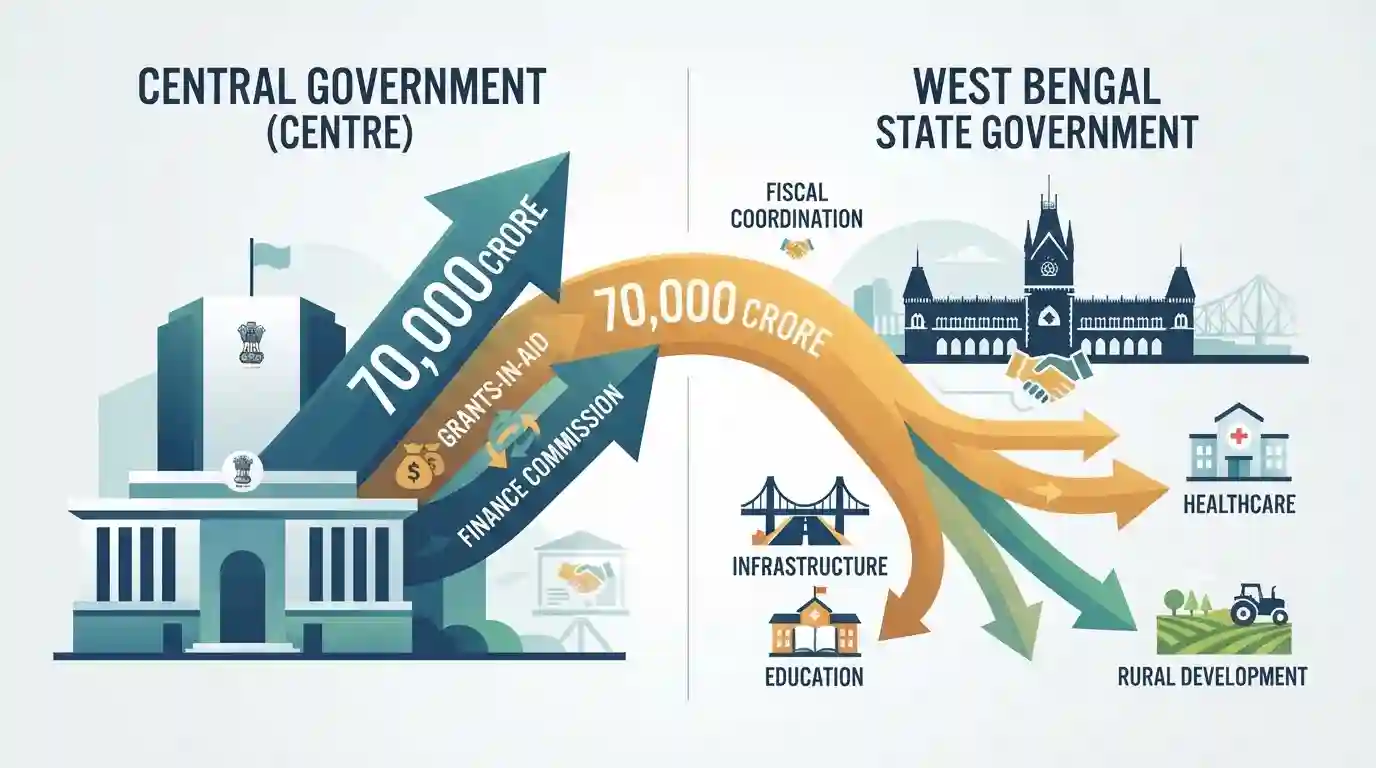
This highlights the practical aspects of fiscal federalism in India, reflecting how central funds are disbursed to states for governance and development. It is directly relevant to constitutional provisions concerning grants-in-aid (Articles 275 and 282) and the role of the Finance Commission in Centre-State financial relations.
সারসংক্ষেপ
The Central Government has sanctioned a significant financial package of Rs 70,000 crore for West Bengal, as announced by the State's Finance Minister Swapan Dasgupta. This substantial allocation underscores the ongoing fiscal coordination between the Centre and the state, potentially encompassing grants-in-aid or devolution of funds directed towards the state's developmental and infrastructural priorities.
মূল বিষয়
- The Central Government has sanctioned Rs 70,000 crore for the state of West Bengal.
- The announcement was made by West Bengal State Finance Minister Swapan Dasgupta.
- The financial sanction highlights the dynamics of Centre-State fiscal relations and federal fund devolution mechanisms.
গুরুত্বপূর্ণ শব্দ
Fiscal Federalism

The framework managing financial relations, resource distribution, and taxation powers between different levels of government—such as the Centre and States—in a federal structure to ensure balanced economic growth.
UPSC context
Vital for GS Paper II and III. It tests Centre-State financial relations, revenue sharing, and the constitutional division of powers.
Finance Commission
A constitutional body established under Article 280 by the President every five years to recommend the distribution of tax revenues and grants-in-aid between the Union and the States.
UPSC context
A high-yield topic for GS Paper II (Polity). Tests knowledge of Article 280, vertical/horizontal devolution formulas, and constitutional bodies.
Grants-in-Aid
Fiscal transfers from the Centre to States designed to support financial needs, tribal welfare, or specific schemes. They comprise statutory grants under Article 275 and discretionary grants under Article 282.
UPSC context
Crucial for GS Paper II. Tests the distinction between statutory (Art 275) and discretionary (Art 282) fiscal transfers in India.
Devolution of Funds
The constitutional mechanism of transferring decision-making authority and a share of central tax revenues down to state and local governments to strengthen decentralized governance and regional equity.
UPSC context
Important for GS Paper II (Centre-State relations). Tests understanding of vertical and horizontal tax sharing mechanisms and local governance empowerment.
Divisible Pool
The portion of the gross tax revenue collected by the Central Government that is mandatorily shared with the States, fundamentally excluding cesses and surcharges.
UPSC context
Relevant for GS Paper III (Economy). Questions frequently test what revenues form part of the divisible pool versus what the Centre retains.
প্রিলিমস ফাঁদ
All grants-in-aid to states by the Centre are recommended by the Finance Commission under Article 275.
Only statutory grants (Art 275) are based on Finance Commission recommendations. Discretionary grants (Art 282), used for Centrally Sponsored Schemes, fall outside its mandate.
সংযুক্ত স্থির ধারণা
What distinguishes Article 275 statutory grants from Article 282 discretionary grants?
- Statutory (Art 275): Grants given to states needing financial assistance, charged on the Consolidated Fund of India, and strictly based on Finance Commission recommendations.
- Discretionary (Art 282): Grants made by the Centre or State for any public purpose, historically used to fund Centrally Sponsored Schemes without FC mandate.
How does the Finance Commission allocate tax resources among states?
- Vertical Devolution: Recommends the percentage of net proceeds of divisible central taxes to be shared collectively with all states.
- Horizontal Devolution: Distributes the total state share among individual states using criteria like income distance, population, area, and demographic performance.
আন্তঃবিষয় প্যাটার্ন
CSS matching funds vs State Autonomy
Discretionary grants (Article 282) for Centrally Sponsored Schemes often require states to provide matching funds, squeezing their independent capital expenditure and impacting long-term fiscal autonomy.
Demographic performance in FC devolution
The 16th FC's criteria will test how demographic management is rewarded, linking fiscal federalism directly to population control and developmental disparities between regions.

Article 275 vs 282 grants and the 16th Finance Commission's horizontal devolution criteria form a high-probability Polity MCQ in 2026.
সংযুক্ত PYQ · 4
সংযুক্ত PYQ · 4
- 2003WBCS_PRELIMSGS1
Centre-State financial relations are looked after by
- 2011WBCS_PRELIMSGS1
Finances are distributed between the Centre and the States on the basis of the recommendations of the
- 2015WBCS_PRELIMSGS1
Which of the following institutions of India is the chief advisory body on the distribution of tax revenue between the Centre and the States ?
- 2017WBCS_PRELIMSGS1
Grants-in-aid are provided for in the Constitution of India under Articles
