Internal Security Challenges and Jammu and Kashmir Governance
Source:The Hindu ↗
Why It Matters
The article touches upon the persistent internal security threat of terrorism in Jammu & Kashmir and the ongoing constitutional debate over the division of powers between the Lieutenant Governor and elected governments in Union Territories.
Summary
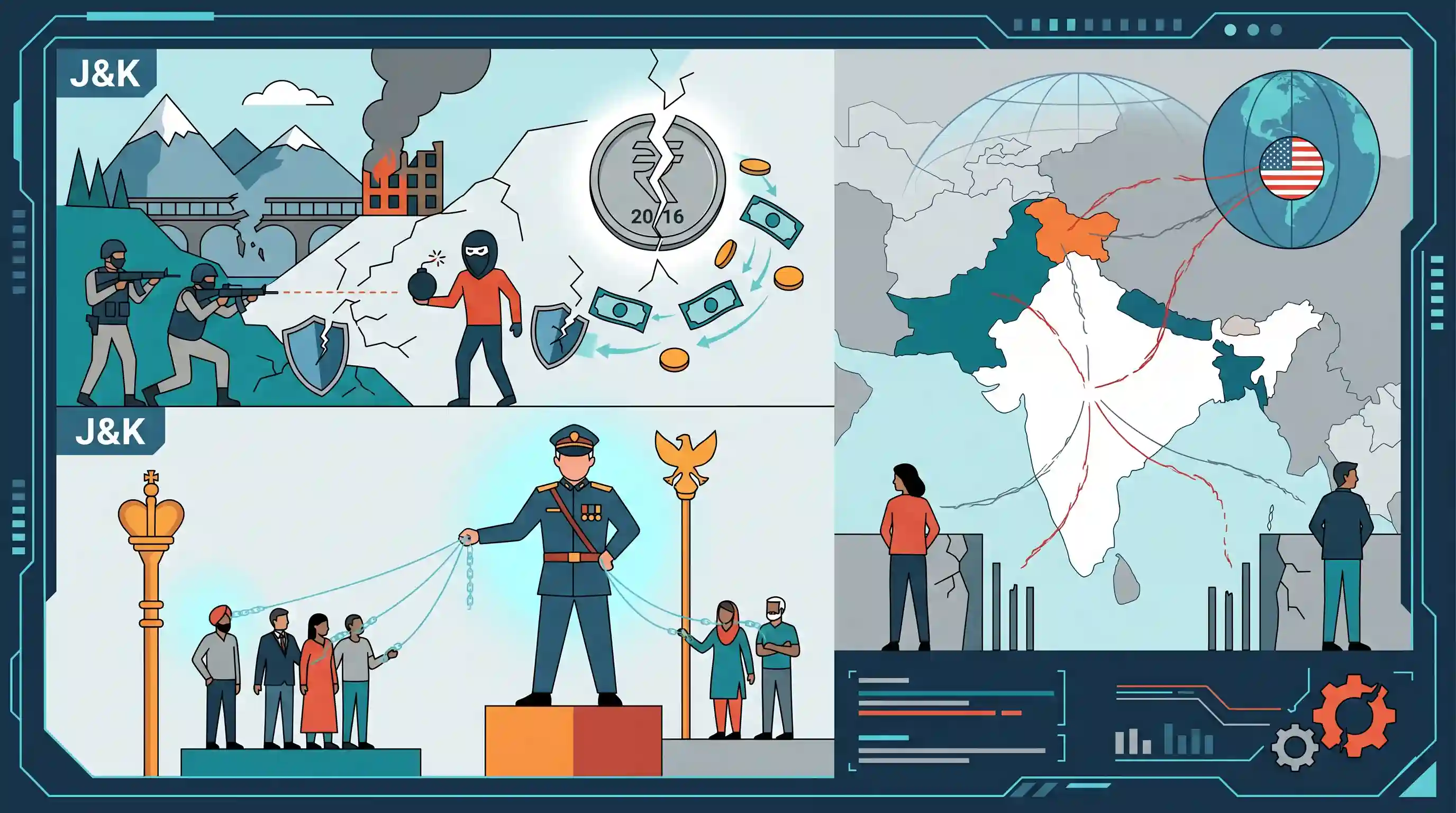
Congress leader Pawan Khera has strongly criticised the BJP-led central government for its inability to end terrorism in Jammu and Kashmir, highlighting recent attacks and anti-terror operations. He questioned the effectiveness of the 2016 demonetisation, which was previously touted as a cure for terror funding. Additionally, Khera condemned the current political setup in J&K, where the Lieutenant Governor exercises greater power than the elected government, and raised broader concerns about India's weakening diplomatic relations with its neighbours and the US.
Key Points
- Congress leader Pawan Khera criticised the Union Government for its failure to curb terrorism in Jammu and Kashmir, citing recent anti-terror operations in Kulgam and the Pahalgam attack.
- Khera pointed out the failure of the 2016 demonetisation policy, which was originally promised by the BJP as a definitive blow to terrorism.
- Concerns were raised regarding the governance framework in J&K, specifically the disproportionate powers held by the Lieutenant Governor compared to the elected government.
- The Congress party also highlighted perceived failures in India's foreign policy, mentioning strained relations with neighbouring countries and the potential impact of US tariffs under President Donald Trump.
Important Terms
Internal Security

The maintenance of peace, law, and order within a country's sovereign boundaries, protecting it from threats like terrorism, insurgency, and organized crime.
UPSC context
GS Paper III: Core theme covering terrorism, extremism, and the mandate of various security forces and agencies.
Lieutenant Governor (LG)
The constitutional head of a Union Territory (UT) in India, appointed by the President, possessing significant executive powers, particularly in UTs like Jammu & Kashmir.
UPSC context
GS Paper II: Tests knowledge of federal structure, UT administration, and executive-legislative relations.
Terror Funding
The financial support provided to terrorists or terrorist organizations through legal or illegal sources like hawala, counterfeit currency, and external state sponsorship.
UPSC context
GS Paper III: Linkages of organized crime with terrorism and measures like PMLA and FATF.
Federalism
A system of government where power is divided between the Centre and States; India's 'quasi-federal' structure often sees tension regarding regional autonomy.
UPSC context
GS Paper II: Essential for understanding Centre-State/UT relations and challenges to the basic structure.
Neighbourhood First Policy
India's diplomatic priority to foster stable, friendly, and mutually beneficial relations with its immediate neighbors for regional prosperity and security.
UPSC context
GS Paper II: International Relations focus on India's foreign policy and regional strategic challenges.
Demonetisation
The 2016 withdrawal of ₹500 and ₹1,000 notes as legal tender, intended to target black money, counterfeit currency, and terror funding.
UPSC context
GS Paper III: Economic reforms and their impact on internal security and the informal economy.
Prelims Trap
The UT of Jammu and Kashmir is governed under Article 239AA, identical to the NCT of Delhi.
J&K UT is administered under Article 239A, not 239AA. While both restrict 'Police' and 'Public Order' from the elected assembly, Article 239AA is exclusively for the National Capital Territory of Delhi.
Static Concepts Connected
What is the administrative framework for the UT of Jammu and Kashmir?
- Constitutional Basis: Governed under Article 239A, originally created for Puducherry, applied to J&K via the J&K Reorganisation Act, 2019.
- LG's Discretion: The Lieutenant Governor holds exclusive executive control over 'Police', 'Public Order', and 'All India Services'.
- Legislative Limits: The elected Assembly can make laws on State List subjects, excluding those explicitly reserved for the LG's discretionary control.
How do modern terror networks adapt to financial constraints?
- Hawala Networks: Relying on informal, trust-based value transfer systems that bypass conventional banking scrutiny and leave no formal paper trail.
- Counterfeit Currency: Smuggling of Fake Indian Currency Notes (FICN) by hostile state actors to artificially inject cash into sleeper cells.
- Cryptocurrencies: Increasing use of decentralized digital assets and privacy coins to anonymously move funds across international borders.
Cross-Topic Patterns
Asymmetric Federalism & Internal Security
Vesting 'Police' and 'Public Order' entirely with the LG in J&K restricts the elected government's ability to execute community policing and intelligence gathering, which are critical for localized anti-terror operations.
Macroeconomic Shocks vs. Terror Financing
Assessing the failure of structural economic measures like demonetisation against resilient terror networks underscores a necessary shift towards real-time FIU tracking, digital forensics, and rigorous FATF compliance.

The constitutional distinction between Article 239A (J&K/Puducherry) and 239AA (Delhi) regarding LG powers is a prime 2026 Prelims target.
Linked PYQs · 3
Linked PYQs · 3
- 2023MainsGS3
Winning of 'Hearts and Minds' in terrorism-affected areas is an essential step in restoring the trust of the population. Discuss the measures adopted by the Government in this respect as part of the conflict resolution in Jammu and Kashmir.
- 2020MainsGS3
Analyze internal security threats and transborder crimes along Myanmar, Bangladesh and Pakistan borders including Line of Control (LoC). Also discuss the role played by various security forces in this regard.
- 2016MainsGS2
Discuss the essentials of the 69th Constitutional Amendment Act and anomalies, if any, that have led to recent reported conflicts between the elected representatives and the institution of the Lieutenant Governor in the administration of Delhi. Do you think that this will give rise to a new trend in the functioning of the Indian federal politics?
