Centre Provides Substantial Capital Assistance Loans to Andhra
Source:theprint ↗
Why It Matters
Highlights the mechanisms of fiscal federalism in India, particularly how the Centre incentivizes states to shift focus from revenue expenditure to capital expenditure through 50-year interest-free loans outside the standard Net Borrowing Ceiling.
Summary
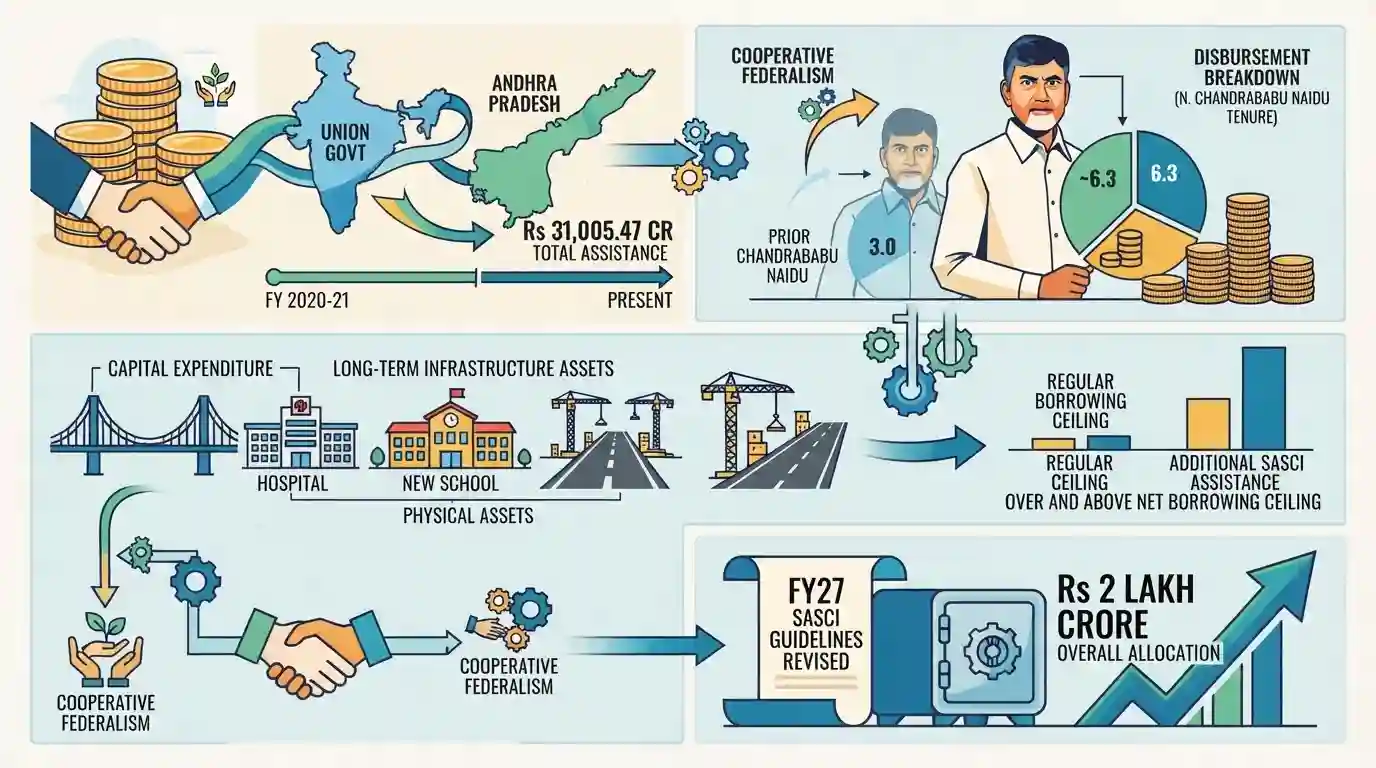
Since the financial year 2020-21, the Union government has provided Andhra Pradesh with Rs 31,005.47 crore in interest-free capital loans under the Special Assistance to States for Capital Investment (SASCI) scheme. Nearly two-thirds of this amount was disbursed during N. Chandrababu Naidu's tenure. This assistance is over and above the regular net borrowing ceiling allowed for states and aims to stimulate capital expenditure, build long-term public infrastructure assets, and foster cooperative federalism. For FY27, the Centre has revised the SASCI guidelines and allocated an overall Rs 2 lakh crore for the scheme.
Key Points
- Andhra Pradesh received Rs 31,005.47 crore in 50-year interest-free capital loans from the Centre between FY21 and FY25 under the SASCI scheme.
- Of the total disbursed amount, roughly two-thirds was approved during the tenure of the Chandrababu Naidu-led state government.
- The SASCI scheme allocations operate over and above a state's standard Net Borrowing Ceiling (NBC), providing additional fiscal headroom for infrastructure development.
- The scheme promotes 'cooperative fiscal federalism' by incentivizing states to prioritize capital expenditure over revenue expenditure, aiding in long-term asset creation.
- For the financial year 2026-27, the Union Ministry of Finance has revised the scheme's guidelines and earmarked Rs 2 lakh crore nationwide.
Important Terms
Special Assistance to States for Capital Investment (SASCI) scheme

A Central Government program providing 50-year interest-free loans to state governments to boost long-term capital expenditure and incentivize key state-level reforms.
UPSC context
GS Paper III (Indian Economy); tests knowledge of fiscal federalism, state-level development, and public infrastructure financing.
Net Borrowing Ceiling (NBC)
A fiscal limit imposed by the Union Government under Article 293 restricting a state's total annual borrowings to a specific percentage of its Gross State Domestic Product.
UPSC context
GS Paper II (Centre-State Relations) and GS III (Public Finance); tests constitutional borrowing provisions and state fiscal autonomy.
Cooperative Federalism
A constitutional concept wherein the Central and State governments collaborate horizontally and vertically as equal partners to address common challenges and achieve national developmental goals.
UPSC context
GS Paper II (Indian Polity & Governance); tests concepts of Centre-State relations, collaborative governance, and federal structures.
National Democratic Alliance (NDA)
A prominent centre-right political alliance in India led by the Bharatiya Janata Party (BJP), representing coalition politics and cooperative governance across various regional states.
UPSC context
GS Paper II (Polity & Governance); tests dynamics of coalition governments, party systems, and multi-party federal setups in India.
YSR Congress Party (YSRCP)
A major regional political party in Andhra Pradesh, founded by Y.S. Jagan Mohan Reddy, known for championing welfare-centric development and regional interests.
UPSC context
GS Paper II (Polity & Governance); tests regionalism, political party systems, and regional party influence on national cooperative federalism.
Prelims Trap
SASCI loans are counted within the state's Net Borrowing Ceiling (NBC) and require no prior central approval under Article 293.
SASCI loans are explicitly over and above the standard NBC, but still constitutionally require central consent under Article 293(3) as long as outstanding central debt exists.
Static Concepts Connected
What are the constitutional limits on state borrowings under Article 293?
- Territorial Restraints: States can only borrow domestically within India; they cannot raise foreign loans directly.
- Central Consent: Under Article 293(3), states must obtain Union consent to borrow if they have outstanding central loans.
- Consolidated Fund: All state borrowings are secured and charged upon the Consolidated Fund of the State.
How does the Union Budget distinguish Capital and Revenue Expenditure?
- Asset Creation: Capital expenditure either creates long-term physical assets or reduces the financial liabilities of the government.
- Revenue Consumption: Revenue expenditure comprises consumption expenses like salaries, pensions, and interest payments without creating assets.
- Multiplier Impact: Capital expenditure has a significantly higher economic multiplier effect compared to consumption-heavy revenue spending.
Cross-Topic Patterns
Fiscal Leverage vs Policy Autonomy
Using SASCI's reform-linked capital incentives allows the Centre to influence State-list subjects like land reforms, urban planning, and local body governance.
NBC Tightening and State Liquidity
As the Centre includes state-guaranteed off-budget borrowings within standard Net Borrowing Ceilings, SASCI acts as a vital extra-budgetary safety valve.

Mains 2026 is highly likely to evaluate Article 293(3) and reform-linked capital schemes as instruments of 'coercive fiscal federalism'.
Linked PYQs · 5
Linked PYQs · 5
- 2019APPSC_PRELIMSGS1
What is the approach followed by National Institution For Transforming India Aayog in the economic policy making?
- 2024APPSC_PRELIMSGS1
Consider the following statements in connection with the distribution of tax revenues between the Centre and the States: I. The proceeds of the surcharges that are levied on taxes and duties referred to in Article 269 and Article 270 of the Constitution of India, would be shared between the Centre and the States. II. Article 268A and Article 272 of the Constitution of India were both repealed by same Constitutional Amendment Act. III. Tax on the sale of petroleum crude is levied by the Centre but collected by the States. IV. The net proceeds of tax categories that are falling under Article 269 of the Constitution of India, do not form a part of the Consolidated Fund of India. Which of the above statement/statements is/are valid?
- 2024APPSC_PRELIMSGS1
The strategic objective of Asset Monetization Programme may be explained as :
- 2023APPSC_PRELIMSGS1
Which of the following is not included in the National Income?
- 2023APPSC_PRELIMSGS1
Given below are two statements, one labelled as Assertion (A) and the other labelled as Reason (R). Select your answer from the codes given below. Assertion (A): Budget Deficit financed by printing currency will lead to price rise. Reason (R): More goods will be produced in the economy. Codes:
