Centre extends UP MSP procurement deadline and approves rural housing
Source:economictimes ↗
Why It Matters
UPPSC frequently asks detailed questions about crop production ranks (such as UP's leading share in wheat), MSP operational mechanisms/deadlines, and targeted timelines/numbers of major central welfare schemes like PMAY-G.
Summary
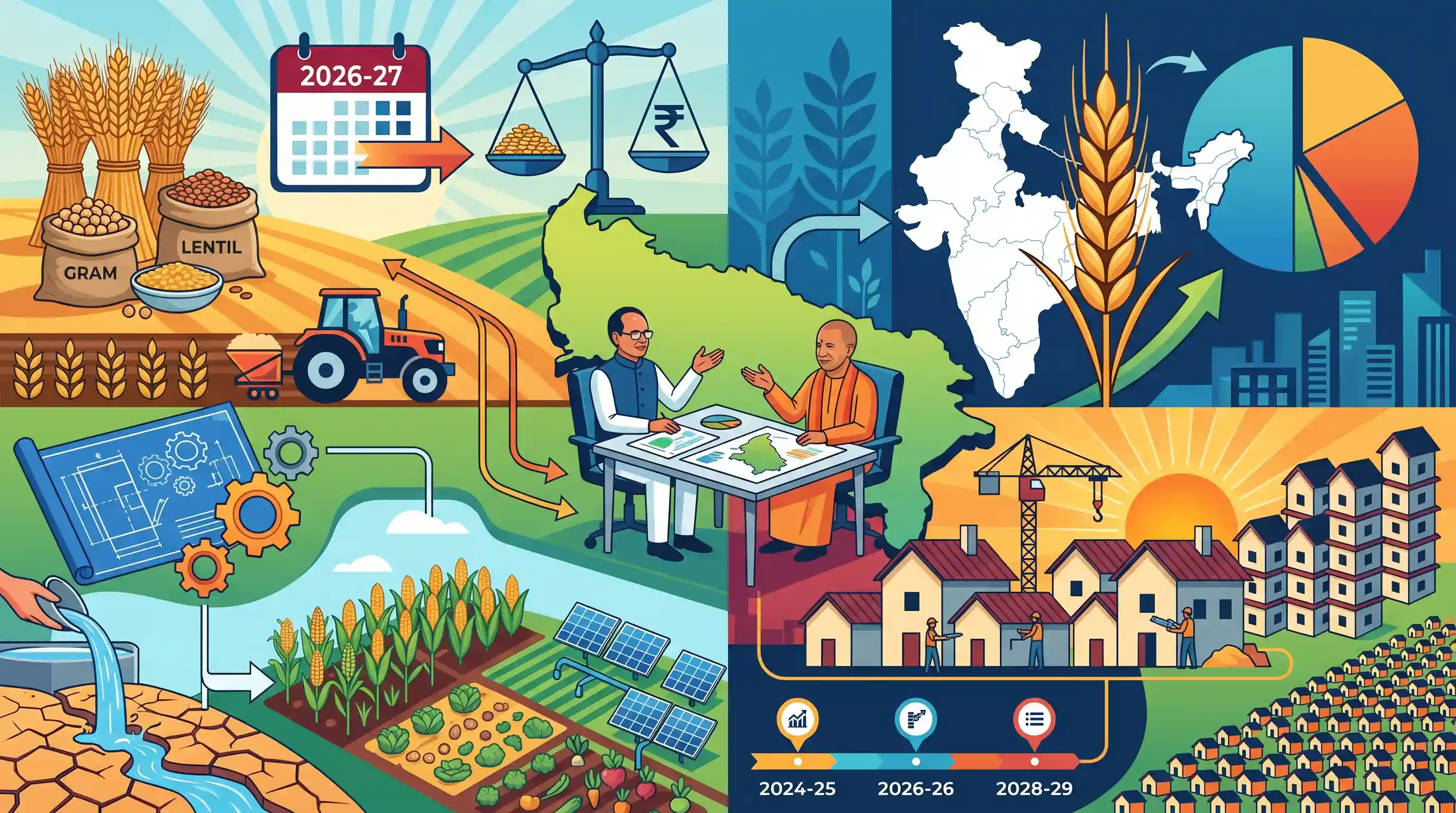
The Union Government has extended the Rabi marketing year 2026-27 MSP procurement deadline in Uttar Pradesh for wheat, gram, and lentil to July 8, 2026. Concurrently, the Centre approved 6,18,482 rural houses for Uttar Pradesh under the new phase of Pradhan Mantri Awas Yojana-Gramin (PMAY-G) covering 2024-25 to 2028-29. This is aligned with the national target of constructing two crore additional pucca houses. The meeting between Union Minister Shivraj Singh Chouhan and UP Chief Minister Yogi Adityanath also focused on a long-term agricultural roadmap and district-wise water-scarcity contingency plans for UP, which produces nearly 38% of India's total wheat.
Key Points
- The Central Government extended the MSP procurement deadline in Uttar Pradesh for wheat, gram, and lentil (Rabi marketing year 2026-27) to July 8, 2026, from the earlier date of June 24.
- Uttar Pradesh accounts for nearly 38% of India's total wheat production, cementing its status as a critical contributor to national food security.
- Under the new phase of Pradhan Mantri Awas Yojana-Gramin (PMAY-G) spanning 2024-25 to 2028-29, the Centre approved the construction of 6,18,482 houses for Uttar Pradesh.
- The new phase of PMAY-G has a nationwide objective of building two crore additional pucca houses across India.
- A scientific and long-term agricultural roadmap is being prepared for UP to cover crop patterns, irrigation, water conservation, seeds, technology, and marketing.
- In response to El Nino conditions and declining groundwater levels, district-wise contingency crop plans are being drafted to promote short-duration and low-water-consuming crops.
Important Terms
Pradhan Mantri Awas Yojana-Gramin (PMAY-G)

A flagship rural housing scheme launched in 2016 to provide pucca houses with basic amenities to homeless households and those living in dilapidated houses in rural areas by March 2029.
UPSC context
GS Paper 2: Social justice and welfare schemes. Tests knowledge of rural development and social inclusion interventions.
Minimum Support Price (MSP)
A price guarantee announced by the government to buy mandated crops from farmers, protecting them from sharp price drops and distress sales.
UPSC context
GS Paper 3: Issues related to direct and indirect farm subsidies and minimum support prices. Tests agricultural pricing policy.
Commission for Agricultural Costs and Prices (CACP)
An attached office under the Ministry of Agriculture that recommends Minimum Support Prices (MSPs) for 22 mandated crops and the Fair and Remunerative Price (FRP) for sugarcane.
UPSC context
GS Paper 3: Agricultural pricing and subsidies. Tests knowledge of institutional bodies that guide agricultural market interventions.
Ministry of Rural Development
The central government department responsible for administering poverty alleviation, employment generation, social security, and housing infrastructure schemes across rural India.
UPSC context
GS Paper 2: Governance and welfare policies. Tests knowledge of administrative systems implementing rural development programs.
Ministry of Agriculture and Farmers' Welfare
The apex Union ministry tasked with formulating agricultural policies, managing food security, coordinating input supplies, and promoting farmer welfare programs in India.
UPSC context
GS Paper 2: Executive ministries and policies. Tests understanding of agrarian administrative bodies in India.
Prelims Trap
MSP is a legally binding statutory price ceiling determined and declared solely by the Commission for Agricultural Costs and Prices.
MSP has no statutory backing under any Act; CACP only recommends the rates, while the Cabinet Committee on Economic Affairs (CCEA) finalizes and approves them.
Static Concepts Connected
How is the Minimum Support Price (MSP) determined and approved in India?
- Recommendatory Body: The Commission for Agricultural Costs and Prices (CACP) analyzes production costs and market factors to recommend annual support prices.
- Approving Authority: The Cabinet Committee on Economic Affairs (CCEA), headed by the Prime Minister, makes the final decision on MSP rates.
- Mandated Crops: Covers 22 mandated crops (14 Kharif, 6 Rabi, 2 commercial crops) along with the Fair and Remunerative Price (FRP) for sugarcane.
What are the core design features and funding patterns of Pradhan Mantri Awas Yojana-Gramin (PMAY-G)?
- Funding Split: Operates as a Centrally Sponsored Scheme with a 60:40 cost sharing ratio in plains, and 90:10 in Himalayan/Northeastern states.
- Target Database: Beneficiary identification has shifted from the old SECC 2011 list to the digitized 'Awaas+ 2024' database to reduce exclusion errors.
- Unit Assistance: Provides direct financial assistance of ₹1.20 lakh in plain areas and ₹1.30 lakh in hilly, difficult, or integrated action plan districts.
Cross-Topic Patterns
MSP & Aquifer Depletion
Open-ended MSP procurement of water-intensive rabi/kharif crops contradicts national groundwater conservation goals, necessitating crop diversification and regional contingency plans.
Green Rural Infrastructure
Integrating energy-efficient, climate-resilient building design into PMAY-G targets aligns social housing welfare with India's Net Zero 2070 commitments.

Transition of PMAY-G to the Awaas+ 2024 database and the non-statutory nature of MSP will likely feature as a core multi-statement Prelims question.
Linked PYQs · 3
Linked PYQs · 3
- 2016UPPSC_PRELIMSGS1
Time span of 'Pradhan Mantri Awas Yojana' is
- 2008UPPSC_PRELIMSGS1
The minimum support price is determined by
- 2007UPPSC_PRELIMSGS1
In which of the following crop production in Uttar Pradesh is not a highest producer?
