Critical Mineral Processing Funding for Lithium and Nickel
Source:The Hindu ↗
Why It Matters
Critical minerals like lithium and nickel are foundational for India's clean energy transition, electric vehicle manufacturing, and high-tech industries. Funding domestic processing helps mitigate supply chain vulnerabilities, reduces import reliance on dominant nations, and aligns with national strategic security objectives.
Summary
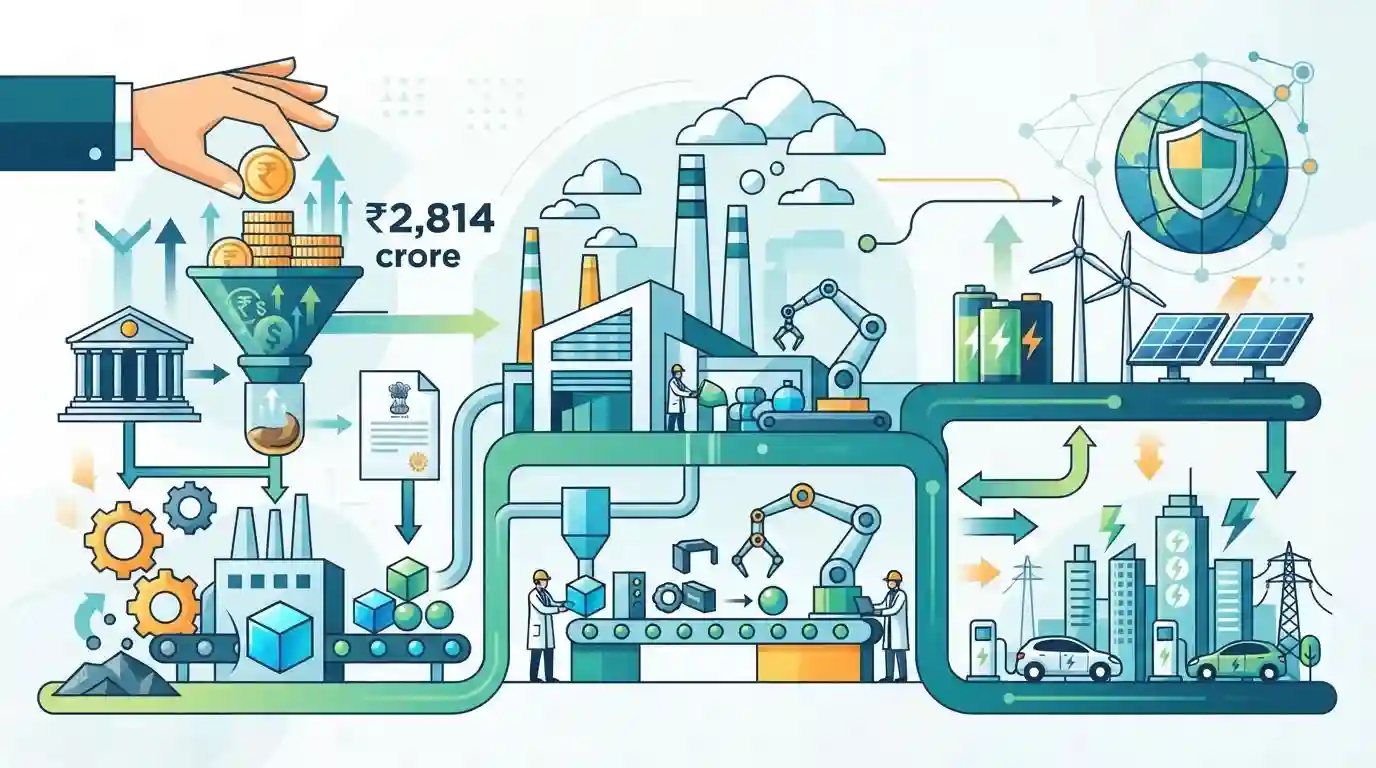
The Central government has earmarked ₹2,814 crore to incentivize and boost the domestic processing of critical minerals such as lithium and nickel. This financial allocation is designed to build domestic refining capacities, lower import dependency for green tech and electric vehicle supply chains, and complement overarching frameworks like the National Critical Mineral Mission.
Key Points
- The government has earmarked ₹2,814 crore to boost domestic processing capabilities for critical minerals like lithium and nickel.
- The initiative aims to reduce import dependence, secure strategic supply chains for electric vehicle batteries, and support green energy transitions.
- It addresses a major bottleneck in India's critical mineral strategy, which has traditionally focused on exploration and mining rather than value-addition and processing.
Important Terms
National Critical Mineral Mission

A strategic Central government initiative launched to secure and build domestic supply chains for essential clean-energy minerals like lithium, nickel, and cobalt, mitigating import dependencies for green technology and electric vehicles.
UPSC context
UPSC Prelims/Mains (GS Paper III - Economy, Environment, Science & Tech): Tests knowledge of government policies on clean energy, rare minerals, and supply chain resilience.
Mines and Minerals Development and Regulation Act
India's principal legislation governing the mining sector, outlining rules for mineral concessions, exploration, and development of major minerals, with recent amendments empowering the Centre to auction critical mineral blocks.
UPSC context
UPSC Prelims/Mains (GS Paper II/III - Polity & Governance, Economy): Tests legal frameworks governing natural resources, federal mineral rights, and industrial regulation.
Ministry of Mines
The nodal union ministry responsible for the survey, exploration, and regulation of mines and mineral resources in India, driving policies for critical minerals and sustainable mining practices.
UPSC context
UPSC Prelims (GS Paper I/II): Tests institutional framework of ministries handling mineral administration and industrial growth in India.
Prelims Trap
The ₹2,814 crore allocation is exclusively meant for the exploration and auctioning of lithium and nickel blocks.
Aspirants often assume critical mineral policies focus exclusively on mining and exploration, missing that recent outlays specifically incentivize domestic value-addition and refining.
Static Concepts Connected
What are the key provisions of the Mines and Minerals (Development and Regulation) Amendment Act, 2023 regarding critical minerals?
- Mineral Category: The Act empowered the Central government to auction mining leases and composite licenses for 24 critical and strategic minerals.
- Private Participation: It removed minerals like lithium, beryllium, and niobium from the list of atomic minerals, opening them up for private sector mining.
Cross-Topic Patterns
Critical Minerals & WTO Subsidy Rules
Critical mineral processing subsidies intersect with WTO rules on subsidies and countervailing measures, testing domestic support policies against international trade disciplines.
Critical Minerals & Net-Zero Transitions
Securing raw materials for EVs and batteries directly underpins India's net-zero 2070 commitments and Faster Adoption and Manufacturing of (Hybrid &) Electric Vehicles.

Critical minerals + processing subsidies + MMDR Act amendments likely to feature as a statement-based prelims question.
Linked PYQs · 3
Linked PYQs · 3
- 2026PrelimsGS1
Which of the following statements about Rare Earth Elements (REEs) and Critical Minerals is/are correct ? 1. Modern technological innovations including Artificial Intelligence, robotics and space exploration extensively utilise Rare Earth Elements (REEs). 2. China has the highest share in mining of REEs followed by India. 3. The Government of India launched the National Critical Mineral Mission (NCMM) in 2025 to establish a robust framework for self-reliance in the critical mineral sector. 4. Rare Earth Elements are a set of 13 metallic elements. Select the answer using the code given below :
- 2025PrelimsGS1
Consider the following statements : I. India has joined the Minerals Security Partnership as a member. II. India is a resource-rich country in all the 30 critical minerals that it has identified. III. The Parliament in 2023 has amended the Mines and Minerals (Development and Regulation) Act, 1957 empowering the Central Government to exclusively auction mining lease and composite license for certain critical minerals. Which of the statements given above are correct?
- 2025PrelimsGS1
Consider the following pairs : Country Resource-rich in I. Botswana : Diamond II. Chile : Lithium III. Indonesia : Nickel In how many of the above rows is the given information correctly matched?
