Centre Drafts AI Regulations to Curb Deepfakes and Misinformation
Source:Indian Express ↗
Why It Matters
This development highlights India's evolving policy stance on regulating emerging technologies, balancing innovation in Artificial Intelligence with cybersecurity safeguards against deepfakes and misinformation.
Summary
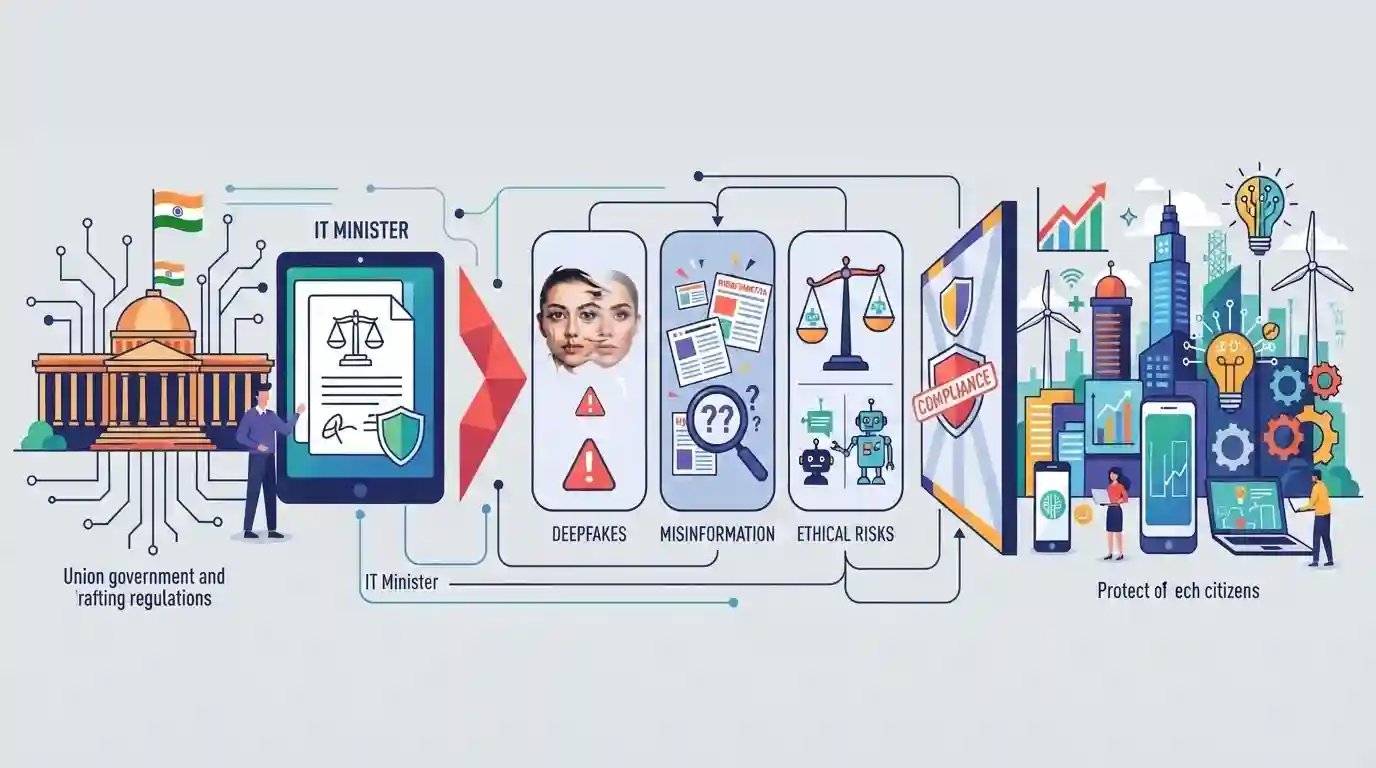
The Union government is drafting dedicated artificial intelligence (AI) regulations to address rising challenges such as deepfakes, misinformation, and ethical risks. Union IT Minister Ashwini Vaishnaw highlighted that the regulatory framework aims to protect citizens while maintaining a conducive environment for technology growth and innovation in India.
Key Points
- The Centre is drafting comprehensive AI regulations to address critical challenges like deepfakes, misinformation, and ethical risks.
- Union IT Minister Ashwini Vaishnaw emphasized the need to balance technological innovation with safety and accountability.
- The proposed framework aims to tackle threats posed by generative AI and safeguard democratic institutions and user privacy.
Important Terms
Information Technology Act

The principal legislation in India governing cyberspace, e-commerce, and digital crimes, which provides the legal foundation for intermediary liability, cyber offenses, and regulatory guidelines addressing AI misuse and deepfakes.
UPSC context
UPSC GS Paper III (Internal Security & Cyber Security). Tests understanding of India's foundational cyber laws, intermediary liabilities, and governance of new technologies.
Digital India Act
The proposed modern legislative framework intended to replace the aging IT Act of 2000, aiming to regulate emerging technologies like artificial intelligence, deepfakes, and open-internet harms with a comprehensive risk-based approach.
UPSC context
UPSC GS Paper III (Science and Technology - IT & Computers). Tests knowledge of upcoming legal reforms and governance of modern digital ecosystems.
Ministry of Electronics and Information Technology
The nodal Union ministry responsible for formulating policies, rules, and regulatory frameworks for information technology, electronics, and emerging technologies like artificial intelligence and cybersecurity in India.
UPSC context
UPSC GS Paper II/III (Governance / Science & Technology). Essential for questions regarding institutional framework, policymaking, and state capacity in tech regulation.
Prelims Trap
India has enacted a comprehensive, standalone AI Act to penalize deepfakes.
Aspirants often assume India has already enacted a standalone, dedicated AI Act, whereas regulations are currently being drafted or managed via existing IT Act advisories.
Static Concepts Connected
What are the key pillars of intermediary liability and safe harbour protection under the IT Act, 2000?
- Safe Harbour: Section 79 grants immunity to intermediaries for third-party content provided they observe due diligence.
- Due Diligence: Intermediaries must remove unlawful content within prescribed timeframes upon receiving actual knowledge or court/government orders.
- Recent Rules: Recent amendments place strict proactive obligations on social media platforms regarding deepfakes and misinformation.
Cross-Topic Patterns
AI Regulation + Electoral Integrity
AI-generated deepfakes target election integrity, linking digital technology regulation directly to the Election Commission's mandate and Representation of the People Act provisions.
Deepfakes + Internal Security & Hybrid Warfare
Synthetic disinformation campaigns blur the line between cyber crime, hybrid warfare, and internal security threats handled by central intelligence agencies.

AI regulation, deepfakes, and intermediary liability under IT Act will likely feature in a multi-statement prelims question.
Linked PYQs · 3
Linked PYQs · 3
- 2023MainsGS3
Introduce the concept of Artificial Intelligence (AI). How does Al help clinical diagnosis? Do you perceive any threat to privacy of the individual in the use of Al in healthcare?
- 2024MainsGS3
Describe the context and salient features of the Digital Personal Data Protection Act, 2023.
- 2024MainsGS3
Social media and encrypting messaging services pose a serious security challenge. What measures have been adopted at various levels to address the security implications of social media? Also suggest any other remedies to address the problem.
