Centre Drafts AI Regulations to Combat Deepfakes and Misinformation
Source:Indian Express ↗
Why It Matters
This development marks a crucial step in India's technology governance, addressing the urgent security and ethical challenges posed by unregulated AI, deepfakes, and misinformation, which are directly relevant to GS3 (Science and Technology / Internal Security) and GS2 (Governance).
Summary
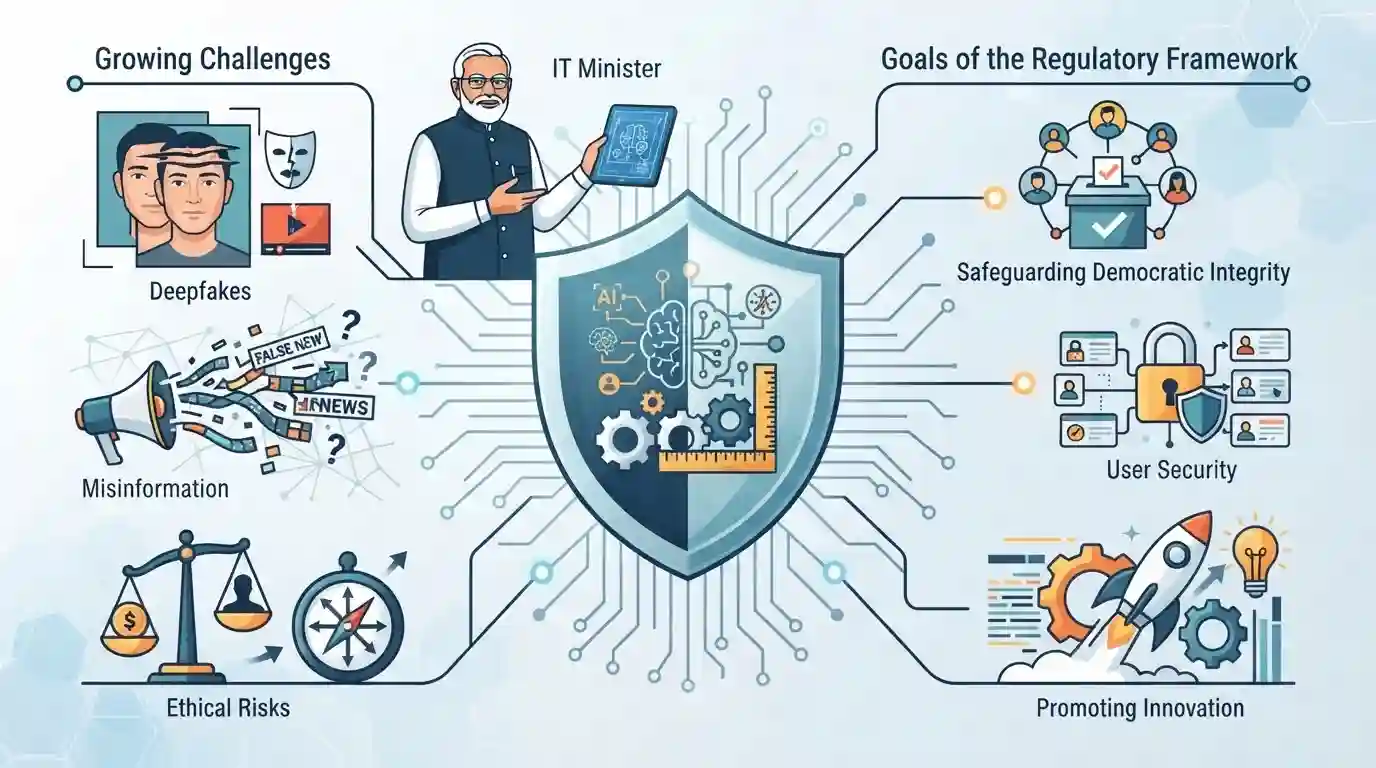
The Union government announced that it is drafting comprehensive regulations for artificial intelligence (AI) to counter growing challenges such as deepfakes, misinformation, and ethical risks. IT Minister Ashwini Vaishnaw emphasized the need for a balanced legal framework that safeguards democratic integrity and user security while promoting technological innovation.
Key Points
- The Union government is drafting comprehensive regulations for artificial intelligence (AI) in India.
- IT Minister Ashwini Vaishnaw highlighted concerns regarding deepfakes, misinformation, and ethical challenges posed by rapid AI advancements.
- The proposed regulatory framework aims to balance innovation with safety, user protection, and accountability for tech platforms.
- The regulations build upon existing IT rules and aim to address emerging threats to democracy, cybersecurity, and data privacy.
Important Terms
Information Technology Act

India's principal legislation governing cyber activities, electronic commerce, and cybercrimes, providing legal recognition for electronic records and digital signatures while setting intermediary liability rules.
UPSC context
GS Paper III (Internal Security / IT): Tests understanding of cyber laws, digital governance, and intermediary liabilities in India.
Digital India Act
Proposed futuristic legislation intended to replace the outdated IT Act of 2000, aiming to regulate emerging technologies like AI, deepfakes, and blockchain while ensuring an open internet.
UPSC context
GS Paper III (Technology / Governance): Tests knowledge of upcoming regulatory frameworks for modern digital ecosystems, AI, and cybersecurity.
Ministry of Electronics and Information Technology
The nodal central government ministry responsible for policy formulation, promotion of digital governance, electronics manufacturing, cybersecurity, and emerging tech initiatives in India.
UPSC context
GS Paper II & III (Governance / IT): Tests institutional mechanisms driving India's digital transformation, e-governance, and tech regulation.
Prelims Trap
Intermediaries enjoy complete safe harbour immunity under Section 79 of the IT Act regardless of AI content hosting.
Aspirants assume safe harbour immunity under the IT Act is absolute for intermediaries, missing that synthetic content non-compliance strips it instantly.
Static Concepts Connected
What are the key legal pillars governing intermediary liability and cyber offences in India?
- IT Act Section 79: Section 79 grants safe harbour protection to intermediaries provided they observe due diligence guidelines set by the central government.
- Bharatiya Nyaya Sanhita: Replaces the IPC, introducing specific penal provisions for cybercrimes, organized crime, and malicious electronic communications or deepfakes.
- IT Intermediary Guidelines: MeitY notified stringent due diligence rules requiring intermediaries to remove flagged deepfakes within strict timeframes.
Cross-Topic Patterns
AI Regulation + Antitrust Competition Law
AI governance models intersect with competition law when large language models create monopolistic gatekeeper dynamics in digital markets.
Deepfakes + Electoral Integrity Linkage
Deepfake disinformation campaigns directly threaten electoral integrity, linking technological regulation with Representation of the People Act provisions.

AI governance + intermediary liability + BNS criminal provisions will be tested as a multi-statement match set in Prelims.
Linked PYQs · 3
Linked PYQs · 3
- 2024MainsGS3
Describe the context and salient features of the Digital Personal Data Protection Act, 2023.
- 2022MainsGS3
What are the different elements of cyber security ? Keeping in view the challenges in cyber security, examine the extent to which India has successfully developed a comprehensive National Cyber Security Strategy.
- 2021MainsGS3
Keeping in view India's internal security, analyse the impact of cross-border cyber attacks. Also discuss defensive measures against these sophisticated attacks.
