Ministry Formulation of Draft Regulations for Artificial Intelligence
Source:Indian Express ↗
આ શા માટે મહત્વનું છે
Crucial for understanding India's evolving regulatory framework regarding emerging technologies, balancing national security and civil liberties against the backdrop of rapid AI proliferation and deepfake threats.
સારાંશ
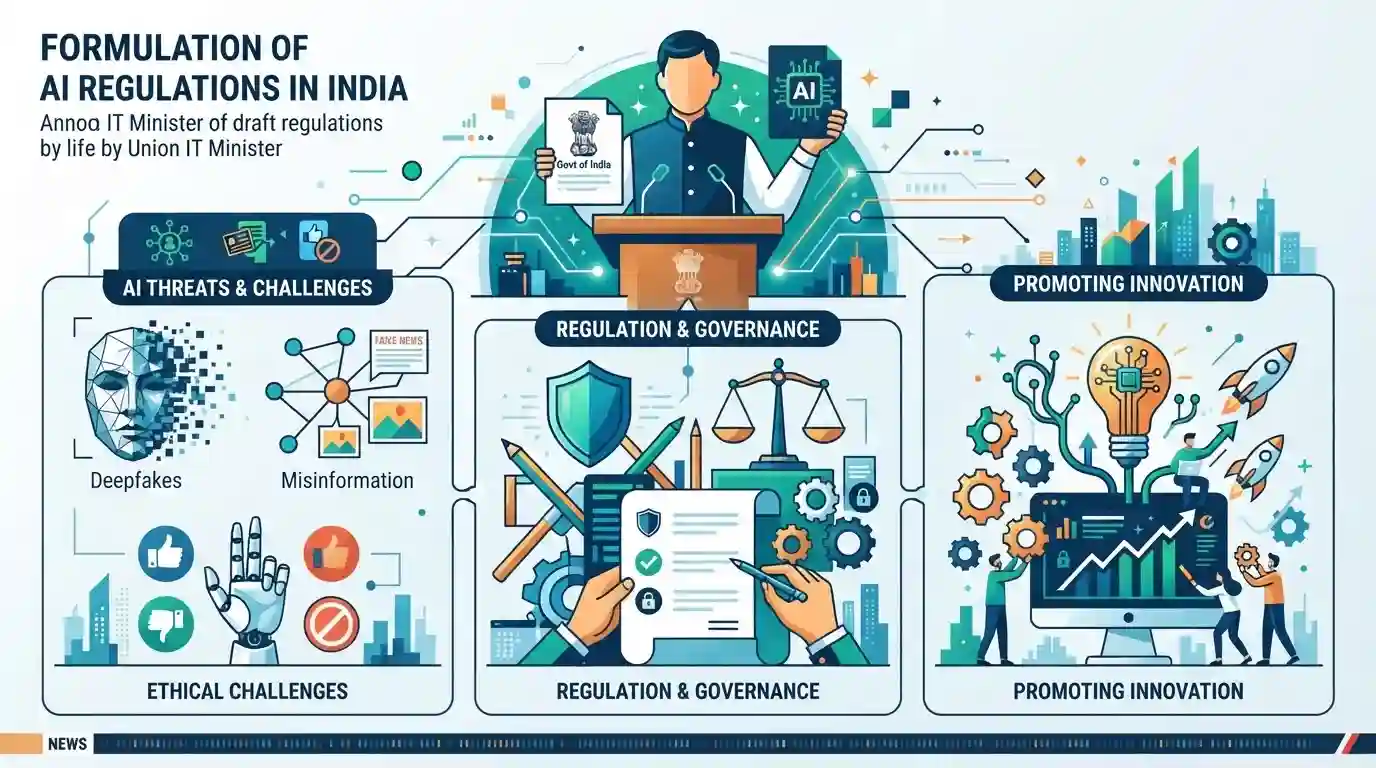
Union IT Minister Ashwini Vaishnaw announced that the Centre is formulating draft regulations for Artificial Intelligence (AI) to combat emerging threats such as deepfakes, misinformation, and ethical challenges, while balancing the need to promote innovation.
મુખ્ય મુદ્દા
- The central government is working on draft regulations specifically tailored for Artificial Intelligence (AI) to address challenges like deepfakes and misinformation.
- IT Minister Ashwini Vaishnaw emphasized the need for a balanced regulatory approach that protects citizens from harms while fostering technological innovation.
- The regulations aim to build upon existing IT frameworks and legal mechanisms to govern generative AI and online safety effectively.
મહત્વપૂર્ણ શબ્દો
Information Technology Act

The primary Indian legislation governing cybercrime, electronic commerce, and digital governance, providing legal recognition for electronic transactions and setting due diligence norms for online intermediaries.
UPSC context
GS Paper III (Internal Security & IT): Tests knowledge of legal frameworks for cyber security, data protection, and digital governance.
Digital India Act
An upcoming comprehensive legislative framework intended to replace the aging Information Technology Act of 2000 to address modern digital challenges, including artificial intelligence, user harms, and online safety.
UPSC context
GS Paper III (Technology): Important for questions on future-ready digital legislations, intermediary liability, and regulation of emerging tech like AI.
Ministry of Electronics and Information Technology (MeitY)
The union government ministry responsible for policy formulation, promotion of electronics and information technology industries, and regulation of cyberspace and internet intermediaries in India.
UPSC context
GS Paper II (Governance) & GS Paper III: Tests institutional roles in implementing national technology policies, AI rules, and digital governance.
સંલગ્ન સ્થિર ખ્યાલો
What are the statutory provisions under the IT Act, 2000 dealing with cyber security and intermediary liability in India?
- Section 66E:: Section 66E criminalizes capturing, publishing, or transmitting images of a private area of a person without their consent (relevant to deepfakes).
- Section 79:: Section 79 provides safe harbor protection to intermediaries, contingent on them exercising due diligence and removing unlawful content upon receiving actual knowledge or court orders.
- IT Rules 2021:: IT (Intermediary Guidelines and Digital Media Ethics Code) Rules, 2021 mandate rapid takedown of misinformation, deepfakes, and illegal content within specified timeframes.
આંતર-વિષય પેટર્ન
AI Misinformation and Constitutional Free Speech Limits
Deepfake regulations intersect with defamation laws, IT intermediary guidelines, and ethical considerations for free speech under Article 19(2).
Techno-Legal Governance in Cyber Security Frameworks
The techno-legal approach combines statutory IT Act provisions with mandatory watermarking and algorithmic auditing, mirroring cybersecurity compliance architectures.

AI regulation + IT Act intermediary liability + deepfakes likely to feature in Mains GS-3 (Security/Tech) or Prelims as a statement trap.
સંલગ્ન PYQ · 2
સંલગ્ન PYQ · 2
- 2020MainsGS3
Discuss different types of cyber crimes and measures required to be taken to fight the menace.
- 2023MainsGS3
Introduce the concept of Artificial Intelligence (AI). How does Al help clinical diagnosis? Do you perceive any threat to privacy of the individual in the use of Al in healthcare?
