Centre Defense of NEET PG Negative Cut off Policy
Source:Indian Express ↗
Why It Matters
It highlights the tension between filling vacant postgraduate medical seats and maintaining rigorous standards for medical specialization. It also touches upon the broader theme of the judiciary reviewing executive policy decisions concerning professional education and public health standards.
Summary
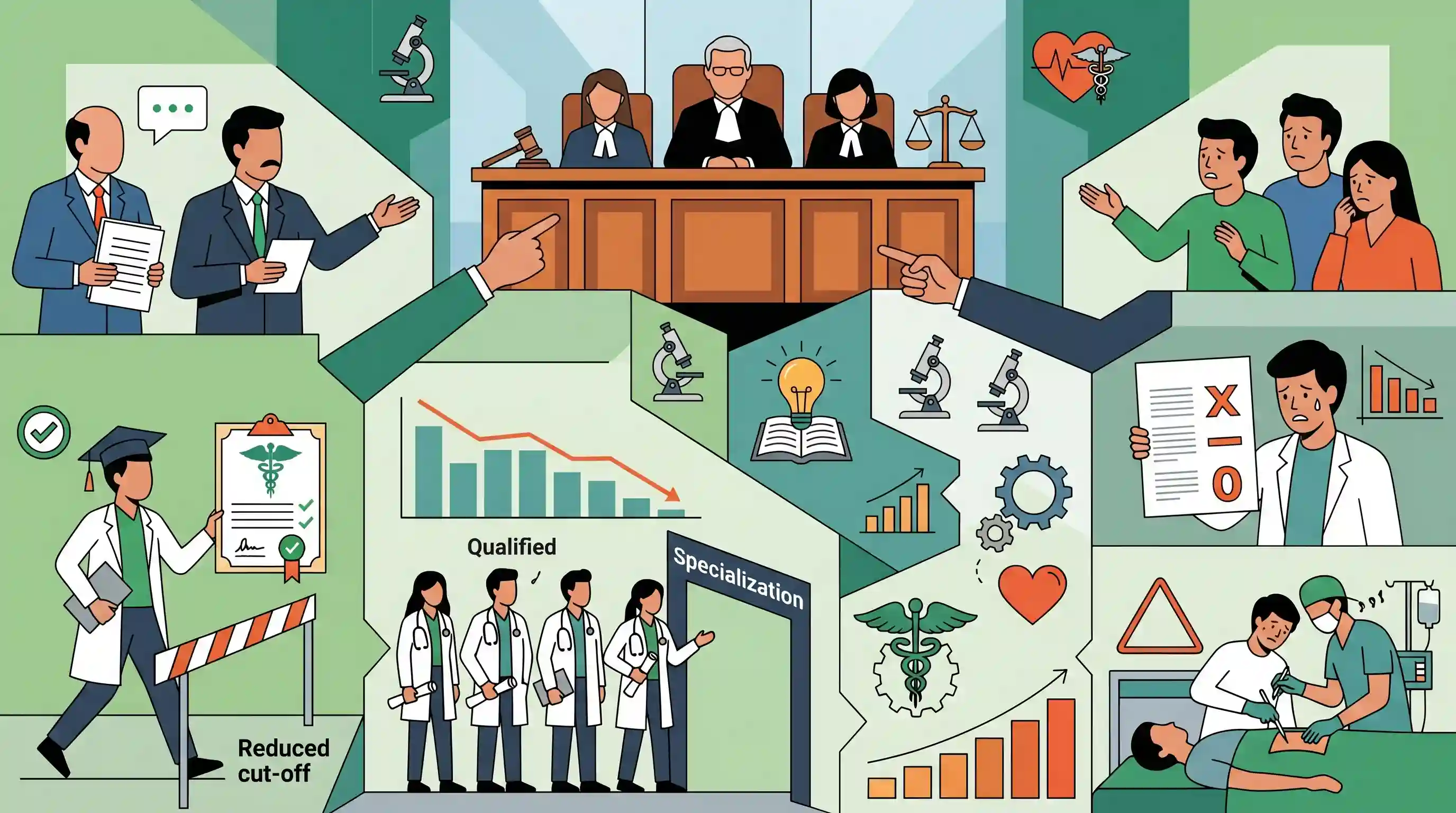
The Centre, through the Ministry of Health and Family Welfare (MoHFW) and the National Board of Examinations in Medical Sciences (NBEMS), filed an affidavit in the Supreme Court defending the reduction of the NEET-PG cut-off. Responding to a PIL that challenged allowing candidates with zero or negative scores to pursue medical specialization, the government argued that clinical competence is already verified when candidates successfully complete their foundational MBBS degrees. However, the Supreme Court questioned the underlying rationale, raising concerns about the standard of specialized medical training when doctors with negative scores in qualifying examinations are admitted.
Key Points
- The Central Government defended its decision to reduce the NEET-PG cut-off, allowing candidates with zero or negative scores to qualify for postgraduate medical admission.
- The Ministry of Health and Family Welfare (MoHFW) and NBEMS submitted an affidavit in the Supreme Court in response to a Public Interest Litigation (PIL) challenging the move.
- The Centre argued that a candidate's clinical competence is already established upon qualifying their MBBS degree, minimizing the impact of a low NEET-PG score on patient care.
- The Supreme Court questioned the policy's rationale, raising concerns over how doctors with 'negative' NEET-PG scores could be deemed fit for advanced specialization.
Important Terms
NEET-PG

A single-window national entrance examination for admission to postgraduate medical courses (MD/MS/PG Diploma) in government and private medical colleges across India.
UPSC context
GS Paper 2 (Education/Governance); tests issues regarding medical education standards and central regulatory authority.
Supreme Court
India's highest judicial authority and final court of appeal, empowered with original, appellate, and advisory jurisdictions to safeguard the Constitution and fundamental rights.
UPSC context
GS Paper 2 (Polity); central to Judicial Review, PIL, and the separation of powers.
Ministry of Health and Family Welfare (MoHFW)
The apex central ministry responsible for national health policy, family welfare programs, medical education regulation, and public health infrastructure across India.
UPSC context
GS Paper 2 (Health/Governance); essential for social sector initiatives and government scheme implementation.
National Board of Examinations in Medical Sciences (NBEMS)
An autonomous body under the MoHFW tasked with standardizing postgraduate medical education and conducting high-stakes examinations like NEET-PG and DNB.
UPSC context
GS Paper 2 (Statutory/Regulatory Bodies); relevant for institutional frameworks ensuring professional education quality.
Prelims Trap
NBEMS is a statutory body created under the National Medical Commission Act.
NBEMS is an autonomous academic body established in 1975 under the Societies Registration Act, whereas NMC is the statutory body created under the 2019 Act.
Static Concepts Connected
What are the key bodies regulating postgraduate medical education in India?
- National Medical Commission: Apex statutory body replacing the MCI; regulates medical education standards, assesses colleges, and registers practitioners.
- NBEMS: Autonomous society under MoHFW that conducts standard exams like NEET-PG and awards DNB qualifications.
On what grounds can courts exercise judicial review over specialized education policies?
- Manifest Arbitrariness: Under Article 14, policies lacking logical rationale or compromising public welfare (like healthcare quality) can be struck down for arbitrariness.
- Wednesbury Unreasonableness: Courts intervene if an administrative decision is so unreasonable or illogical that no sensible authority could ever have made it.
Cross-Topic Patterns
Healthcare HR vs. Quality Trade-off
Links to GS2 human resource planning. The rush to fill vacant PG seats highlights the structural tension between addressing specialist doctor shortages and maintaining rigorous clinical standards.
Judicial Review of Expert Bodies
Parallels environmental and telecom cases where the Supreme Court scrutinizes the foundational rationale of executive policy, challenging the doctrine of absolute deference to domain experts.

Mains GS2 is likely to probe the "quantity vs. quality" trade-off in medical education, focusing on NMC regulatory effectiveness.
Linked PYQs · 3
Linked PYQs · 3
- 2015MainsGS2
The quality of higher education in India requires major improvements to make it internationally competitive. Do you think that the entry of foreign educational institutions would help improve the quality of higher and technical education in the country? Discuss.
- 2020MainsGS2
Judicial Legislation is antithetical to the doctrine of separation of powers as envisaged in the Indian Constitution. In this context justify the filing of large number of public interest petitions praying for issuing guidelines to executive authorities.
- 2023MainsGS2
The crucial aspect of development process has been the inadequate attention paid to Human Resource Development in India. Suggest measures that can address this inadequacy.
