Windfall Tax Reduction on Petroleum Exports and Energy Security
Source:Indian Express ↗
Why It Matters
Demonstrates how the government uses indirect taxation (excise/export duties) as a flexible macroeconomic tool to shield the domestic economy from global geopolitical shocks and secure energy supplies.
Summary
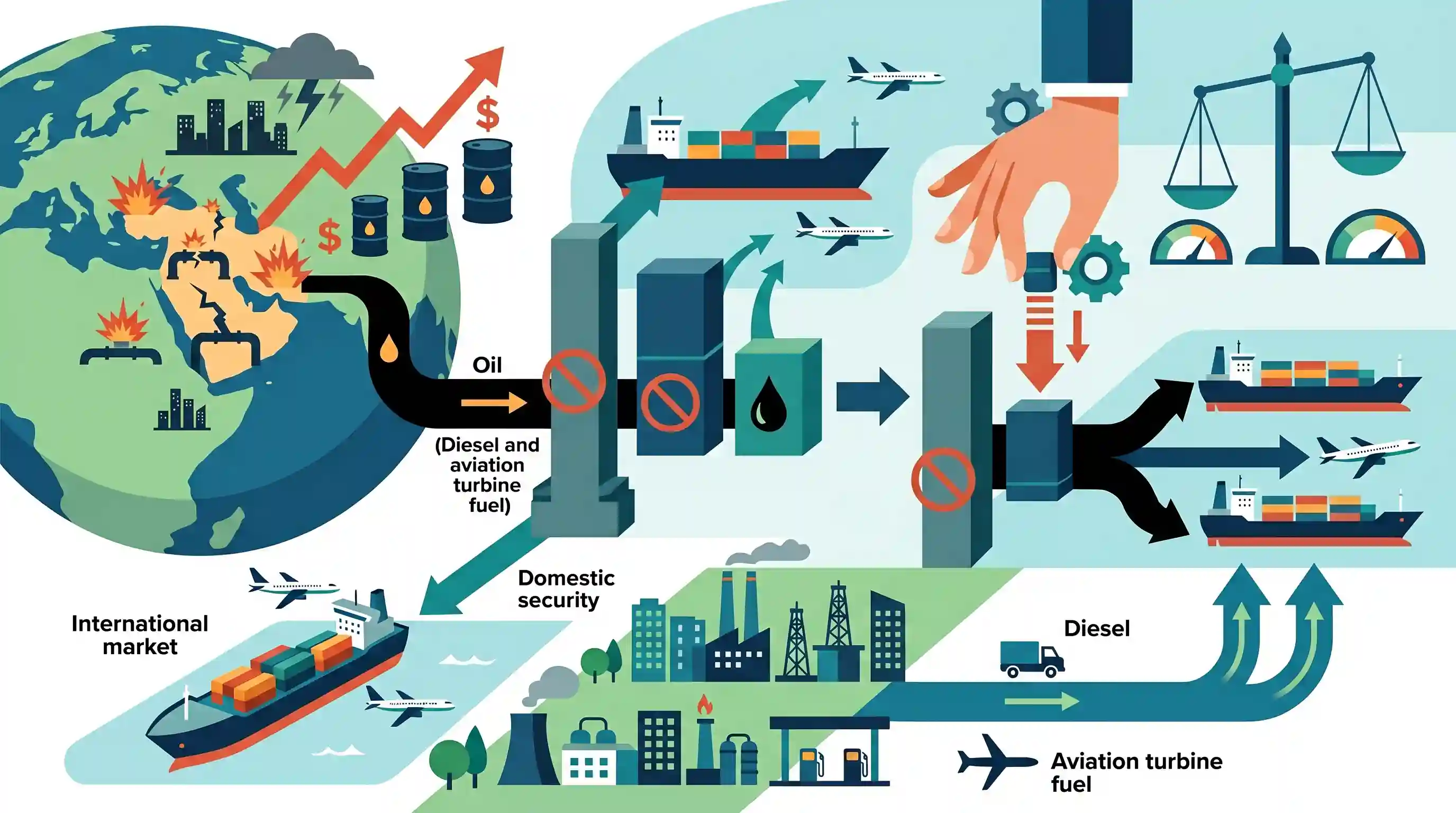
The Indian government has reduced the windfall tax on the export of diesel and aviation turbine fuel (ATF) in its latest fortnightly revision. The tax, levied as excise duties, was initially imposed to discourage lucrative exports and ensure adequate domestic fuel availability amidst a surge in global crude prices driven by the ongoing conflict in West Asia.
Key Points
- The Indian government has significantly reduced the export duty on diesel to Rs 23 per litre (down from Rs 55.5) and on aviation turbine fuel (ATF) to Rs 33 per litre (down from Rs 42).
- Export duty on petrol continues to remain at nil.
- These export duties act as a windfall tax, applied in the form of excise duties, and are revised on a fortnightly basis.
- The tax was initially imposed in late March to disincentivize exports and prioritize domestic fuel availability.
- The policy response was triggered by a surge in global crude oil prices and a widening gap between domestic and international prices, driven primarily by the geopolitical conflict in West Asia.
Important Terms
Windfall Tax

A higher tax rate imposed on companies that experience unexpected, 'supernormal' profits due to external events like geopolitical crises or commodity price surges.
UPSC context
GS Paper III (Economy); relevant for taxation policy, fiscal management, and government intervention in energy markets.
Special Additional Excise Duty (SAED)
The specific mechanism used in India to levy windfall taxes on crude oil production and fuel exports like diesel and jet fuel.
UPSC context
GS Paper III (Economy); tests knowledge of indirect taxes and petroleum sector regulation.
Aviation Turbine Fuel (ATF)
A specialized petroleum-based fuel used for aircraft, currently kept outside the Goods and Services Tax (GST) regime and subject to central excise duties.
UPSC context
GS Paper III (Infrastructure: Energy); important for understanding fuel pricing and aviation sector challenges.
Fortnightly Revision
The scheduled two-week interval at which the Indian government reviews and adjusts windfall tax rates based on global crude oil price fluctuations.
UPSC context
GS Paper III (Economy); highlights the dynamic nature of fiscal policy in response to global volatility.
Energy Security
The reliable and affordable availability of energy sources; the primary stated reason for imposing export taxes to prioritize domestic fuel supply.
UPSC context
GS Paper III (Energy); a core objective of India's strategic and economic policies.
Department of Revenue
A branch of the Ministry of Finance responsible for the administration of direct and indirect taxes, including the notification of SAED changes.
UPSC context
GS Paper II (Governance); identifies the specific executive authority managing fiscal revisions.
Prelims Trap
"Windfall tax on crude oil in India is levied as an additional direct corporate income tax on petroleum companies."
Despite targeting 'profits', India implements this windfall tax as a Special Additional Excise Duty (SAED) on production and exports. It is an indirect tax, not a direct corporate income tax.
Static Concepts Connected
How is the Windfall Tax implemented in India's taxation system?
- Nature of tax: It is levied as a Special Additional Excise Duty (SAED), which classifies it as an indirect tax.
- Target base: Applied to domestically produced crude oil and the exports of diesel, petrol, and aviation turbine fuel (ATF).
- Fortnightly revision: Reviewed every 14 days to dynamically respond to global crude price volatility and refinery margins.
What is the current status of petroleum products under the GST regime?
- Outside GST: Crude oil, high-speed diesel, petrol, natural gas, and ATF are currently kept outside the purview of GST.
- Applicable taxes: These products continue to attract Central Excise Duty and State Value Added Tax (VAT).
- GST Council role: They can be brought under the GST framework only from a date recommended by the GST Council.
Cross-Topic Patterns
Energy Security & West Asian Chokepoints
India imports roughly 85% of its crude. Conflicts threatening the Strait of Hormuz directly force domestic fiscal interventions, like windfall taxes, to ensure domestic supply and buffer price shocks.
Crude Prices and the Twin Deficits
Elevated global crude prices inflate India's import bill, widening the CAD. Subsequent domestic tax cuts to cushion consumers simultaneously risk widening the fiscal deficit, exacerbating the twin deficit problem.

Expect a 2026 Prelims question linking SAED (indirect tax), GST exclusion of petroleum, and imported inflation from global shocks.
Linked PYQs · 3
Linked PYQs · 3
- 2025PrelimsGS1
Consider the following activities : I. Production of crude oil II. Refining, storage and distribution of petroleum III. Marketing and sale of petroleum products IV. Production of natural gas How many of the above activities are regulated by the Petroleum and Natural Gas Regulatory Board in our country?
- 2017MainsGS2
The question of India's Energy Security constitutes the most important part of India's economic progress. Analyze India's energy policy cooperation with West Asian countries.
- 2025MainsGS2
"Energy security constitutes the dominant kingpin of India's foreign policy, and is linked with India's overarching influence in Middle Eastern countries.” How would you integrate energy security with India's foreign policy trajectories in the coming years?
