Social Media Intermediary Liability and Impersonation Risks
Source:The Hindu ↗
Why It Matters
This development provides a practical case study of the ongoing conflict between the government and social media intermediaries regarding content regulation, fake news, and statutory liabilities under the IT Act. It is highly relevant for GS3 (Internal Security challenges posed by social media) and GS2 (Freedom of speech vs. state censorship).
Summary
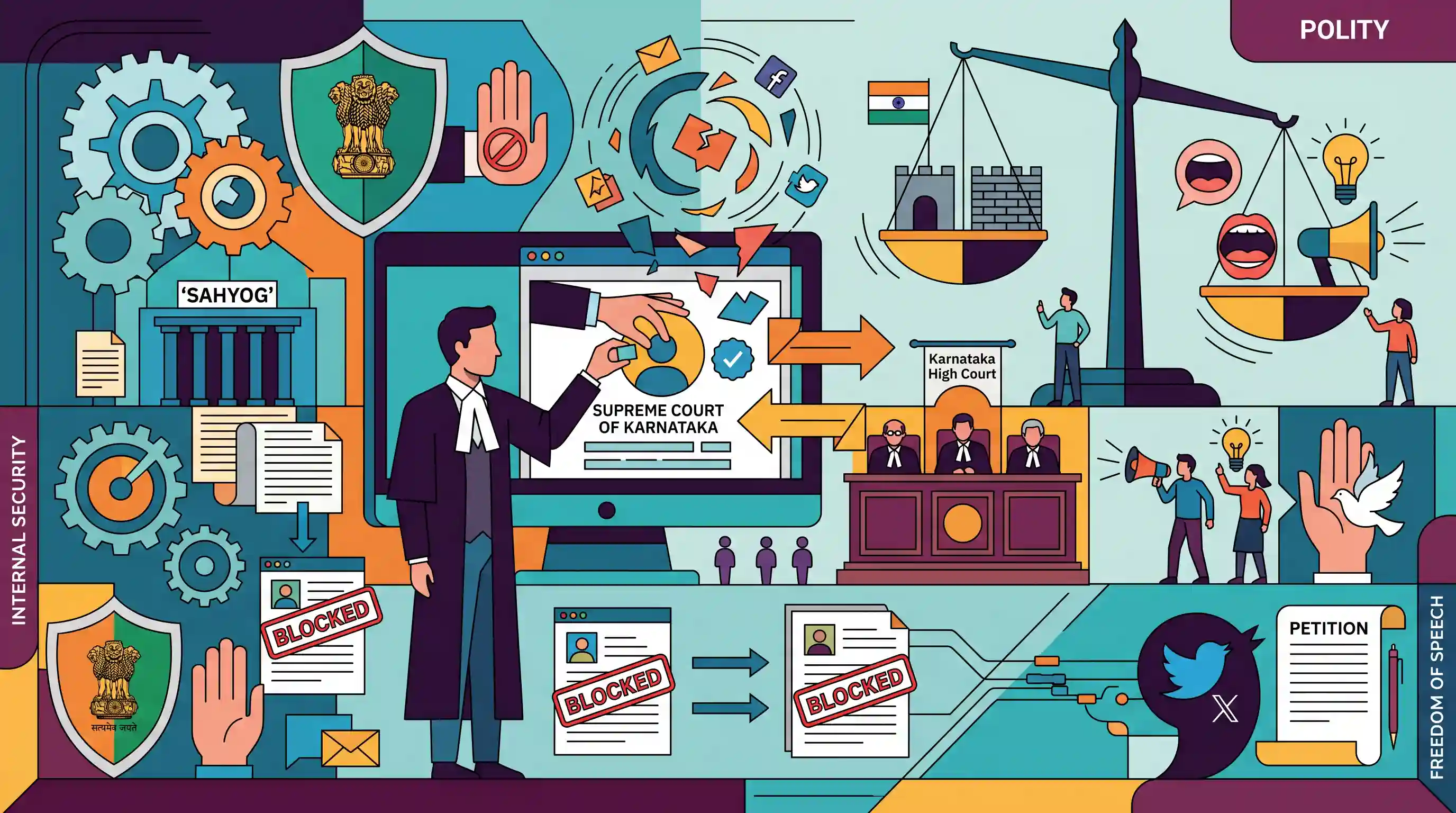
The Central government, represented by Solicitor-General Tushar Mehta, created a fake verified account on X (formerly Twitter) in the name of the non-existent "Supreme Court of Karnataka" to demonstrate to the Karnataka High Court how easily social media platforms can be misused for impersonation and disinformation. The incident took place during hearings on a petition by X Corp challenging government account-blocking orders issued under Section 79 of the Information Technology Act. X Corp alleges that these blocking orders bypass statutory safeguards and has also criticized the government's 'Sahyog' portal as a "censorship portal" that streamlines takedowns using automated templates. The case underscores the ongoing tension between enforcing intermediary liability to curb digital misuse and addressing concerns over state censorship and free speech.
Key Points
- The Centre created a fake but verified X account for the non-existent 'Supreme Court of Karnataka' to demonstrate the platform's vulnerability to impersonation and disinformation.
- The demonstration occurred during a Karnataka High Court hearing on X Corp's petition challenging government blocking orders issued under Section 79 of the IT Act.
- X Corp argued that the government's blocking orders bypass procedural safeguards and violate principles of natural justice.
- X also criticized the Centre's 'Sahyog' portal, labeling it a 'censorship portal' that facilitates automated takedown requests via pre-approved templates without adequate scrutiny.
- The issue highlights the broader regulatory friction between ensuring platform accountability/intermediary liability and protecting digital free speech from potential state overreach.
Important Terms
Section 79 (Information Technology Act)

A provision in the IT Act, 2000 that grants 'safe harbor' protection to intermediaries, exempting them from liability for third-party content if they follow due diligence.
UPSC context
GS Paper III: Internal Security (Cybersecurity) and GS Paper II: Governance (Government policies and interventions).
Sahyog Portal
A centralized digital dashboard by the Ministry of Home Affairs used to automate and track content takedown requests sent to social media intermediaries.
UPSC context
GS Paper II: Governance (Transparency and accountability in digital regulation) and GS Paper III: Cyber Security.
Section 69A (Information Technology Act)
Empowers the government to block public access to online information in the interest of national sovereignty, security, or public order.
UPSC context
GS Paper II: Polity (Fundamental Rights vs State restrictions) and GS Paper III: Internal Security.
Intermediary
Entities that receive, store, or transmit data on behalf of others, such as social media platforms, ISPs, and search engines.
UPSC context
GS Paper II & III: Legal framework governing digital platforms and their responsibility toward user content.
Shreya Singhal v. Union of India
A landmark 2015 Supreme Court judgment that struck down Section 66A of the IT Act and upheld Section 69A with procedural safeguards.
UPSC context
GS Paper II: Polity (Freedom of Speech and Expression under Article 19).
Prelims Trap
"The 'Sahyog' portal is a public grievance redressal mechanism operated by the Ministry of Electronics and Information Technology."
Sahyog is an MHA-operationalised portal used exclusively by law enforcement and government agencies to automate and issue content-blocking requests to intermediaries, not for the public.
Static Concepts Connected
What is the "Safe Harbour" protection under Section 79 of the IT Act?
- Conditional immunity: Protects social media platforms and intermediaries from legal liability for third-party, user-generated content hosted on their networks.
- Loss of protection: Protection is revoked under Section 79(3)(b) if the platform fails to observe due diligence or ignores lawful government/court takedown orders.
- Shreya Singhal ruling: Clarified that platforms are required to take down content only upon receiving a specific court order or authorized government notification.
How does Section 69A differ from Section 79(3)(b) for content takedowns?
- Section 69A: Empowers the Centre to directly block content to protect sovereignty and security. It includes procedural safeguards like written justifications and hearings.
- Section 79(3)(b): Obligates intermediaries to remove content upon receiving "actual knowledge". Critics argue it is increasingly used to bypass the safeguards of Section 69A.
Cross-Topic Patterns
Deepfakes, verification & Internal Security
The demonstrated ease of creating "verified" fake accounts ties into GS3 Internal Security, showing how platforms can be weaponized for rapid disinformation campaigns or civil unrest.
Procedural safeguards vs. Automated censorship
The Sahyog portal’s automated takedown templates raise GS2 constitutional concerns about violating the principles of natural justice and bypassing the judicial safeguards mandated in the Shreya Singhal judgment.

Expect a tricky Prelims question contrasting Section 69A (content blocking) with Section 79 (safe harbour exemption) of the IT Act.
Linked PYQs · 2
Linked PYQs · 2
- 2024MainsGS3
Social media and encrypting messaging services pose a serious security challenge. What measures have been adopted at various levels to address the security implications of social media? Also suggest any other remedies to address the problem.
- 2016MainsGS3
Use of Internet and social media by non-state actors for subversive activities is a major security concern. How have these been misused in the recent past? Suggest effective guidelines to curb the above threat.
