Centre Bans Fixed Dose Combination Drugs to Curb Health Risks
Source:The Hindu ↗
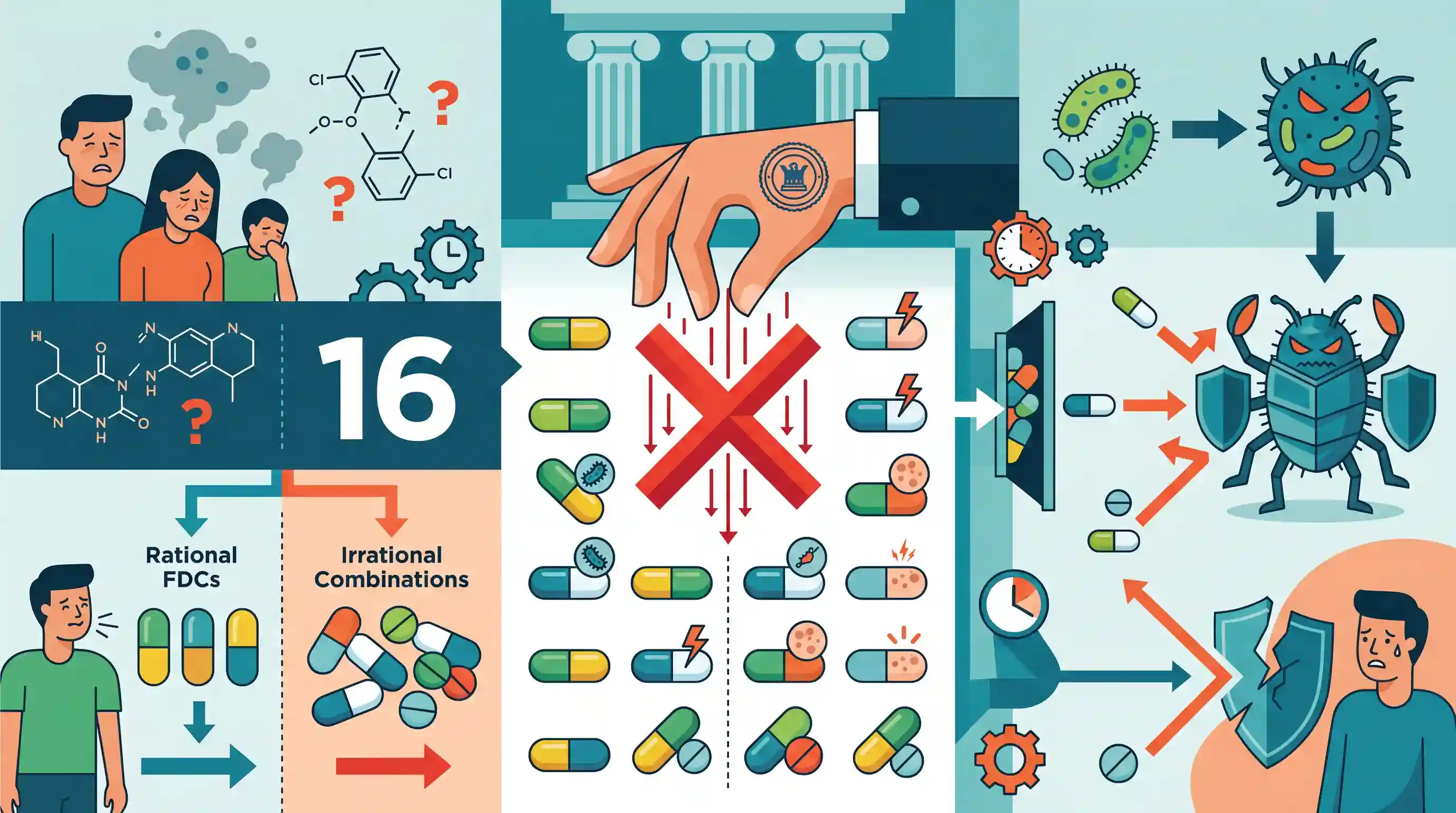
Why It Matters
Regulating irrational Fixed Dose Combinations (FDCs) is a critical governance and public health issue. It directly ties into India's fight against Antimicrobial Resistance (AMR) and the mandate of CDSCO under the Drugs and Cosmetics Act, making it highly relevant for GS2 (Governance/Health) and GS3 (Science & Tech/AMR).
Summary
The Union Ministry of Health and Family Welfare has banned 16 fixed-dose combination (FDC) drugs, citing public health concerns and a lack of therapeutic justification. These banned FDCs include combinations of antibiotics, painkillers, and medications for skin infections. The action, taken under Section 26A of the Drugs and Cosmetics Act, highlights the government's ongoing effort to regulate the pharmaceutical sector and remove irrational drug cocktails from the market. While scientifically validated FDCs can improve patient compliance, irrational combinations pose significant risks, including toxicity and accelerating antimicrobial resistance (AMR).
Key Points
- The Union Health Ministry has banned 16 fixed-dose combination (FDC) drugs, including certain antibiotics, painkillers, and skin medications, citing public health risks and lack of therapeutic justification.
- The ban was enforced under Section 26A of the Drugs and Cosmetics Act, which allows the government to prohibit drugs that pose a risk to human health or lack therapeutic value.
- Fixed Dose Combinations (FDCs) combine two or more active drugs in a single dosage form; while some are effective (e.g., for TB or HIV), irrational combinations can lead to adverse effects and contribute to antimicrobial resistance (AMR).
- This move is part of an ongoing regulatory crackdown by the CDSCO to eliminate unscientific drug cocktails and ensure only safe, scientifically validated medicines remain on the market.
Important Terms
Fixed-Dose Combination (FDC)

A pharmaceutical product containing two or more active ingredients in a fixed ratio within a single dosage form, such as a tablet or capsule.
UPSC context
GS-2 Health/GS-3 Science; crucial for understanding 'irrational drugs', patient compliance, and pharmaceutical regulation in India.
Drugs and Cosmetics Act, 1940 (Section 26A)
A legal provision empowering the Central Government to prohibit or regulate drugs in public interest if they pose risks or lack scientific justification.
UPSC context
GS-2 Governance/Statutory Acts; tests knowledge of the legal framework governing drug safety and executive powers.
Central Drugs Standard Control Organisation (CDSCO)
India's national regulatory body for pharmaceuticals and medical devices, functioning under the Ministry of Health and Family Welfare to ensure drug safety.
UPSC context
GS-2 Regulatory Bodies; essential for questions on health governance, drug approval processes, and pharmaceutical standards.
Antimicrobial Resistance (AMR)
The process where microorganisms evolve to resist medications, rendering standard treatments ineffective and creating difficult-to-treat 'superbugs.'
UPSC context
GS-3 Science & Tech; a major global health threat often linked to the misuse of irrational antibiotic combinations.
Drugs Technical Advisory Board (DTAB)
The highest statutory body in India providing technical advice to the government on drug regulation and pharmaceutical policy matters.
UPSC context
GS-2 Health Governance; relevant for understanding the expert-driven decision-making process behind drug bans.
Therapeutic Justification
The scientific and clinical evidence required to prove that a drug combination offers a clear medical advantage over individual components.
UPSC context
GS-2 Public Health; tests understanding of 'rational' drug use and the scientific criteria for pharmaceutical approvals.
Prelims Trap
All Fixed Dose Combination (FDC) drugs are banned in India for accelerating antimicrobial resistance.
Only irrational FDCs are banned. Scientifically validated FDCs are legally approved and essential for treating conditions like Tuberculosis (TB) and HIV, as they improve patient adherence by reducing pill burden.
Static Concepts Connected
What is the regulatory framework for drugs in India?
- CDSCO: The Central Drugs Standard Control Organisation, headed by the DCGI under the Health Ministry, handles drug approvals, import, and clinical trials.
- State Licensing Authorities: While the Centre approves new drugs, State Drug Regulatory Authorities issue licenses for the manufacture, sale, and distribution of drugs.
- Drugs and Cosmetics Act: The core legislation governing the sector. Section 26A specifically empowers the Central Government to ban drugs that lack therapeutic justification or pose public health risks.
What are Fixed-Dose Combinations (FDCs) and why are they debated?
- Definition: FDCs are pharmaceutical formulations that combine two or more active pharmaceutical ingredients (APIs) in a single pill or capsule.
- Therapeutic Benefits: Rational FDCs reduce 'pill burden', significantly improving patient compliance for chronic or infectious diseases like HIV, Malaria, and Tuberculosis.
- Irrational FDC Risks: Unscientific combinations unnecessarily expose pathogens to multiple drugs, increasing toxicity risks and accelerating Antimicrobial Resistance (AMR) without added medical benefit.
Cross-Topic Patterns
AMR and the One Health Approach
Irrational FDCs in humans parallel the misuse of antibiotics (like colistin) in the poultry sector. Both are critical drivers of India's Antimicrobial Resistance (AMR) crisis, often addressed via the 'One Health' approach.
Patent Evergreening vs. FDC Formulations
Pharma companies sometimes use minor FDC formulations to artificially extend patent life. This connects FDC regulation directly to Section 3(d) of the Indian Patent Act, which prevents 'evergreening'.

AMR drivers (irrational FDCs) combined with CDSCO statutory powers under the Drugs & Cosmetics Act will likely form a 2026 Prelims MCQ.
Linked PYQs · 3
Linked PYQs · 3
- 2019PrelimsGS1
Which of the following are the reasons for the occurrence of multi-drug resistance in microbial pathogens in India? 1. Genetic predisposition of some people 2. Taking incorrect doses of antibiotics to cure diseases 3. Using antibiotics in livestock farming 4. Multiple chronic diseases in some people Select the correct answer using the code given below.
- 2024MainsGS2
In a crucial domain like the public healthcare system the Indian State should play a vital role to contain the adverse impact of marketisation of the system. Suggest some measures through which the State can enhance the reach of public healthcare at the grassroots level.
- 2022PrelimsGS1
Consider the following statements: 1. Biofilms can form on medical implants within human tissues. 2. Biofilms can form on food and food processing surfaces. 3. Biofilms can exhibit antibiotic resistance. Which of the statements given above are correct?
