Centre Support for Himachal University Tribal Healing Research
Source:tribuneindia ↗
Why It Matters
Important for HPAS aspirants as it highlights state-specific tribal culture, indigenous knowledge systems, and central-state academic collaborations in preservation of heritage.
Summary
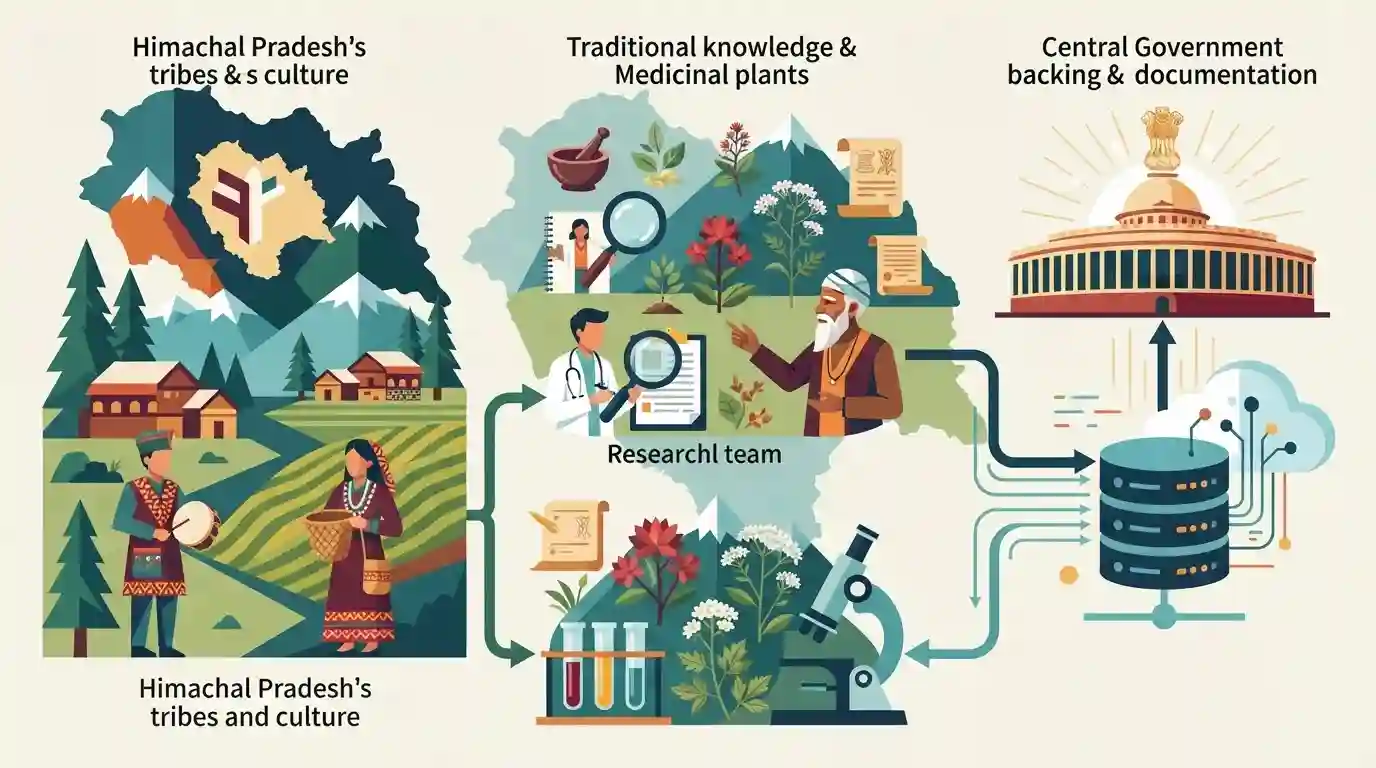
The Central Government has backed Himachal Pradesh University's research initiative focused on documenting and validating tribal healing knowledge and traditional medicine systems in the state.
Key Points
- The Central Government has extended backing and support to Himachal Pradesh University (HPU) for conducting specialized research into tribal healing knowledge and indigenous medicine systems.
- The research initiative aims to document, preserve, and scientifically validate traditional healing practices, folklore, and medicinal plant usage prevalent among the tribal communities of Himachal Pradesh.
- This project underscores the integration of traditional tribal wisdom with modern scientific frameworks to safeguard intangible cultural heritage and indigenous health systems in the state.
Important Terms
Himachal Pradesh University

A premier state university in Shimla, Himachal Pradesh, hosting academic institutions like the Institute of Tribal Studies, which conducts research on indigenous communities, ethnomedicine, and regional development.
UPSC context
HPAS GS Paper I & III: Tests knowledge of higher education institutions, regional research initiatives, and documentation of local tribal heritage in HP.
Centre (Central Government)
The Union Government of India, which funds and supports specialized initiatives like Tribal Research Institutes and developmental schemes for indigenous mountain communities.
UPSC context
HPAS GS Paper II & III: Important for understanding Centre-State financial coordination, centrally sponsored schemes, and tribal welfare policies.
Prelims Trap
Institute of Tribal Studies was recently established as a statutory body under the Ministry of Tribal Affairs.
Aspirants often confuse the Institute of Tribal Studies (ITS) with a newly created autonomous body, whereas it was established in 1994 and got TRI status in 2008.
Static Concepts Connected
What are the major notified Scheduled Tribes and their traditional habitats in Himachal Pradesh?
- Major Tribes: Gaddis & Gujjars: Primarily inhabit Chamba district (Bharmour and Pangi) and parts of Kangra, known for semi-nomadic pastoralism and transhumance.
- Border Tribes: Kinnauras & Lahaulas: Inhabit the cold desert and high-altitude districts of Kinnaur and Lahaul-Spiti, possessing rich Buddhist and indigenous folk healing traditions.
- Traditional Systems: Pangwahas & Lahaulis: Indigenous groups residing in difficult terrain, relying heavily on local Amchi systems and herbal medicine for primary healthcare.
Cross-Topic Patterns
Ethnomedicine Documentation & Intellectual Property Rights
The documentation of ethnomedicine in tribal belts links directly to the Geographical Indication (GI) tag registration for indigenous medicinal flora and traditional handicraft items under the Intellectual Property Rights framework.
Tribal Research & Fifth Schedule Governance
Research initiatives by institutions like HPU's Institute of Tribal Studies connect directly with the Fifth Schedule governance mechanisms and tribal sub-plans operational in Kinnaur, Lahaul-Spiti, and Chamba.

Ethnomedicine projects and tribal district distribution (Kinnaur, Lahaul-Spiti, Chamba) are high-yield areas for HPAS Prelims matching lists.
Linked PYQs · 2
Linked PYQs · 2
- 2025HPAS_PRELIMSGS1
Given below are two statements : Statement I : The Gujjars of Himachal Pradesh are both Hindus and Muslims. Statement II : Lahaulis and Spitianis have Mongoloid features. In the light of the above statements, choose the most appropriate answer from the options given below :
- 2020HPAS_PRELIMSGS1
‘Mundro’ and ‘Garu’ are known as the children of hypergamous union of which of the following tribe?
