Civil Defence Preparedness and Border Security Management
Source:The Hindu ↗
Why It Matters
This issue comprehensively links internal security preparedness (civil defence mechanisms and border management) with international diplomacy (abeyance of the Indus Waters Treaty). It demonstrates the operationalization of passive defence strategies and represents a crucial case study for GS3 (Security Challenges) and GS2 (India and its Neighborhood).
Summary
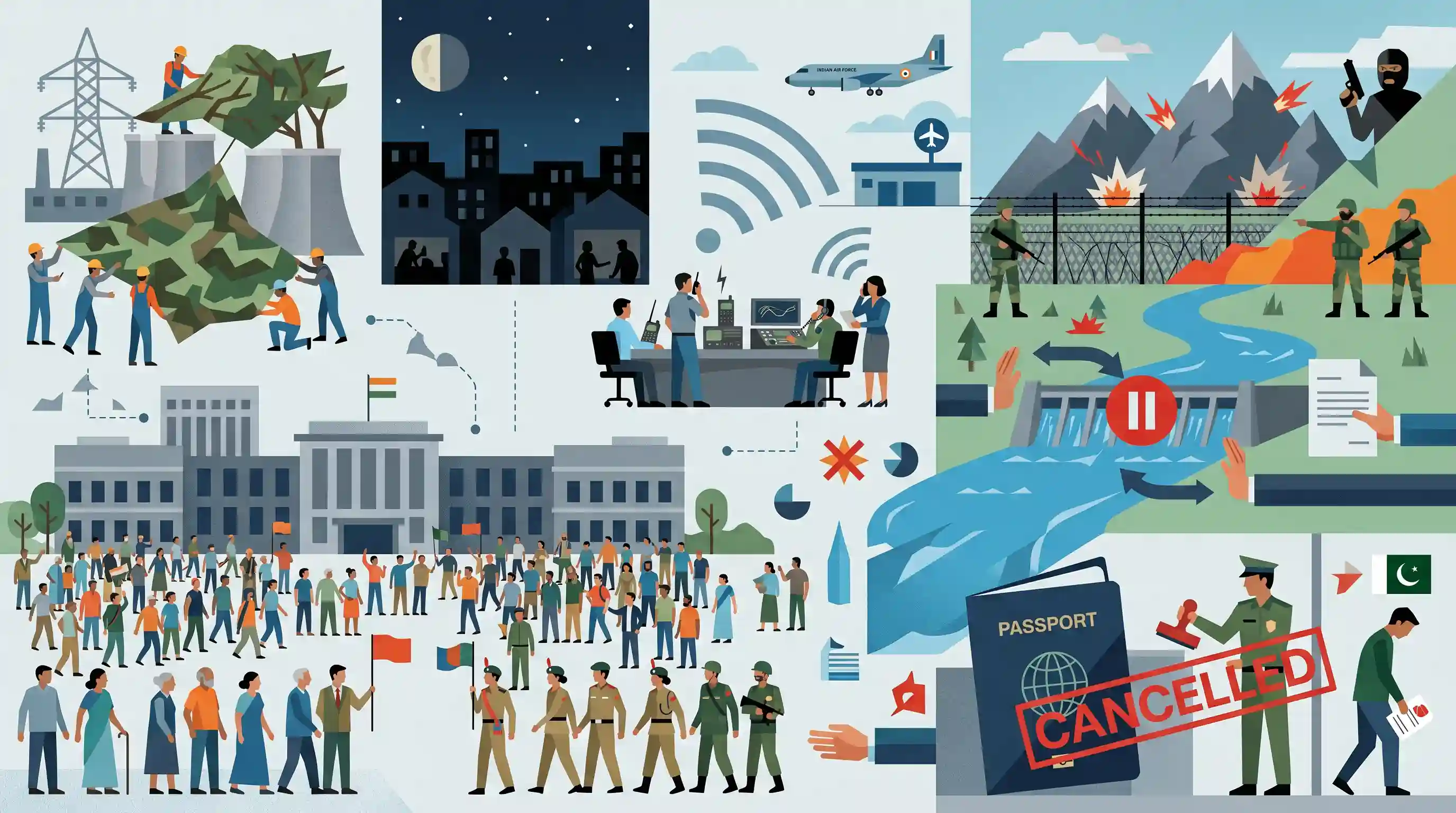
In response to the Pahalgam terror attack and escalating border tensions with Pakistan, the Ministry of Home Affairs (MHA) has instructed states to conduct large-scale civil defence mock drills across 244 vulnerable districts. The exercises, mobilizing over four lakh volunteers alongside the NCC and NYKS, involve blackout protocols, camouflaging vital installations, and establishing hotlines with the Indian Air Force to prepare for potential hostile attacks. Concurrently, India has escalated diplomatic countermeasures by placing the Indus Waters Treaty (IWT) in abeyance and cancelling visas for Pakistani nationals amid unprovoked cross-border firing along the Line of Control.
Key Points
- The MHA directed 244 categorised districts to conduct mock drills to prepare for hostile attacks, involving air-raid sirens, blackouts, and camouflaging vital installations.
- The drills mobilize over four lakh Civil Defence volunteers, NCC cadets, and NYKS members, coordinated with state police and the Indian Air Force.
- These measures follow the April 22 Pahalgam terror attack that killed 26 people, along with unprovoked cross-border firing by the Pakistani Army along the LoC.
- Diplomatically, India has placed the Indus Waters Treaty (IWT) in abeyance and cancelled visas for Pakistani nationals in response to the escalation.
Important Terms
Indus Waters Treaty (IWT)

A 1960 World Bank-brokered water-sharing agreement between India and Pakistan. Following the 2025 Pahalgam attack, India placed it in 'abeyance', suspending data-sharing and technical cooperation pending a halt to cross-border terrorism.
UPSC context
GS Paper II: India-Pakistan relations and transboundary water governance; tests understanding of water diplomacy and 'abeyance' as a strategic tool.
Directorate General of Civil Defence
A specialized department under the Ministry of Home Affairs (MHA) responsible for coordinating civilian protection during war or disasters. It oversees 'Operation Abhyaas' mock drills in 244 vulnerable districts.
UPSC context
GS Paper III: Disaster Management and Internal Security; tests knowledge of organizational frameworks for hinterland protection during hostile attacks.
Civil Defence Act, 1968
The legal framework governing India's civil defense measures. It empowers the government to mobilize volunteers and conduct drills for protecting life and property during 'hostile attacks' or disasters.
UPSC context
GS Paper III: Internal Security/Disaster Management; relevant for questions on legislative measures for national preparedness and civilian mobilization.
National Cadet Corps (NCC)
A tri-service youth organization under the Ministry of Defence. In internal security contexts, its cadets provide volunteer support for civil defence mock drills, assisting in evacuation and public safety training.
UPSC context
GS Paper III: Role of non-state actors/youth organizations in supporting internal security and disaster response frameworks.
Nehru Yuva Kendra Sangathan (NYKS)
An autonomous body under the Ministry of Youth Affairs and Sports. It mobilizes rural youth for nation-building and is integrated into MHA’s civil defence drills to ensure village-level preparedness.
UPSC context
GS Paper II: Government policies and interventions; tests understanding of grassroots mobilization for emergency preparedness.
Prelims Trap
"India formally terminated the Indus Waters Treaty under the Vienna Convention in response to cross-border terrorism."
India placed the IWT in 'abeyance' (temporary suspension of procedural cooperation), not formal termination. This preserves the legal framework while halting active cooperation.
Static Concepts Connected
How does placing an international treaty in 'abeyance' differ from formal termination?
- Nature of Abeyance: It temporarily pauses procedural cooperation (e.g., Permanent Indus Commission meetings) without dissolving the underlying legal agreement.
- Vienna Convention (VCLT): VCLT allows suspension of treaty operations due to a material breach, keeping the treaty legally alive to preserve future diplomatic leverage.
- Formal Termination: Permanently ends all legal obligations, usually requiring specific clauses, mutual consent, or complete withdrawal to trigger.
What is the statutory basis and mandate of Civil Defence in India?
- Statutory Origin: Governed by the Civil Defence Act, 1968, originally designed to protect persons and property from hostile attacks and minimize disruptions.
- Disaster Management Shift: A 2009 amendment expanded its mandate beyond wartime hostilities to formally include disaster management and peacetime emergency first-responder duties.
- Grassroots Deployment: Utilizes community volunteers, NCC cadets, and NYKS members, heavily integrated with local police and the district administration during crises.
Cross-Topic Patterns
IWT Abeyance + VCLT Principles
Linking the IWT suspension to the Vienna Convention on the Law of Treaties connects bilateral security escalations with static international law principles often tested in Prelims.
Civil Defence + Disaster Management
The evolution of Civil Defence volunteers from wartime blackout wardens to frontline disaster responders bridges the Civil Defence Act of 1968 with the Disaster Management framework.

Expect a multi-statement Prelims question contrasting 'abeyance' of the Indus Waters Treaty with formal termination under the VCLT.
Linked PYQs · 3
Linked PYQs · 3
- 2024MainsGS3
India has a long and troubled border with China and Pakistan fraught with contentious issues. Examine the conflicting issues and security challenges along the border. Also give out the development being undertaken in these areas under the Border Area Development Programme (BADP) and Border Infrastructure and Management (BIM) Scheme.
- 2016MainsGS2
Increasing cross-border terrorist attacks in India and growing interference in the internal affairs of several member-states by Pakistan are not conducive for the future of SAARC (South Asian Association for Regional Cooperation)." Explain with suitable examples.
- 2012MainsGS2
The situation today is far different to that prevalent fifty years back when the Indus Water Treaty was signed." Highlight the complexity of the current challenges on both sides of the border in this regard. Do you think that a review of the Treaty is in India's best interests?
