Price Support Scheme Pulses and Oilseeds Procurement in Uttar Pradesh
Source:dd-news ↗
Why It Matters
Agricultural price support mechanisms, cropping seasons (especially Zaid/summer crops like Moong and Urad), and economic data pertaining to Uttar Pradesh's agricultural sector are recurrent areas of high relevance for the UPPSC PCS Prelims.
Summary
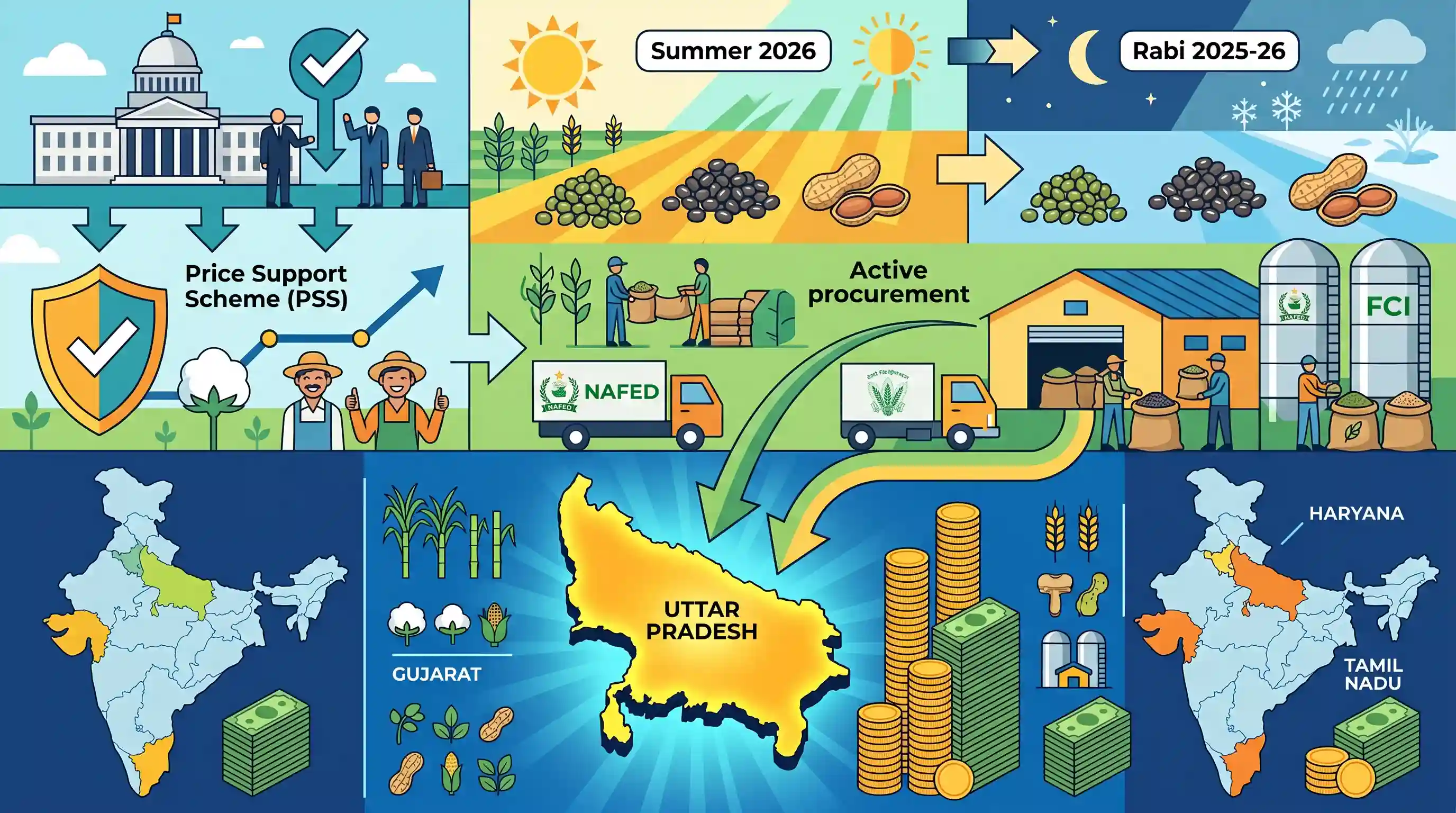
The Central Government approved the large-scale procurement of pulses (moong and urad) and oilseeds (groundnut) under the Price Support Scheme (PSS) at Minimum Support Prices (MSP) for the Summer 2026 and Rabi 2025-26 seasons. Benefitting four states, Uttar Pradesh emerged as the largest beneficiary with a sanctioned procurement package worth over ₹1,490 crore, followed by Gujarat, Haryana, and Tamil Nadu.
Key Points
- Union Agriculture Minister Shivraj Singh Chouhan approved large-scale procurement of pulses (moong, urad) and oilseeds (groundnut) under the Price Support Scheme (PSS) at MSP to prevent distress sales.
- Four states are the direct beneficiaries: Uttar Pradesh, Gujarat, Tamil Nadu, and Haryana, with Uttar Pradesh being the largest beneficiary.
- For Uttar Pradesh (Summer 2026 season): The government cleared procurement of 48,298 MT of moong, 97,970 MT of urad, and 41,718 MT of groundnut, valued at over ₹1,490 crore at MSP.
- For Gujarat (Summer 2026 season): Approved procurement of 18,250 MT of moong, valued at over ₹160 crore at MSP.
- For Tamil Nadu (Rabi Marketing Season 2025-26): Revised the moong procurement target upward from 885 MT to 990 MT, valued at ₹8.68 crore.
- For Haryana (Summer 2026 season): Approved procurement of 2,115 MT of moong, valued at over ₹18 crore.
- PSS is a central scheme executed through nodal agencies like NAFED and FCI, focusing on maintaining stable agricultural pricing for pulses, oilseeds, and copra.
Important Terms
Price Support Scheme (PSS)

A market intervention scheme of the Central Government that physically procures notified pulses, oilseeds, and copra at the Minimum Support Price (MSP) when market prices fall below the floor price.
UPSC context
GS Paper III: Agriculture and Subsidies. Tests understanding of agricultural price stabilization, crop procurement, and farmer income protection.
PM-AASHA (Pradhan Mantri Annadata Aay Sanraksan Abhiyan)
An umbrella scheme launched in 2018 to ensure remunerative prices to farmers. It integrates components like the Price Support Scheme and Price Stabilization Fund to safeguard farmers from market price volatility.
UPSC context
GS Paper III: Government Schemes and Agriculture. Evaluates knowledge of policies enhancing farm viability, MSP compliance, and agricultural safety nets.
National Agricultural Cooperative Marketing Federation of India (NAFED)
An apex cooperative marketing organization established in 1958. It acts as a primary central nodal agency for procuring pulses and oilseeds directly from farmers under government price support schemes.
UPSC context
GS Paper III: Agricultural Marketing. Assesses knowledge of cooperative marketing, price stabilization, and institutional mechanisms in crop procurement.
Food Corporation of India (FCI)
A statutory body established in 1965 to execute national food policies, manage the procurement, storage, and distribution of food grains (mainly wheat and paddy), and maintain buffer stocks for food security.
UPSC context
GS Paper III: Food Security and PDS. Evaluates understanding of public distribution systems, buffer stock management, and state food intervention policies.
Prelims Trap
The Price Support Scheme (PSS) manages physical procurement for all 22 mandated MSP crops, including cereals and cotton.
PSS under PM-AASHA specifically targets pulses, oilseeds, and copra. Main cereals (wheat, paddy) are procured under regular central pool operations, not under the PSS mechanism.
Static Concepts Connected
What are the three core components of the PM-AASHA umbrella scheme?
- Price Support Scheme (PSS): Physical procurement of pulses, oilseeds, and copra by central nodal agencies (NAFED, FCI) with losses borne by the Centre.
- Price Deficiency Payment Scheme (PDPS): Direct payment of the difference between MSP and market price to registered farmers; no physical procurement is undertaken.
- Private Procurement & Stockist Scheme (PPPS): Involvement of selected private sector entities on a pilot basis to procure oilseeds in designated districts.
How is MSP calculated and approved in India?
- CACP Recommendation: An attached office of the Ministry of Agriculture that recommends MSPs based on cost of production, market trends, and inter-crop price parity.
- CCEA Approval: The Cabinet Committee on Economic Affairs (CCEA), chaired by the Prime Minister, holds the final authority to approve recommended MSPs.
- Crop Coverage: Covers 22 mandated crops (including 5 pulses and 7 oilseeds) plus Fair and Remunerative Price (FRP) for sugarcane.
Cross-Topic Patterns
Price support schemes vs WTO Amber Box limits
Indian physical procurement programs like PSS face international scrutiny at the WTO as trade-distorting Amber Box subsidies, testing India's "Peace Clause" defense limits.
Pulses procurement and National Food Security
Leveraging schemes like PSS to build a buffer stock of pulses directly supports protein-diversification efforts under the PM-Poshan and Targeted Public Distribution System (TPDS).

Expect a multi-statement question on PM-AASHA components, distinguishing between physical procurement (PSS) and price deficiency payments (PDPS).
Linked PYQs · 2
Linked PYQs · 2
- 2011UPPSC_PRELIMSGS1
Which of the following crops are grown mainly in the irrigated areas during Zaid?
- 2004UPPSC_PRELIMSGS1
NAFED is associated with
