Patna high court acting chief justice constitutional appointment
Source:indianmasterminds ↗
Why It Matters
This current affairs development is of high relevance to BPSC Prelims, highlighting key constitutional provisions (Article 223) regarding the appointment of acting judges, the background of Bihar's judicial leadership, and links to state education history (Patna College).
Summary
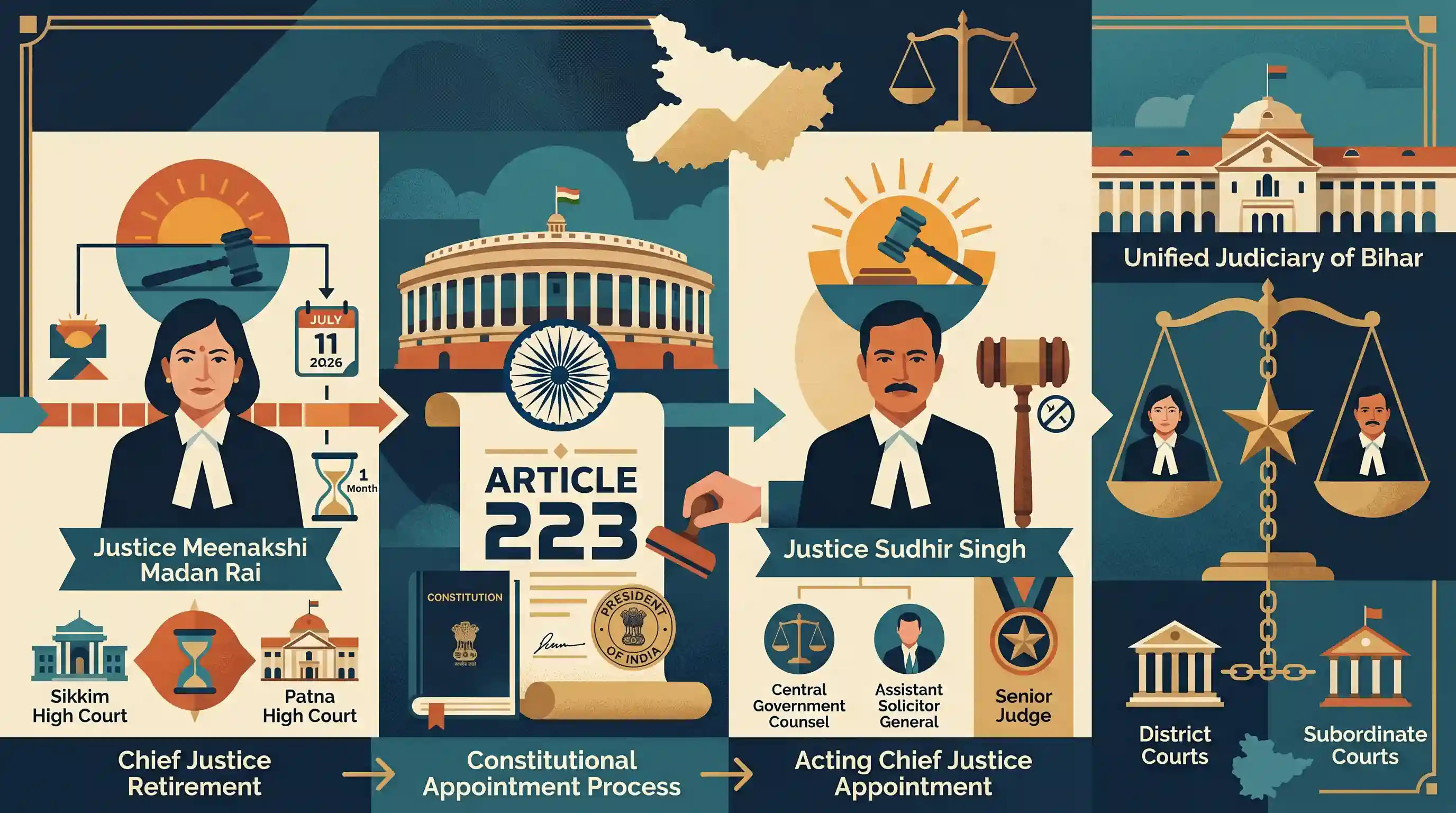
The Central Government has appointed senior judge Justice Sudhir Singh as the Acting Chief Justice of the Patna High Court under Article 223 of the Constitution of India, following the retirement of Chief Justice Meenakshi Madan Rai on July 11, 2026.
Key Points
- Justice Sudhir Singh has been appointed as the Acting Chief Justice of the Patna High Court, effective from July 11, 2026, following the retirement of Chief Justice Meenakshi Madan Rai.
- The official notification of the appointment was issued by the Ministry of Law and Justice, with President Droupadi Murmu making the appointment under Article 223 of the Constitution of India.
- Article 223 enables the President of India to appoint an Acting Chief Justice of a High Court when the office is vacant or when the Chief Justice is unable to perform official duties.
- Justice Sudhir Singh has over a decade of judicial experience; he was appointed as an Additional Judge of the Patna High Court on April 15, 2015, and became a Permanent Judge on April 20, 2016.
- He is an alumnus of Patna College (graduated in Political Science) and Patna Law College, and his father, Justice N.P. Singh, was a former Supreme Court Judge and Chairman of the Cauvery Water Disputes Tribunal.
Important Terms
Article 223 of the Constitution of India

A constitutional provision empowering the President of India to appoint a judge of a High Court as Acting Chief Justice when the office is vacant, absent, or unable to perform duties.
UPSC context
GS Paper II (Polity): Explores constitutional provisions regarding the state judiciary, executive power, and maintaining judicial continuity.
Patna High Court
The High Court of the state of Bihar, established in 1916, serving as the highest judicial authority in the state with a sanctioned strength of 44 judges.
UPSC context
GS Paper II (Polity): Focuses on the structure, jurisdiction, and functioning of the state judiciary in India.
Ministry of Law and Justice
The federal cabinet ministry responsible for managing India's legal affairs, legislative activities, and the administrative machinery of judicial appointments.
UPSC context
GS Paper II (Governance): Tests knowledge of the executive organs responsible for judicial appointments and administration.
Supreme Court of India
The apex judicial body in India, established under Article 124, serving as the ultimate court of appeal and guardian of the Constitution.
UPSC context
GS Paper II (Polity): Vital for understanding the integrated judicial system, judicial review, and landmark rulings.
Cauvery Water Disputes Tribunal
A statutory tribunal constituted under the Inter-State Water Disputes Act, 1956, to adjudicate the sharing of Cauvery River water among southern states.
UPSC context
GS Paper II (Polity): Evaluates constitutional mechanisms under Article 262 for resolving inter-state river water disputes.
Prelims Trap
The Governor of the respective state appoints the Acting Chief Justice of a High Court under Article 223.
Aspirants confuse the Governor’s power to administer the judicial oath (Article 219) with the President's exclusive power to appoint the Acting CJ under Article 223.
Static Concepts Connected
What is the constitutional framework for appointing an Acting Chief Justice of a High Court?
- Constitutional Basis: Article 223 empowers the President of India to appoint an acting Chief Justice when the office is vacant, absent, or unable to perform duties.
- Appointing Authority: The appointment is made solely by the President of India, while the state Governor only administers the oath of office under Article 219.
How do judge-strength determination rules differ between the Supreme Court and High Courts?
- High Court Strength: Under Article 216, the President of India has the executive power to determine and adjust the strength of individual High Courts.
- Supreme Court Strength: Under Article 124(1), the strength of the Supreme Court is determined strictly by the Parliament through legislative acts.
Cross-Topic Patterns
Executive Discretion vs Judicial Collegium
The interaction between Article 223 (Presidential appointment of Acting CJs) and the Collegium system highlights the delicate balance of executive discretion in temporary judicial leadership.
Colonial Charters and Modern High Courts
Charter High Courts (like Patna, established 1916) carry historical Letters Patent jurisdictions that transitioned into modern constitutional setups under Article 225.

Expect multi-statement questions testing differences in structural controls: President's Article 216 powers vs Parliament's SC powers.
Linked PYQs · 3
Linked PYQs · 3
- 2019BPSC_PRELIMSGS1
Who was the Chief Justice of the Patna High Court who administered the oath of office to Mr. Fagu Chauhan as the Governor of Bihar in July 2019?
- 2023BPSC_PRELIMSGS1
The authority to determine the number of Judges in a High Court rests with which of the following entities?
- 2024-IBPSC_PRELIMSGS1
When was the Patna College established?
