Census 2027 and Caste Enumeration Implications for Delimitation
Source:The Hindu ↗
Why It Matters
The Census directly impacts the federal structure (delimitation), affirmative action (caste enumeration), and political representation (women's reservation). It integrates core polity topics that UPSC tests on regarding electoral reforms, federal disputes, and social justice.
Summary
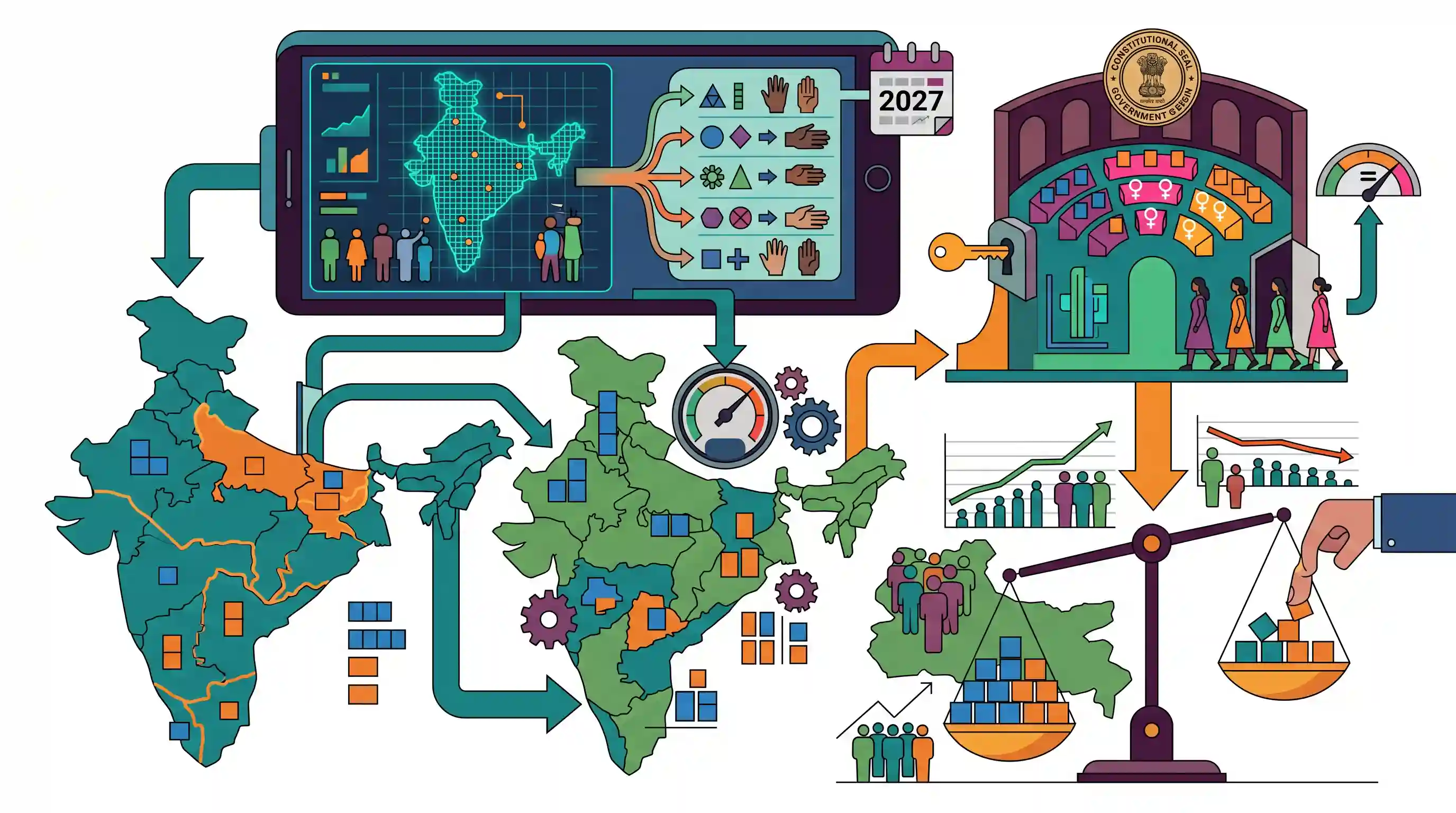
The Centre has announced that India's much-delayed decadal Census will be concluded by March 2027. Significantly, it will be the first digital Census and the first to enumerate caste data in independent India. The exercise holds immense political and constitutional importance, as the first Census published after 2026 will trigger the delimitation of Lok Sabha and State Assembly constituencies. This delimitation exercise is also a constitutional prerequisite for the implementation of the Nari Shakti Vandan Adhiniyam, which mandates 33% reservation for women in legislative bodies. Furthermore, the impending delimitation has sparked concerns among Southern states regarding potential loss of representation due to their lower population growth rates.
Key Points
- The Union Government announced the decadal Census will conclude by March 2027, delayed from 2021.
- It will be India's first digital Census and the first independent India census to enumerate caste.
- The census data will serve as the basis for the next delimitation of Lok Sabha constituencies, frozen since 2001.
- Delimitation raises federal concerns among Southern states fearing loss of political representation due to successful population control.
- The census is a prerequisite for implementing the Nari Shakti Vandan Adhiniyam (33% women's reservation in Parliament and State Assemblies).
Important Terms
Nari Shakti Vandan Adhiniyam

The Constitution (106th Amendment) Act, 2023, which reserves one-third of seats in the Lok Sabha, State Assemblies, and Delhi Assembly for women, including sub-reservations for SC/ST women.
UPSC context
GS-II (Polity/Governance); tests understanding of gender-responsive governance and the census-linked implementation mechanism.
84th Constitutional Amendment Act
Amending Articles 82 and 170, it froze the total number of Lok Sabha and State Assembly seats until the first census after 2026 to incentivize state-level population stabilization.
UPSC context
GS-II (Polity/Elections); tests knowledge of constituency seat allocation and the federal north-south representation debate.
Delimitation Commission
A statutory, quasi-judicial body appointed by the President to redraw electoral constituency boundaries based on the latest census, ensuring the principle of 'One Vote, One Value.'
UPSC context
GS-II (Electoral Processes); tests understanding of Articles 82/170 and the commission's non-challengeable legal status.
Caste Census
The systematic enumeration of caste identities (particularly OBCs) during the national census. Discontinued after 1931, its revival aims to provide empirical data for targeted affirmative action.
UPSC context
GS-I (Society) & GS-II (Social Justice); tests the history of social stratification and its impact on reservation policies.
Census Act, 1948
The 1948 legislation providing the legal framework for the decennial census, empowering the Centre to conduct the exercise while ensuring strict confidentiality of the data collected.
UPSC context
GS-II (Polity); tests the legal basis of India's largest demographic exercise and administrative separation of powers.
Prelims Trap
"Orders of the Delimitation Commission can be modified by the Lok Sabha before taking final effect."
Delimitation Commission orders possess the force of law, are strictly insulated from judicial review, and cannot be modified by either Parliament or State Legislative Assemblies.
Static Concepts Connected
How is the Delimitation Commission constituted and what are its core powers?
- Constitutional Basis: Under Article 82, Parliament enacts a Delimitation Act after every census. Article 170 mandates a similar exercise for State Legislative Assemblies.
- Composition: It is appointed by the President, typically comprising a retired Supreme Court judge, the Chief Election Commissioner, and respective State Election Commissioners.
- Absolute Immunity: Its orders have the force of law, cannot be challenged in any court, and cannot be modified when laid before the Lok Sabha.
What is the constitutional history of freezing Lok Sabha seats?
- 42nd Amendment (1976): Froze the allocation of inter-state Lok Sabha seats based on 1971 census figures until the year 2000 to incentivize state-level family planning.
- 84th Amendment (2001): Extended this freeze on the total number of seats until the publication of the first census after the year 2026.
- 87th Amendment (2003): Allowed for internal territorial redrawing of constituencies within a state based on the 2001 census, but kept the total number of state seats frozen.
Cross-Topic Patterns
Demographic Penalty and Federalism
Southern states' success in population control creates a federalism paradox. They face potential loss of political representation to Northern states, sparking debates on the metrics of cooperative federalism.
106th CAA Contingency Linkage
The Nari Shakti Vandan Adhiniyam's implementation structurally relies on post-2026 delimitation, officially linking women's political empowerment to the resolution of complex demographic and census data disputes.
Digital Census vs Data Privacy
India's first digital census intersects directly with the new Digital Personal Data Protection (DPDP) Act, raising critical governance questions about processing and safeguarding massive, sensitive caste datasets.

Expect a multi-statement question in 2026 combining the 84th CAA freeze, 106th CAA prerequisites, and Delimitation Commission immunity.
Linked PYQs · 4
Linked PYQs · 4
- 2024MainsGS1
Intercaste marriages between castes which have socio-economic parity have increased, to some extent, but this is less true of interreligious marriages. Discuss.
- 2022MainsGS1
Analyse the salience of 'sect' in Indian society vis-a-vis caste, region and religion.
- 2023MainsGS2
Discuss the contribution of civil society groups for women's effective and meaningful participation and representation in state legislatures in India.
- 2019MainsGS2
“The reservation of seats for women in the institutions of local self-government has had a limited impact on the patriarchal character of the Indian Political Process.” Comment.
