Interim financial allocation for rural employment mission
Source:The Hindu ↗
Why It Matters
The transition from MGNREGS to VB-GRAMG represents a major overhaul of India's flagship poverty alleviation and rural employment guarantee program. The integration of e-KYC and the proposed use of the Finance Commission's horizontal devolution formula to allocate funds signify major shifts in transparency, targeted welfare, and fiscal federalism, making it highly relevant for GS2 and GS3 syllabus areas.
Summary
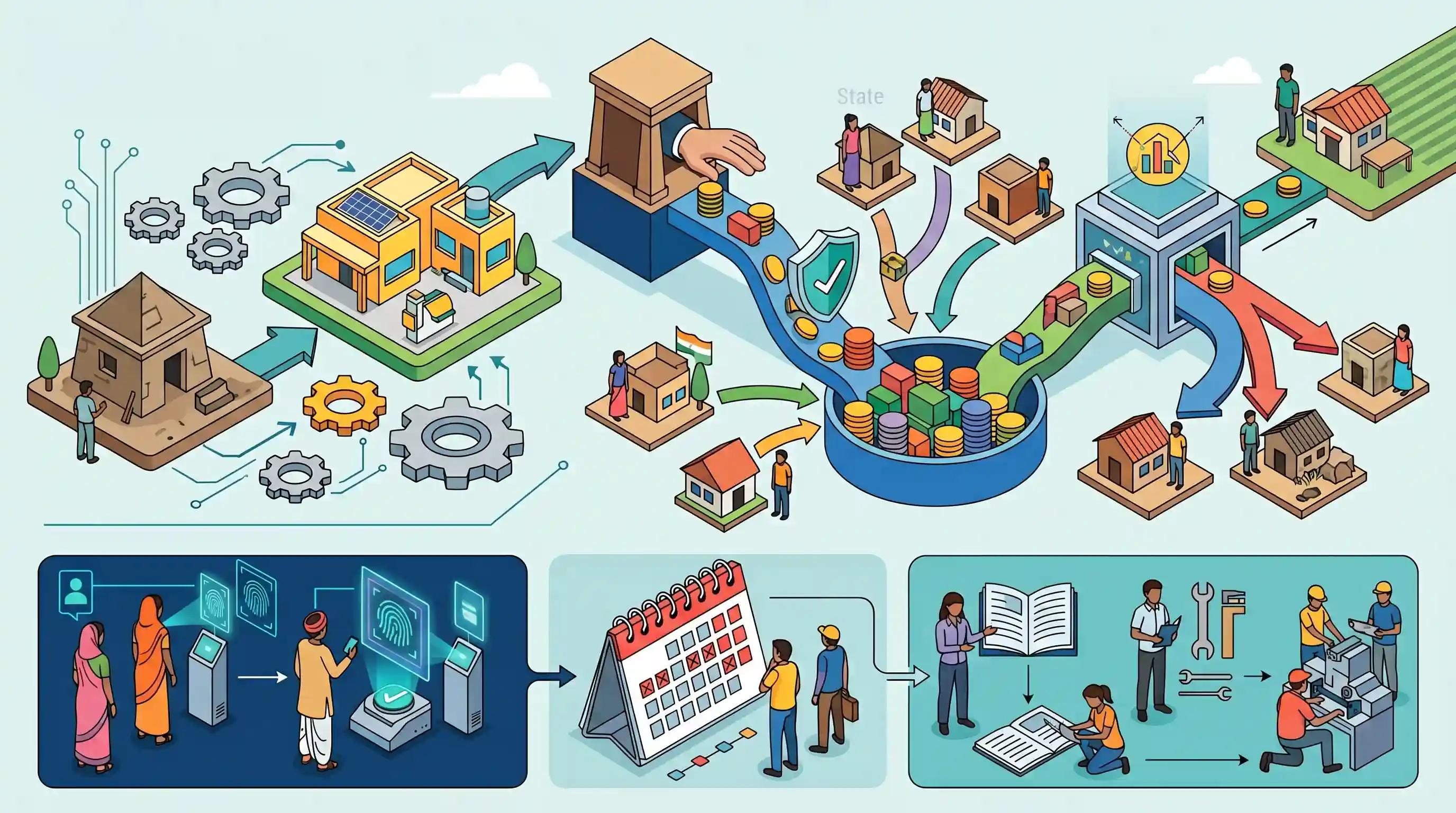
The Centre has announced an interim allocation of ₹95,962 crore for the Vikshit Bharat Guarantee for Rozgar and Ajeevika Mission Gramin (VB-GRAMG), the rural employment scheme replacing MGNREGS on July 1. Including the 40% state contribution, the total outlay stands at ₹1.25 lakh crore. While the interim allocation protects states from immediate fund cuts, draft rules suggest distributing future funds using the 16th Finance Commission's horizontal devolution formula to prioritize economically weaker states. To operationalize the scheme, states are currently completing procedural prerequisites like beneficiary e-KYC, fixing blackout periods, and capacity building.
Key Points
- VB-GRAMG will replace MGNREGS on July 1, with an interim central allocation of ₹95,962 crore to ensure seamless transition without a gap in work availability.
- The combined outlay is ₹1.25 lakh crore, with most States required to contribute an additional 40% of their allocated sum.
- Draft rules propose using the 16th Finance Commission's horizontal devolution formula to determine Central allocations, aiming to expand the scheme's presence in economically weaker States.
- Before implementation, States must frame rules, complete beneficiary e-KYC, set blackout periods aligned with agricultural cycles, and conduct capacity-building.
- While 26 States are ready, four are finalising formalities; additionally, West Bengal's pending ₹8,508 crore MGNREGA dues remain unresolved despite the state agreeing to new central conditions.
Important Terms
Vikshit Bharat Guarantee for Rozgar and Ajeevika Mission Gramin (VB-GRAMG)

A statutory rural employment scheme replacing MGNREGS in 2026. It guarantees 125 days of unskilled manual work per household, focusing on durable infrastructure and shifting to a normative, state-wise allocation model.
UPSC context
GS-2 (Welfare Schemes) & GS-3 (Employment). Tests knowledge of transformative social safety nets and the shift from demand-driven to allocation-based models.
Mahatma Gandhi National Rural Employment Guarantee Scheme (MGNREGS)
A landmark 2005 social security legislation that guaranteed 100 days of demand-driven wage employment to rural households. It was the predecessor to VB-GRAMG and emphasized worker rights and decentralization.
UPSC context
GS-2/GS-3. Tests the history of rights-based legislation, rural development, and the evolution of India's social security framework.
16th Finance Commission
A constitutional body chaired by Arvind Panagariya, tasked with recommending the distribution of tax revenues between the Centre and States (2026–31). It introduced performance-based metrics like GDP contribution.
UPSC context
GS-2 (Constitutional Bodies) & GS-3 (Fiscal Federalism). Tests understanding of resource allocation and the shifting balance of Centre-State relations.
Horizontal Devolution
The formula-based distribution of the states' share of the central tax pool among individual states. It uses criteria like income distance and population to ensure equity and reward efficiency.
UPSC context
GS-2/GS-3. Tests technical understanding of fiscal transfers, inter-state equity, and the criteria used to address regional imbalances.
Centrally Sponsored Scheme (CSS)
Welfare programs implemented by state governments but partially funded by the Central government with a defined cost-sharing ratio (e.g., 60:40). They allow the Centre to direct national development priorities.
UPSC context
GS-2 (Centre-State Relations) & GS-3 (Economy). Tests knowledge of the financial architecture and implementation of flagship national programs.
e-KYC (Electronic Know Your Customer)
A paperless, Aadhaar-based process to verify a beneficiary's identity electronically. In scheme delivery, it ensures targeted fund transfer and eliminates leakages through biometric or OTP-based authentication.
UPSC context
GS-2 (E-governance). Tests the application of technology in improving transparency, accountability, and the efficiency of public service delivery.
Prelims Trap
"VB-GRAMG retains the demand-driven legal guarantee of employment, with the Centre bearing 100% of unskilled wage costs."
Unlike MGNREGS, VB-GRAMG is a budget-capped scheme rather than demand-driven, and it crucially shifts unskilled wage funding to a 60:40 Centre-State ratio.
Static Concepts Connected
What are the key criteria typically used in Finance Commission horizontal devolution?
- Income Distance: Assigns the highest weightage (often around 42.5% to 45%) to ensure equity by directing proportionally more funds to economically weaker states.
- Population & Demographics: Uses 2011 census population figures, balanced by a 'demographic performance' criterion to reward states that have successfully controlled fertility rates.
- Area & Ecology: Considers total geographical expanse and forest/ecology cover, compensating states for maintaining carbon sinks and restricting economic land use.
What differentiates Centrally Sponsored Schemes (CSS) from Central Sector Schemes?
- Central Sector Schemes: 100% funded and directly implemented by the Union Government. These schemes are typically formulated on subjects present in the Union List.
- Centrally Sponsored Schemes: Funded jointly by the Centre and States (usually in a 60:40 or 90:10 ratio) but implemented by State Governments. They target vital State List subjects like health and rural development.
Cross-Topic Patterns
Fiscal Federalism & CSS Rationalization
The shift from 100% central wage funding to a 60:40 ratio increases state fiscal burdens, tying directly into broad syllabus debates on Centrally Sponsored Scheme (CSS) rationalization and state debt.
Agricultural Labor vs. Welfare Schemes
Introducing up to 60-day "blackout periods" addresses long-standing economic friction: farmer complaints that rural employment schemes cannibalize agricultural labor and inflate wages during peak sowing and harvesting seasons.
E-Governance and Targeted Delivery
Mandating 100% e-KYC before scheme implementation highlights the persistent push to eliminate ghost beneficiaries, reflecting the broader integration of welfare delivery via the JAM (Jan Dhan-Aadhaar-Mobile) trinity.

Expect a 2026 Prelims question contrasting MGNREGA’s demand-driven, 100% wage-funded model with VB-GRAMG’s budget-capped, 60:40 structure.
Linked PYQs · 4
Linked PYQs · 4
- 2017MainsGS2
Poverty alleviation programmes in India remain mere showpieces until and unless they are backed up by political will." Discuss with reference to the performance of the major poverty alleviation programmes in India.
- 2025MainsGS2
Examine the evolving pattern of Centre-State financial relations in the context of planned development in India. How far have the recent reforms impacted the fiscal federalism in India?
- 2023MainsGS2
e-governance, as a critical tool of governance, has ushered in effectiveness, transparency and accountability in governments. What inadequacies hamper the enhancement of these features ?
- 2022MainsGS2
Besides the welfare schemes, India needs deft management of inflation and unemployment to serve the poor and the underprivileged sections of the society. Discuss.
