Centre Directs Assessment of Yamuna Dam Impact on Taj Mahal Foundation
Source:Indian Express ↗
Why It Matters
This issue perfectly illustrates the intersection of infrastructure development, environmental conservation, and heritage protection. For UPSC aspirants, it highlights the practical application of Environmental Impact Assessments (EIAs) and the vulnerability of ancient architectural marvels to modern hydrological interventions.
Summary
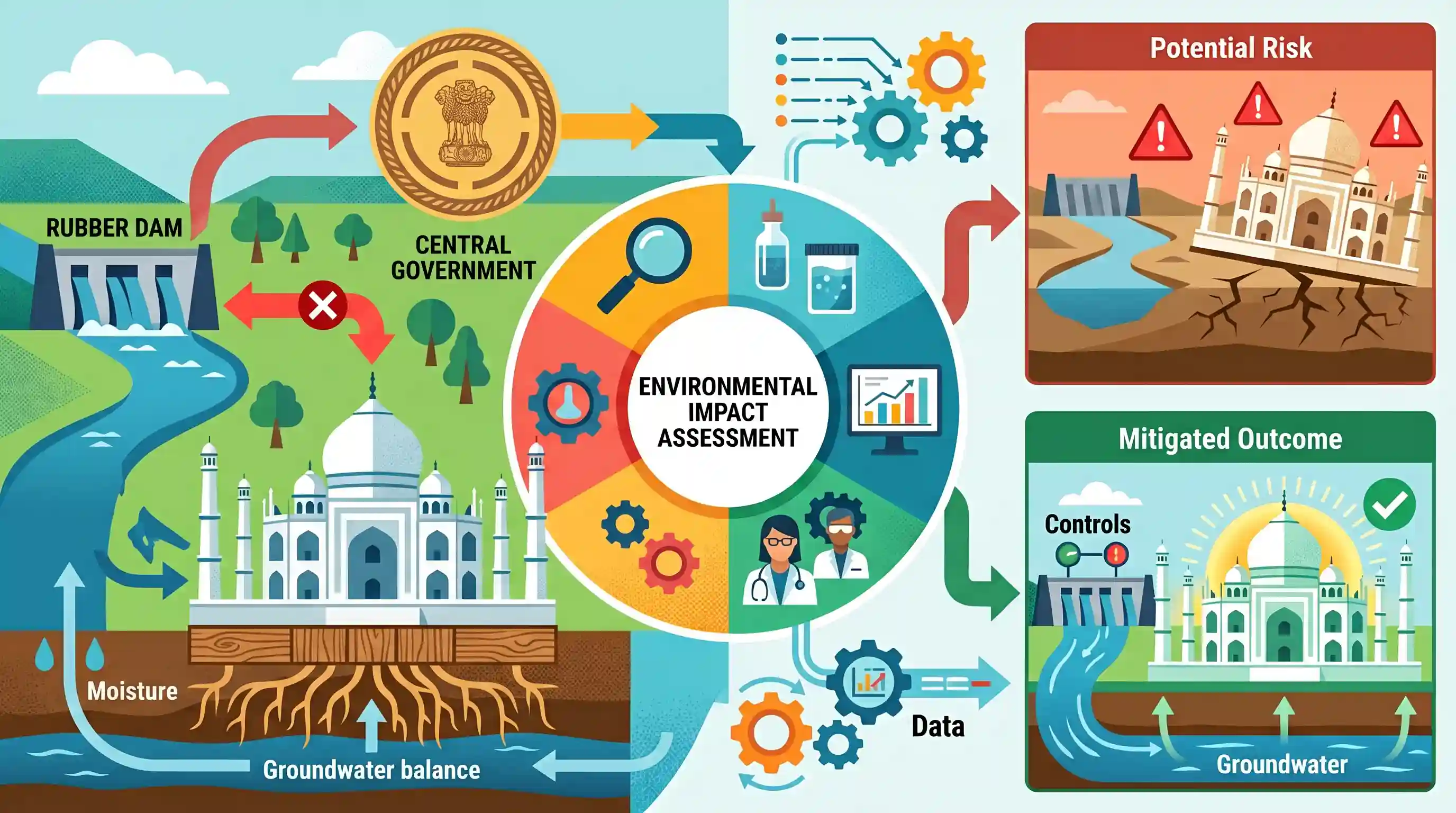
The Central Government has directed the Uttar Pradesh state government to conduct a comprehensive assessment of a proposed rubber dam on the Yamuna River in Agra, specifically focusing on its potential impact on the Taj Mahal's foundation. The monument is built on a wooden foundation that depends on a specific moisture level from the adjacent river to remain structurally sound. Authorities emphasize that before altering the river's natural hydrology, a rigorous Environmental Impact Assessment (EIA) must be undertaken to ensure the infrastructure project does not inadvertently jeopardize India's most iconic heritage site.
Key Points
- The Central government has advised Uttar Pradesh to thoroughly assess the potential impact of a proposed rubber dam on the Yamuna river on the Taj Mahal.
- The proposed rubber dam aims to maintain adequate water levels in the Yamuna behind the Taj Mahal for aesthetic and environmental purposes.
- The 17th-century monument rests on a specialized wooden foundation (primarily ebony and sal) that requires continuous, regulated moisture from the Yamuna to maintain its structural integrity and prevent wood decay.
- Any alteration to the river's hydrology—such as prolonged waterlogging, shifts in the water table, or drying up—could destabilize the foundation.
- The situation underscores the critical need for rigorous Environmental Impact Assessments (EIAs) when planning infrastructure projects near sensitive historical and heritage sites.
Important Terms
Environmental Impact Assessment (EIA)

A systematic process evaluating the potential environmental, social, and economic consequences of a proposed development project before it receives statutory clearance.
UPSC context
GS Paper III: Environment & Ecology; tests understanding of sustainable development and environmental governance frameworks.
Archaeological Survey of India (ASI)
An attached office of the Ministry of Culture responsible for archaeological research and the conservation of centrally protected monuments like the Taj Mahal.
UPSC context
GS Paper I: Art & Culture; relevant for heritage management and conservation of historical monuments.
Taj Trapezium Zone (TTZ)
A defined area of 10,400 sq km around the Taj Mahal to protect the monument from pollution-induced discoloration and structural decay.
UPSC context
GS Paper III: Environment; essential for case studies on pollution control and judicial activism.
National Mission for Clean Ganga (NMCG)
The implementation wing of the National Ganga Council, responsible for pollution abatement and rejuvenation of the Ganga river basin and its tributaries.
UPSC context
GS Paper II: Government Policies; tests knowledge of statutory bodies and river rejuvenation schemes.
Rubber Dam
A flexible, inflatable weir made of rubber-coated fabric, used to regulate river flow and store water without permanent concrete obstruction.
UPSC context
GS Paper III: Science & Technology/Environment; innovative engineering solutions for water resource management.
Hydrogeological Study
The scientific study of the distribution and movement of groundwater within the soil and rock formations of the Earth's crust.
UPSC context
GS Paper I: Geography; relevant to groundwater management and environmental impact studies.
Prelims Trap
"Higher moisture levels from the Yamuna river cause the decay of the Taj Mahal's wooden foundations."
This is a classic trap. The Taj Mahal's ebony/sal well-foundation specifically requires continuous moisture to remain in an anaerobic state, preventing aerobic decay and brittleness.
Static Concepts Connected
What is the statutory basis and scope of EIA in India?
- Statutory backing: EIA derives its legal mandate from the Environment (Protection) Act, 1986.
- Core mandate: Mandates Environmental Clearance (EC) for new projects or expansions of existing ones as listed in the EIA Notification (2006).
- Heritage provisions: Special appraisal procedures are triggered when infrastructure projects are proposed near eco-sensitive zones or protected archaeological monuments.
How did Mughal engineers construct the Taj Mahal's foundation on a riverbank?
- Well foundation: Deep wells were sunk into the soft alluvial soil and filled with rocks, mortar, and heavy timber rafts.
- Weight distribution: This engineering technique effectively dispersed the massive weight of the marble mausoleum across the sandy riverbank.
- Submerged timber: Utilized heavy woods like ebony and sal, which actually gain strength and resist microbial decay when kept continuously submerged in water.
Cross-Topic Patterns
Infrastructure vs. Heritage Hydrology
The tension between urban riverfront development (like rubber dams) and ancient monument hydrology mirrors debates seen in projects like the Kashi Vishwanath corridor and their impact on natural riverine ecosystems.
EIA mandates for riverine modifications
UPSC frequently links EIA mandates with river interventions (like dams or dredging), testing whether such hydrological modifications require mandatory environmental clearance under the Environment Protection Act.

Taj Mahal's well-foundation mechanics and EIA mandates under EPA 1986 for riverine heritage sites are prime for a 2026 multi-statement Q.
Linked PYQs · 4
Linked PYQs · 4
- 2024MainsGS3
What role do environmental NGOs and activists play in influencing Environmental Impact Assessment (EIA) outcomes for major projects in India? Cite four examples with all important details.
- 2018MainsGS1
Safeguarding the Indian art heritage is the need of the moment. Discuss.
- 2019PrelimsGS1
Consider the following pairs: Famous place River 1. Pandharpur : Chandrabhaga 2. Tiruchirappalli : Cauvery 3. Hampi : Malaprabha Which of the pairs given above are correctly matched?
- 2022PrelimsGS1
Consider the following pairs: Reservoirs States 1. Ghataprabha - Telangana 2. Gandhi Sagar - Madhya Pradesh 3. Indira Sagar - Andhra Pradesh 4. Maithon - Chhattisgarh How many pairs given above are not correctly matched?
