Solapur flood crop damage assessment and administrative apathy
Source:Indian Express ↗
Why It Matters
The article serves as a strong case study for GS-2 (Governance) and GS-4 (Ethics in public administration) regarding administrative apathy, bureaucratic disconnect, and the failure of top-down approaches in disaster management and farmer welfare.
Summary
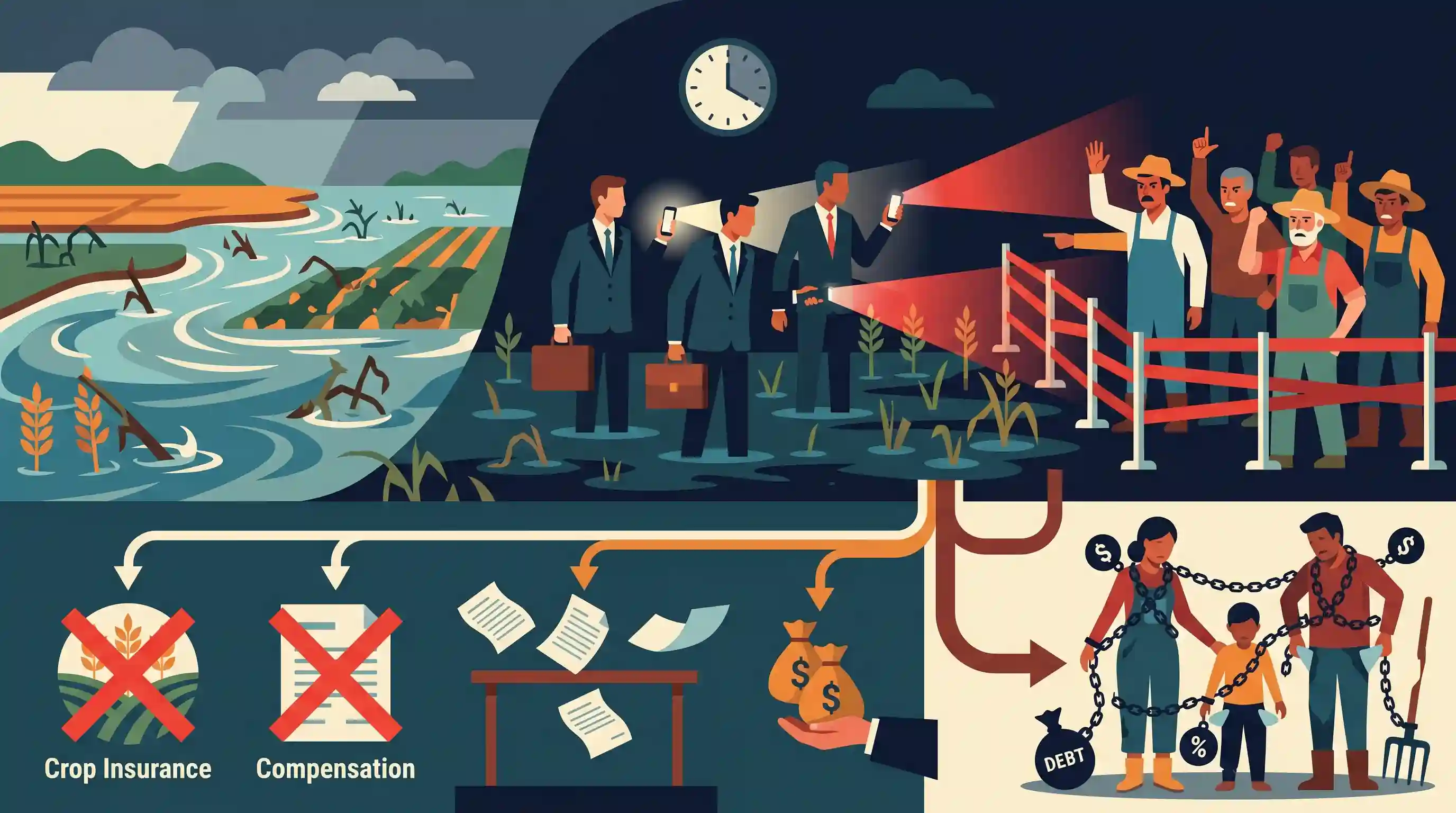
A Central government team deployed to assess flood-induced crop damage in Solapur, Maharashtra, faced backlash from farmers after conducting the evaluation in the dark using mobile phone torchlights. This hasty and seemingly superficial assessment highlights a severe bureaucratic disconnect and administrative apathy in post-disaster response. Poor damage assessment mechanisms directly hinder affected farmers from receiving accurate compensation and timely crop insurance payouts, exacerbating agrarian distress. The incident underscores the urgent need for empathetic, transparent, and scientifically rigorous protocols for disaster relief evaluations.
Key Points
- A Central team visited flood-hit villages in Solapur to assess the extent of crop damage and agrarian distress.
- The assessment exercise drew sharp criticism from local farmers as the officials reportedly conducted the survey late in the evening using mobile phone torchlights.
- This incident highlights severe administrative apathy and raises questions about the efficacy and seriousness of post-disaster damage assessments.
- Inaccurate or hasty damage assessments directly impact the timely disbursement of relief funds and crop insurance claims, exacerbating the financial distress of flood-affected farmers.
- The event underscores the disconnect between top-down bureaucratic procedures and ground-level realities in disaster management.
Important Terms
Inter-Ministerial Central Team (IMCT)

A group of experts from various Union Ministries (e.g., Agriculture, Finance) constituted by the Ministry of Home Affairs to conduct on-the-spot assessments of severe natural disasters.
UPSC context
GS Paper III: Disaster Management. Understanding the institutional mechanism for post-disaster damage assessment and relief coordination.
National Disaster Response Fund (NDRF)
A fund managed by the Central Government under the Disaster Management Act, 2005, providing additional financial assistance for relief in disasters of a 'severe nature.'
UPSC context
GS Paper III: Disaster Management and Economy. Focuses on fiscal federalism and disaster relief funding mechanisms.
State Disaster Response Fund (SDRF)
The primary fund available to State Governments for immediate response to notified disasters; the Centre contributes 75% (90% for Himalayan/North-Eastern states).
UPSC context
GS Paper II: Federalism. Tests knowledge of Centre-State cost-sharing and administrative responsibilities during calamities.
Pradhan Mantri Fasal Bima Yojana (PMFBY)
India's flagship yield-based crop insurance scheme providing comprehensive financial support to farmers for crop losses arising from non-preventable natural risks.
UPSC context
GS Paper III: Agriculture. Critical for questions on risk mitigation and social security for the farming community.
Crop Cutting Experiments (CCE)
The standard scientific method used by government agencies to estimate crop yield by harvesting a small representative plot to determine insurance payouts.
UPSC context
GS Paper III: Agriculture. Relevant for discussions on technology vs. manual methods in loss estimation.
Agrarian Distress
A socio-economic condition in the agriculture sector marked by falling incomes, high indebtedness, and low productivity, often exacerbated by climate-induced crop failures.
UPSC context
GS Paper III: Indian Economy and Agriculture. A recurring theme regarding farmer welfare and structural reforms.
Disaster Management Act, 2005
The comprehensive legal framework that mandates the creation of disaster management authorities and funds at national, state, and district levels.
UPSC context
GS Paper III: Disaster Management. The foundational law for all administrative actions during natural and man-made disasters.
Prelims Trap
NDRF is the primary fund for all natural disasters and mandatory Central teams assess all damages.
SDRF is the primary fund. NDRF is supplementary, triggered only for disasters of a 'severe nature', which necessitates the Inter-Ministerial Central Team (IMCT) visit.
Static Concepts Connected
What is the funding mechanism under the Disaster Management Act 2005?
- SDRF Primary: State Disaster Response Fund (SDRF) is the primary fund available to States. The Centre contributes 75% for general states and 90% for special category states.
- NDRF Supplementary: National Disaster Response Fund (NDRF) is supplementary, used only for disasters of a 'severe nature', and is financed by the National Calamity Contingent Duty (NCCD).
- IMCT Role: An Inter-Ministerial Central Team (IMCT) must conduct an on-ground evaluation to assess damage severity before any NDRF supplementary funds are released.
How is crop damage assessed under PMFBY?
- Manual CCEs: Traditional Crop Cutting Experiments rely on physical sampling, leading to human error and typical claim settlement delays of 3-6 months.
- YES-TECH: Yield Estimation System Based on Technology uses drones, AI, and satellite remote-sensing for objective, rapid, and transparent damage assessments, replacing slow manual surveys.
Cross-Topic Patterns
Ethics: Compliance vs Empathy
Conducting assessments in the dark via torchlight illustrates mechanical bureaucratic compliance lacking administrative empathy—a classic GS4 case study theme on public service values.
Tech adoption in agriculture
Manual survey failures reinforce GS3 themes on digitizing agriculture, specifically the urgent transition from manual Crop Cutting Experiments (CCEs) to drone and AI-based YES-TECH frameworks.

Expect a 2026 Prelims statement differentiating SDRF vs NDRF triggers, or a GS3 Mains question on leveraging YES-TECH for PMFBY delays.
Linked PYQs · 3
Linked PYQs · 3
- 2020MainsGS3
Discuss the recent measures initiated in disaster management by the Government of India departing from the earlier reactive approach.
- 2025MainsGS2
"In contemporary development models, decision-making and problem-solving responsibilities are not located close to the source of information and execution defeating the objectives of development." Critically evaluate.
- 2017MainsGS3
How do subsidies affect the cropping pattern, crop diversity and economy of farmers? What is the significance of crop insurance, minimum support price and food processing for small and marginal farmers?
