Central Sanskrit University Launches BTech in AI and Data Science
Source:The Hindu ↗
Why It Matters
This development serves as a tangible case study for UPSC aspirants on the implementation of NEP 2020's multidisciplinary mandate. It illustrates how modern technology (AI/Data Science) can be leveraged to preserve and advance India's ancient cultural heritage, traditional knowledge systems, and classical languages.
Summary
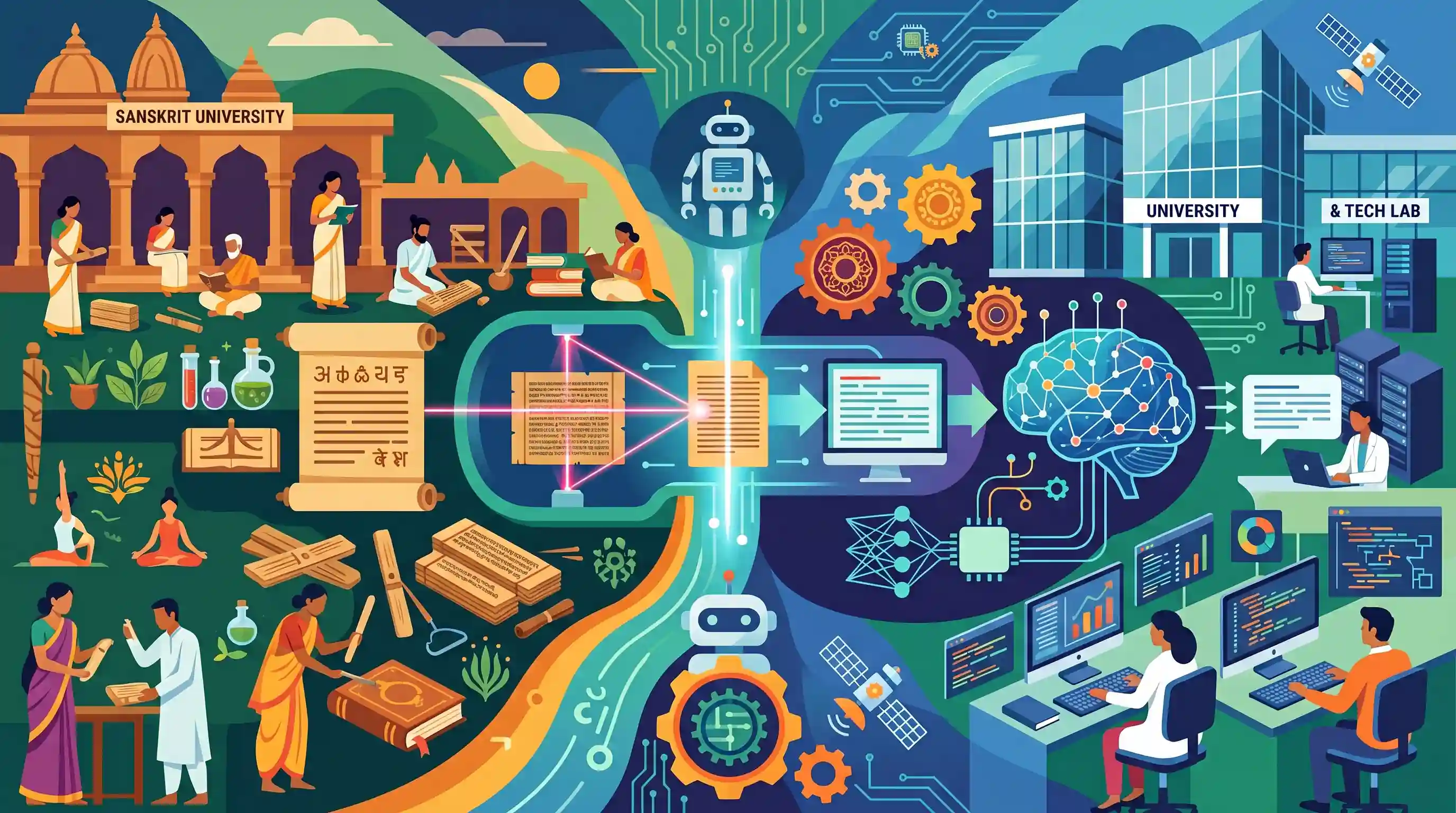
Central Sanskrit University (CSU) is set to introduce a four-year B.Tech program in Artificial Intelligence and Data Science from the 2026-27 academic session. Driven by the multidisciplinary mandate of the National Education Policy (NEP) 2020, the initiative aims to bridge traditional Indian knowledge systems—including Ayurveda, Yoga, and classical texts—with advanced technologies. The program will equip students to develop Natural Language Processing (NLP) tools, Optical Character Recognition (OCR) systems for ancient manuscripts, and specialized Large Language Models (LLMs) for Sanskrit and other Indian languages. This intersection of technology and heritage will not only help preserve ancient texts but also advance indigenous computing.
Key Points
- Central Sanskrit University will launch a four-year B.Tech program in Computer Science with specializations in AI and Data Science starting the 2026-27 academic year.
- The initiative aligns with the National Education Policy (NEP) 2020's vision to transform higher education institutions into multidisciplinary centers.
- The curriculum aims to merge ancient Indian knowledge systems—such as Ayurveda, Yoga, and Vedanta—with modern AI technologies.
- The program will focus on Computational Linguistics, Natural Language Processing (NLP), and Optical Character Recognition (OCR) to digitize and decipher ancient manuscripts.
- The move facilitates the development of indigenous Large Language Models (LLMs) and advanced machine translation systems for Sanskrit and other Indian languages.
Important Terms
National Education Policy (NEP) 2020

India's 21st-century education framework replacing the 1986 policy, emphasizing holistic, multidisciplinary, and flexible learning to transform the country into a global knowledge superpower.
UPSC context
GS Paper II (Education/Governance); tests understanding of landmark policy shifts impacting human resource development and social justice.
Indian Knowledge Systems (IKS)
A structured body of indigenous knowledge covering disciplines like Ayurveda, mathematics, and philosophy, which NEP 2020 mandates to be integrated across all levels of modern education.
UPSC context
GS Paper I (Culture) & GS II (Education); evaluates awareness of India's intellectual heritage and its contemporary socio-technical relevance.
All India Council for Technical Education (AICTE)
A statutory body under the Ministry of Education responsible for the planning, coordination, and standard-setting of technical and management education in India.
UPSC context
GS Paper II (Statutory Bodies); tests knowledge of the regulatory architecture governing professional and technical higher education.
Central Sanskrit University (CSU)
The world's largest Sanskrit university, upgraded to a Central University in 2020, serving as the nodal agency for implementing Sanskrit-related policies and indigenous research.
UPSC context
GS Paper II (Education); relevant for institutional reforms in language promotion and implementing the multidisciplinary mandates of NEP.
Natural Language Processing (NLP)
A branch of AI that enables computers to understand and process human language; in India, it is critical for digital inclusion across diverse regional scripts.
UPSC context
GS Paper III (Science & Tech); tests knowledge of AI applications in governance, digital literacy, and cultural preservation.
Prelims Trap
"Institutions categorized exclusively as language or humanities universities cannot offer AICTE-approved B.Tech programs."
NEP 2020 explicitly mandates the phasing out of single-stream institutions, encouraging specialized language or humanities universities to integrate STEM and technical courses.
Static Concepts Connected
What is the National Language Translation Mission (Bhashini)?
- Primary Objective: To break digital language barriers and ensure every citizen can access the internet and digital services in their native language.
- Core Technology: Leverages Artificial Intelligence, Natural Language Processing (NLP), and massive datasets to create open-source language translation models.
- Crowdsourcing: Utilizes the 'Bhasha Daan' platform to collect voice, text, and translation data directly from citizens to train AI models.
How does NEP 2020 reform higher education structures?
- Multidisciplinary Shift: Mandates transforming all single-stream Higher Education Institutions (HEIs) into multidisciplinary universities or clusters by 2040.
- Academic Flexibility: Introduces multiple entry and exit options, supported by an Academic Bank of Credits (ABC) to digitally store academic scores.
- Unified Regulation: Proposes the Higher Education Commission of India (HECI) as a single overarching umbrella body, replacing UGC and AICTE.
Cross-Topic Patterns
AI + National Mission for Manuscripts
Optical Character Recognition (OCR) applied to ancient scripts directly advances the Ministry of Culture’s mandate to unearth and digitally preserve India's undocumented documentary heritage.
Multidisciplinary tech + Traditional Knowledge
Applying Data Science to Ayurveda or Yoga represents the shift from purely theoretical heritage studies to empirical, computationally validated Indian Knowledge Systems (IKS).
Bhashini DPI + Multilingual LLMs
Indigenous LLMs trained on Sanskrit expand India's Digital Public Infrastructure (DPI), reducing the structural bias of English-centric AI models and bolstering digital inclusion.

Expect a Mains question linking NEP 2020's multidisciplinary mandate with the use of AI/Bhashini to modernize Traditional Knowledge.
Linked PYQs · 3
Linked PYQs · 3
- 2020MainsGS2
National Education Policy 2020 is in conformity with the Sustainable Development Goal-4 (2030). It intends to restructure and reorient education system in India. Critically examine the statement.
- 2023MainsGS3
What is the status of digitalization in the Indian economy? Examine the problems faced in this regard and suggest improvements.
- 2018MainsGS1
Safeguarding the Indian art heritage is the need of the moment. Discuss.
