Three-Year Roadmap to Phase Out Riverbed Sand Mining
Source:The Hindu ↗
Why It Matters
Addressing ecological degradation caused by unscientific riverbed sand mining is critical for water security, river morpholology, and sustainable infrastructure development in India.
Summary
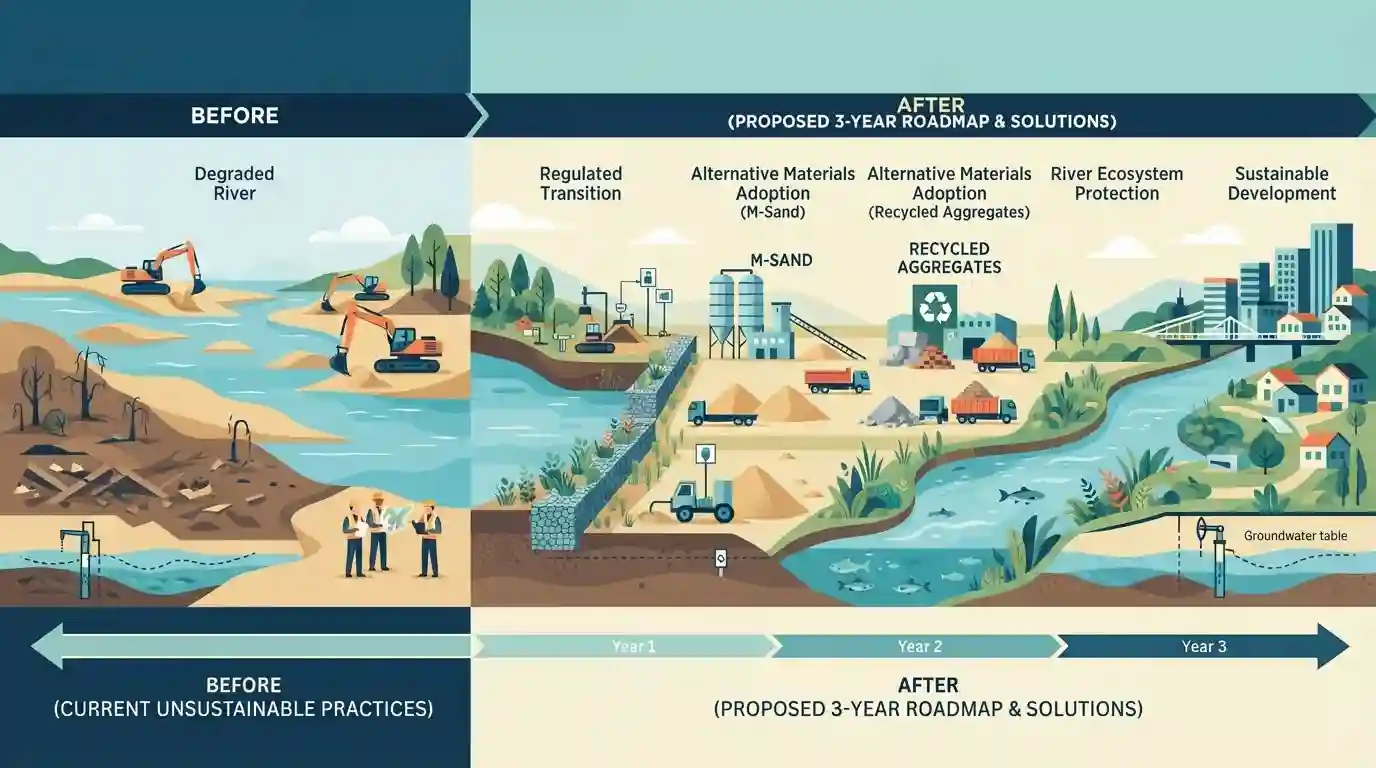
A central committee has proposed a comprehensive three-year roadmap to eliminate unsustainable sand mining from active river channels across India. The strategy aims to mitigate severe environmental degradation, protect river ecosystems, lower groundwater depletion risks, and promote alternative materials like manufactured sand (M-sand) and recycled aggregates.
Key Points
- A central committee has recommended a three-year roadmap to completely phase out unsustainable sand mining from active river channels.
- The proposal emphasizes shifting reliance to alternative sources such as manufactured sand (M-sand), offshore mining, and aggregate recycling.
- Unregulated riverbed sand mining degrades aquatic ecosystems, lowers water tables, destabilizes riverbanks, and impacts groundwater recharge.
- Effective implementation requires strict coordination between central regulatory frameworks and state-level enforcement of minor mineral laws.
Important Terms
Mines and Minerals Development and Regulation Act

The primary legislation governing mining and mineral development in India, classifying sand as a minor mineral and empowering states to regulate extraction and curb illegal mining.
UPSC context
UPSC Prelims/Mains (GS Paper II/III): Tests knowledge of statutory frameworks, environmental governance, and minor mineral regulation in India.
Sustainable Sand Mining Management Guidelines
Comprehensive regulatory frameworks issued by the MoEFCC to promote scientific sand extraction, district survey reporting, monsoon bans, and technological surveillance.
UPSC context
UPSC Prelims/Mains (GS Paper III - Environment): Tests understanding of policy instruments for river ecosystem protection and mitigation of illegal mining.
Ministry of Environment, Forest and Climate Change
The nodal central government ministry responsible for formulating environmental policies, wildlife protection, forestry laws, and issuing guidelines for sustainable resource extraction.
UPSC context
UPSC Prelims/Mains (GS Paper II - Governance & GS Paper III - Environment): Tests role, jurisdiction, and mandates of key environmental institutions in India.
Static Concepts Connected
How are minor minerals regulated in India under the MMDR Act and Supreme Court jurisprudence?
- MMDR Classification: Statutory definition under Section 3(e) of the MMDR Act, 1957; includes building stones, ordinary clay, gravel, and sand.
- State Power: Empowers State Governments to make rules for minor mineral concessions, illegal mining prevention, and royalty collection.
- Deepak Kumar Ruling: Supreme Court in Deepak Kumar v. State of Haryana (2012) mandated Environmental Clearance for all minor mineral leases irrespective of size.
Cross-Topic Patterns
Federalism vs. Environment: Minor Minerals Regulation
Sand is legally classified as a minor mineral under the MMDR Act, vesting regulation with States, yet national guidelines and apex court rulings compel central intervention for environmental protection.

Expect a statement-based question linking Deepak Kumar judgment, MMDR Act minor mineral classification, and M-sand alternatives.
Linked PYQs · 3
Linked PYQs · 3
- 2019MainsGS3
Coastal sand mining, whether legal or illegal, poses one of the biggest threats to our environment. Analyze the impact of sand mining along the Indian coasts, citing specific examples.
- 2018PrelimsGS1
Which of the following is/are the possible consequence/s of heavy sand mining in riverbeds? 1. Decreased salinity in the river 2. Pollution of groundwater 3. Lowering of the water-table Select the correct answer using the code given below:
- 2019PrelimsGS1
With reference to the management of minor minerals in India, consider the following statements: 1. Sand is a 'minor mineral' according to the prevailing law in the country. 2. State Governments have the power to grant mining leases of minor minerals, but the powers regarding the formation of rules related to the grant of minor minerals lie with the Central Government. 3. State Governments have the power to frame rules to prevent illegal mining of minor minerals. Which of the statements given above is/are correct?
