Central Bank of India Profitability and Diversification Strategy
Source:The Hindu ↗
Why It Matters
The article highlights the recovery trajectory of Public Sector Banks (PSBs) in India. The exit from the PCA framework and strategic expansion into non-interest income streams illustrate banking sector resilience, regulatory success by the RBI, and the evolving business models of PSBs to achieve commercial viability.
Summary
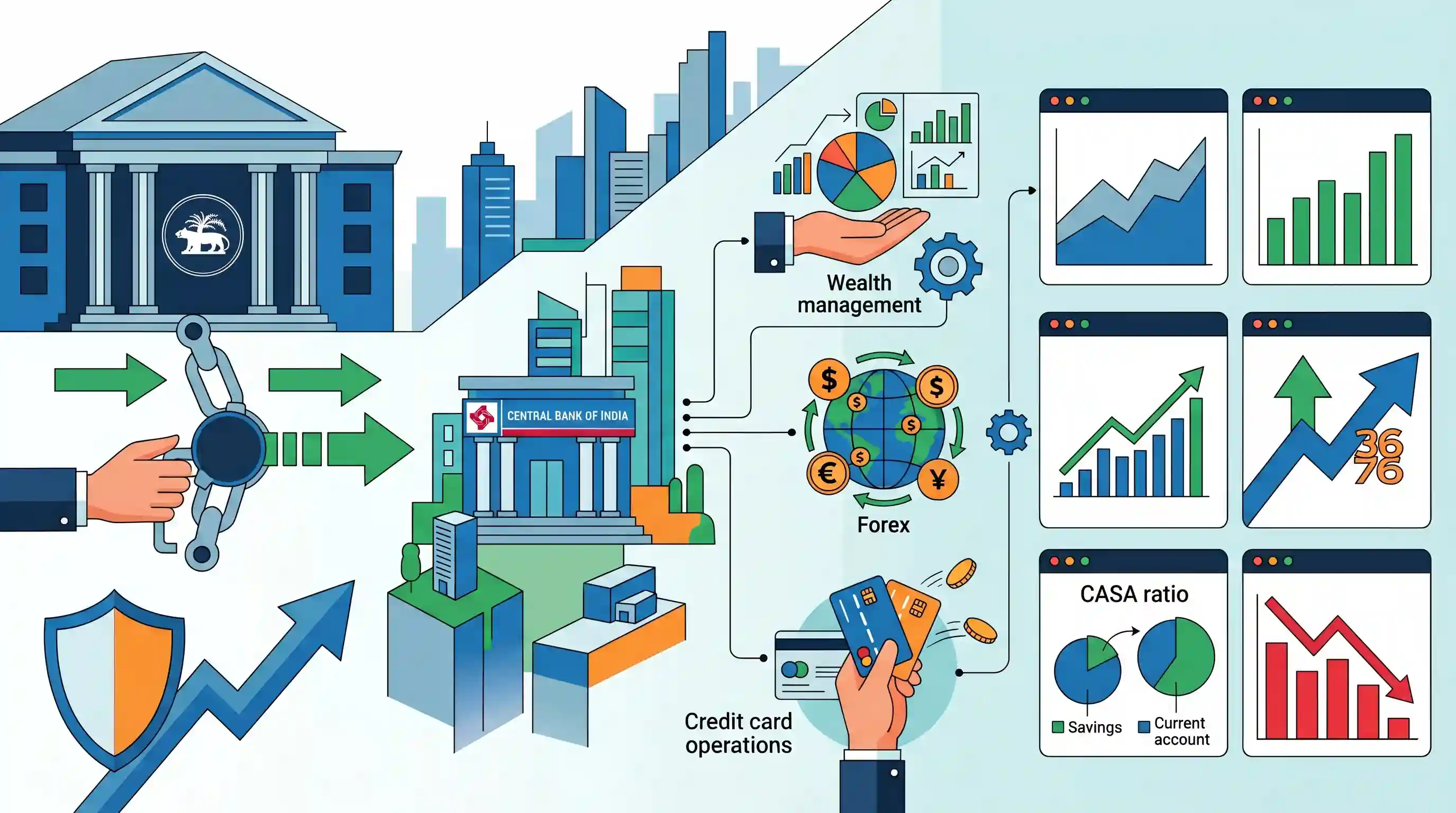
Following its exit from the Reserve Bank of India's Prompt Corrective Action (PCA) framework, the Central Bank of India is shifting its strategy towards expansion and profitability. The public sector bank plans to establish subsidiaries or joint ventures to enter wealth management and forex businesses, and aims to restart its credit card operations to boost non-interest income. The bank is targeting key financial metrics, including a Return on Assets (ROA) of approximately 1%, maintaining Net Interest Margins (NIM) above 3%, and sustaining double-digit credit growth, while continuing to improve its CASA ratio and manage non-performing assets.
Key Points
- Central Bank of India plans to enter new business segments such as wealth management, forex, and credit cards to improve profitability and non-interest income.
- The bank was removed from the RBI's Prompt Corrective Action (PCA) framework, allowing it to pursue growth and expansion.
- The bank targets improving its Return on Assets (ROA) to around 1% and maintaining its Net Interest Margin (NIM) above 3%.
- Focus areas include enhancing the CASA (Current Account Savings Account) ratio, sustaining double-digit credit growth, and reducing NPAs.
Important Terms
Prompt Corrective Action (PCA) framework

A supervisory tool used by the RBI to intervene in banks with weak financial metrics like capital, asset quality, or profitability to prevent systemic failure.
UPSC context
GS-III Indian Economy; relates to banking sector reforms and RBI's regulatory role in maintaining financial stability.
Reserve Bank of India (RBI)
India's central bank and regulatory body responsible for monetary policy, supervising the banking sector, and managing the country's foreign exchange reserves.
UPSC context
GS-III Indian Economy; essential for understanding monetary policy, banking regulation, and institutional frameworks.
Non-Performing Assets (NPAs)
A loan or advance where interest or principal payments remain overdue for more than 90 days, indicating a potential loss for the bank.
UPSC context
GS-III Indian Economy; a critical metric for assessing the health of the banking sector and asset quality.
CASA Ratio
The proportion of a bank's total deposits held in current and savings accounts; a higher ratio indicates lower cost of funds and better profitability.
UPSC context
GS-III Indian Economy; tests understanding of banking efficiency, liquidity management, and operational costs.
Net Interest Margin (NIM)
A profitability metric measuring the difference between interest income earned and interest paid out, expressed as a percentage of total earning assets.
UPSC context
GS-III Indian Economy; fundamental for evaluating the core lending profitability and efficiency of financial institutions.
Return on Assets (ROA)
A ratio showing how effectively a bank converts its asset base into net income, calculated by dividing net profit by total average assets.
UPSC context
GS-III Indian Economy; used to evaluate managerial efficiency and the overall financial health of commercial banks.
Prelims Trap
"Return on Assets (ROA) is one of the parameters used to trigger the RBI's Prompt Corrective Action (PCA) framework."
The RBI revised the PCA framework in 2021, explicitly removing Return on Assets (ROA) as a trigger. The current triggers are strictly Capital, Asset Quality, and Leverage Ratio.
Static Concepts Connected
What are the parameters that trigger the RBI's Prompt Corrective Action (PCA) framework?
- Capital Adequacy: Breach of the minimum Capital to Risk-Weighted Assets Ratio (CRAR) and Common Equity Tier 1 (CET1) ratio.
- Asset Quality: A high Net Non-Performing Assets (NNPA) ratio, indicating a deterioration in the bank's loan portfolio.
- Leverage Ratio: Breach of the minimum Tier-1 Leverage ratio, showing the bank is over-leveraged compared to its core capital.
How do CASA and NIM determine a commercial bank's profitability?
- CASA Ratio: Current and Savings Accounts offer zero-to-low interest. A higher CASA ratio gives banks access to cheaper funds, lowering their overall cost of borrowing.
- Net Interest Margin (NIM): The difference between interest earned on assets (loans) and interest paid on liabilities (deposits). It measures the core efficiency of the bank's intermediation.
Cross-Topic Patterns
PCA exits and the Financial Stability Report
Bank turnarounds and PCA exits heavily correlate with data in the RBI's bi-annual Financial Stability Report, which recently highlighted decadal lows in gross NPAs across scheduled commercial banks.
Unsecured retail credit risks
As public sector banks aggressively enter wealth management and credit cards to boost non-interest income, it increases their exposure to unsecured retail credit, prompting recent RBI risk-weight tightening.

Expect a multi-statement question on PCA 2021 revisions, specifically testing the removal of ROA as a trigger and new leverage rules.
Linked PYQs · 2
Linked PYQs · 2
- 2022PrelimsGS1
With reference to the 'Banks Board Bureau (BBB)', which of the following statements are correct? 1. The Governor of RBI is the Chairman of BBB. 2. BBB recommends for the selection of heads for Public Sector Banks. 3. BBB helps the Public Sector Banks in developing strategies and capital raising plans. Select the correct answer using the code given below:
- 2018PrelimsGS1
Which one of the following links all the ATMs in India?
