Central Bank of India enters insurance via IBC insolvency resolution
Source:The Hindu ↗
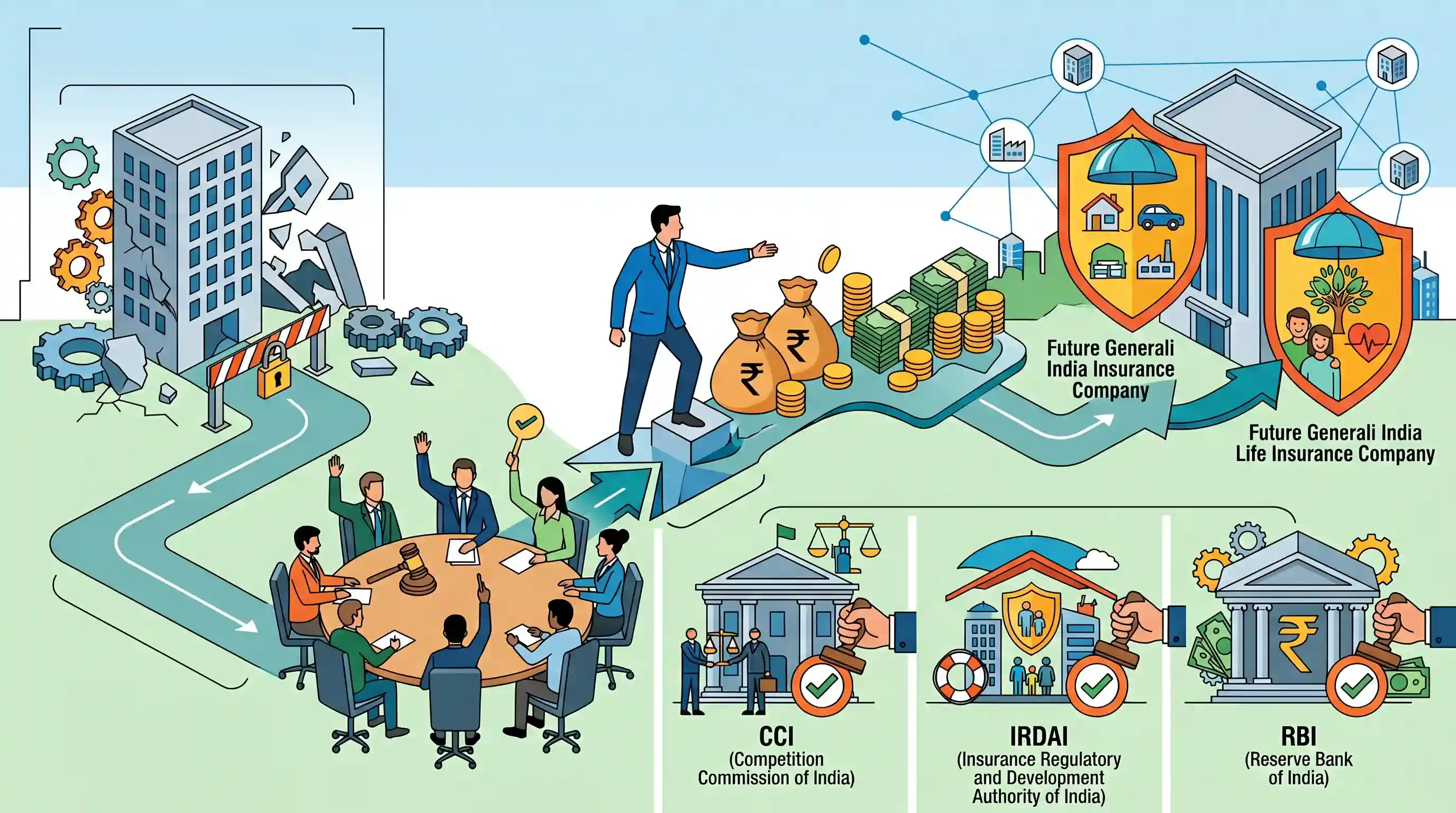
Why It Matters
Demonstrates the practical application of the Insolvency and Bankruptcy Code (IBC) in resolving distressed corporate assets. It also highlights the expanding role of Public Sector Banks into allied financial sectors (insurance) and the involvement of multiple statutory regulators (RBI, IRDAI, CCI) in corporate acquisitions.
Summary
Central Bank of India has formally acquired the stakes of Future Enterprises in two joint venture insurance companies—Future Generali India Insurance Company and Future Generali India Life Insurance Company—for ₹508 crore. The transaction marks the state-owned lender's entry into the insurance sector. The acquisition was facilitated through the Corporate Insolvency Resolution Process (CIRP) after the bank was declared the successful bidder by the Committee of Creditors, and it received necessary clearances from regulators including the RBI, IRDAI, and CCI.
Key Points
- Central Bank of India has acquired Future Enterprises' 25.18% stake in Future Generali India Insurance and 33.29% stake in Future Generali India Life Insurance.
- The acquisition was completed for an aggregate amount of ₹508 crore, marking the public sector bank's foray into the insurance sector.
- The deal was executed under the Corporate Insolvency Resolution Process (CIRP) of the Insolvency and Bankruptcy Code (IBC).
- Regulatory approvals were secured from the RBI, IRDAI, and the Competition Commission of India (CCI).
Important Terms
Insolvency and Bankruptcy Code (IBC)

A 2016 law consolidating the legal framework for time-bound insolvency resolution of companies and individuals to maximize asset value, protect creditors, and promote entrepreneurship.
UPSC context
GS Paper 3 (Economy); critical for understanding stressed asset resolution and its impact on banking sector Non-Performing Assets (NPAs).
Corporate Insolvency Resolution Process (CIRP)
A time-bound recovery mechanism under the IBC where creditors evaluate whether a defaulting corporate debtor's business can be restructured or must be liquidated to settle debts.
UPSC context
GS Paper 3 (Economy); tests knowledge of debt recovery procedures and the role of the National Company Law Tribunal.
Committee of Creditors (CoC)
A decision-making body comprising a defaulting company's financial creditors that oversees the resolution process and votes on restructuring plans or liquidation.
UPSC context
GS Paper 3 (Economy); essential for understanding creditor rights and the "commercial wisdom" principle in insolvency law.
Competition Commission of India (CCI)
A statutory body established under the Competition Act, 2002, to prevent anti-competitive agreements, regulate mergers/acquisitions, and ensure fair market competition to protect consumer interests.
UPSC context
GS Paper 2 (Governance) and GS Paper 3 (Economy); relevant for market regulation and corporate governance.
Reserve Bank of India (RBI)
India's central bank and primary regulatory authority for the banking system, responsible for formulating monetary policy, issuing currency, and ensuring overall financial stability.
UPSC context
GS Paper 3 (Economy); core topic for monetary policy, banking supervision, and financial sector reforms.
Central Bank of India
A major Indian public sector commercial bank, founded in 1911 as the first commercial bank completely owned and managed by Indians; nationalized in 1969.
UPSC context
GS Paper 3 (Economy); significant for banking history, nationalization, and the role of Public Sector Banks (PSBs).
Prelims Trap
Acquisitions executed under the IBC resolution process do not require prior approvals from sectoral regulators like CCI or IRDAI.
Section 31 of IBC mandates that resolution plans requiring approval under other laws must obtain them. CCI, RBI, and IRDAI approvals remain strictly mandatory.
Static Concepts Connected
What is the role and composition of the Committee of Creditors (CoC) under IBC?
- Financial Creditors Only: The CoC comprises solely financial creditors. Operational creditors can attend meetings if their dues exceed 10% of total debt, but they hold no voting rights.
- Voting Threshold: Approval of a corporate resolution plan mandates a minimum 66% voting share majority from the CoC.
- Creditor-in-control: During CIRP, management of the distressed entity shifts from promoters to the Resolution Professional acting under the CoC's directions.
How does Bancassurance differ from a bank setting up an insurance joint venture?
- Bancassurance: The bank acts strictly as a corporate agent to distribute third-party insurance products for a commission, carrying zero insurance risk.
- Equity Investment: Setting up a JV or subsidiary involves capital investment and risk exposure, necessitating explicit prior regulatory approval from both RBI and IRDAI.
Cross-Topic Patterns
Multi-regulator jurisdiction in IBC
This transaction proves that while the IBC has overriding effects, resolution plans involving complex combinations still require concurrent clearances from antitrust (CCI) and sectoral (RBI/IRDAI) regulators.
PSB diversification and non-interest income
Public Sector Banks are moving away from sole reliance on core lending, actively utilizing IBC stress-asset opportunities to enter lucrative subsidiary-driven markets like insurance to boost non-interest income.

Expect a multi-statement prelims question testing the boundaries of IBC's overriding powers versus sectoral regulators (CCI/RBI) in 2026.
Linked PYQs · 1
Linked PYQs · 1
- 2023MainsGS2
Discuss the role of the Competition Commission of India in containing the abuse of dominant position by the Multi-National Corporations in India. Refer to the recent decisions.
