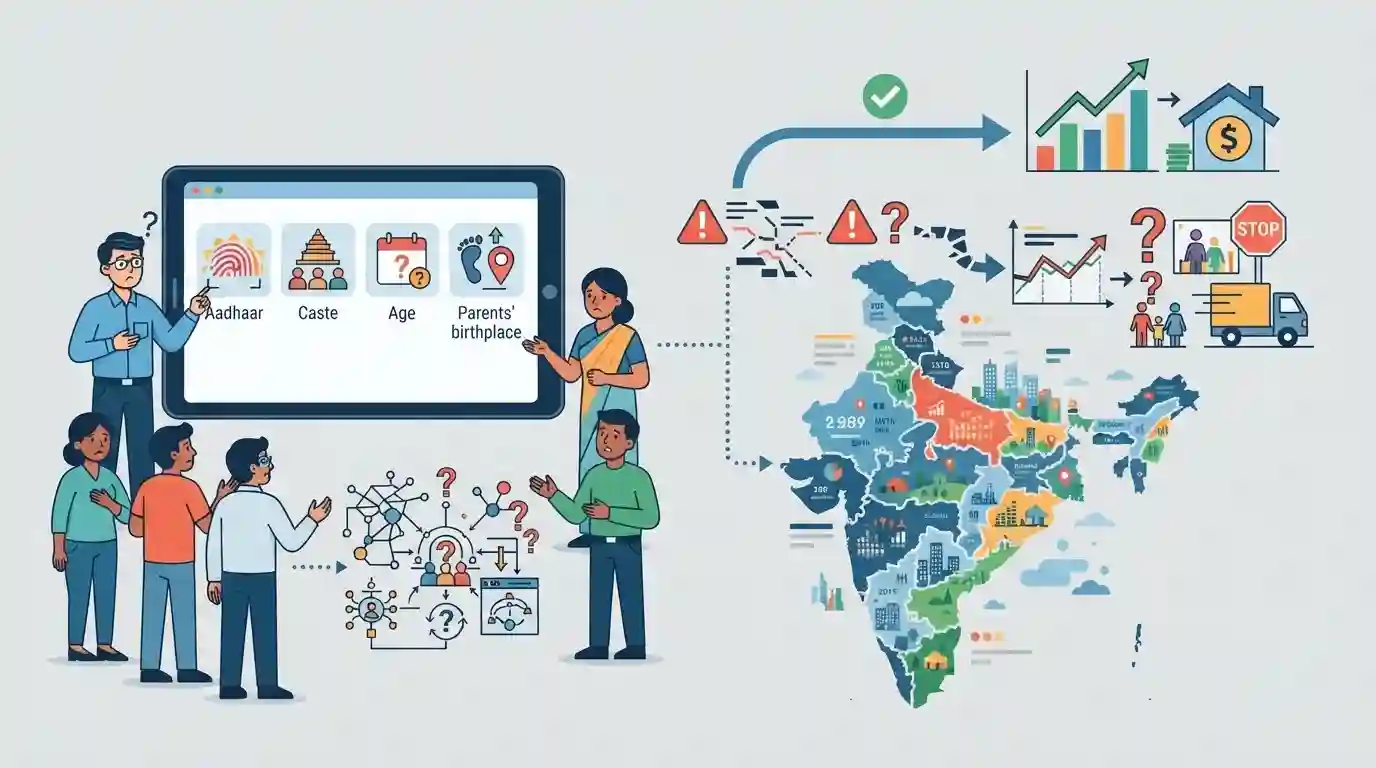
Census trainers flag Aadhaar and caste queries as key challenges
Source:The Hindu ↗
हे का महत्त्वाचे आहे
Understanding the operational hurdles of India's census exercise is vital for assessing how demographic and socio-economic data influence public policy, resource allocation, and governance transparency.
सारांश
Census trainers flagging key challenges regarding queries on Aadhaar, caste, age, and parents' birthplace highlight the practical and technical complexities involved in upcoming census operations in India, impacting demographic tracking and welfare planning.
मुख्य मुद्दे
- Census trainers have identified specific queries around Aadhaar, detailed caste enumeration, age determination, and the birthplace of parents as major training and operational challenges.
- The complexities reflect public anxiety and field-level operational difficulties in capturing granular social and demographic indicators during large-scale enumeration exercises.
- Accurate data collection is critical for evidence-based policymaking, resource allocation, and target delivery of welfare schemes, but requires robust public awareness campaigns to address privacy and identification concerns.
महत्त्वाच्या संज्ञा
Census Act 1948

The principal legislation enacted in 1948 that provides the legal framework and statutory backing for conducting the decennial population census in India, mandating legal compliance and data confidentiality.
UPSC context
GS Paper I & II (Population, Governance, Legal Frameworks). Tests statutory provisions, data confidentiality, and administrative duties for national demographic exercises.
Aadhaar
A 12-digit unique identification number issued by UIDAI to residents of India, serving as a prominent tool for targeted welfare delivery, authentication, and governance verification.
UPSC context
GS Paper II (Governance, Welfare Schemes, Polity). Tests issues around digital identity, targeted subsidies, data security, and privacy rights.
Office of the Registrar General and Census Commissioner of India
The apex statutory authority under the Ministry of Home Affairs responsible for coordinating, organizing, and conducting the population census and maintaining vital statistics in India.
UPSC context
GS Paper II (Statutory Bodies, Government Policies). Tests administrative institutional setup for census operations and demographic data collection.
संबंधित स्थिर संकल्पना
What are the constitutional and statutory provisions governing the Census of India?
- Union List: Constitutional Basis: Census is a Union Subject under Entry 69 of the Union List in the Seventh Schedule of the Constitution.
- Census Act 1948: Statutory Backing: Conducted under the provisions of the Census Act, 1948, which empowers the Central Government to notify and conduct a census.
- Nodal Agency: Administrative Authority: Office of the Registrar General and Census Commissioner, India, under the Ministry of Home Affairs.
- Confidentiality: Legal Confidentiality: Individual data collected during the census is legally confidential, cannot be disclosed in court, and is exempt from the RTI Act.
आंतर-विषय नमुने
Caste Census and Federal Fiscal Devolution
Detailed caste enumeration alongside parents' birthplace queries intersects with federal fiscal devolution and the 15th Finance Commission's demographic performance criteria.
Census Data Collection vs Right to Privacy
Public anxiety over Aadhaar and parental birthplace during enumeration highlights ongoing tensions between state-driven welfare targeting and informational privacy jurisprudence (Puttaswamy judgment).

Expect a statement-based prelims question on the legal framework of Census Act 1948, OR a mains question on caste enumeration challenges.
संबंधित PYQ · 2
संबंधित PYQ · 2
- 2016MainsGS2
Demographic Dividend in India will remain only theoretical unless our manpower becomes more educated, aware, skilled and creative." What measures have been taken by the government to enhance the capacity of our population to be more productive and employable?
- 2019MainsGS2
Performance of welfare schemes that are implemented for vulnerable sections is not so effective due to absence of their awareness and active involvement at all stages of policy process. Discuss.
